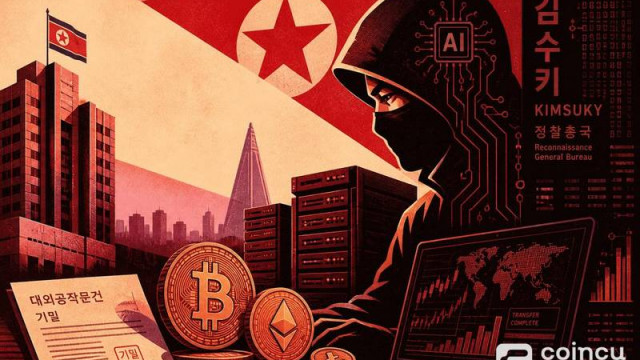
North Korea's Kimsuky group has integrated artificial intelligence into its cyberattacks targeting crypto and finance, building local large language model environments and generating fake documents to sharpen phishing lures, according to a new technical report from South Korean security firm Genians.
The findings, published August 9, describe a state-linked espionage crew moving beyond generic AI text generation toward operational tooling that supports malware development, data analysis, and attack automation. Reuters reported on the study a day later, noting the conclusions could not be independently verified.
Genians said Kimsuky built and operated local LLM environments using Ollama, GPT4All, and Msty. Running models locally lets an operator avoid the content filters and logging of commercial cloud AI services.
The same campaign infrastructure reportedly showed evidence of retrieval-augmented generation tooling, the Cursor AI coding assistant, speech-to-text software, Git-based command-and-control, and AsyncRAT payload delivery. That toolchain is what separates this case from vague claims about AI in hacking.
Genians said Kimsuky continued attacks against foreign diplomatic missions, military, security, and virtual asset sectors. Investigators found AI-generated documents tied to virtual assets and finance being used as lures. Those documents are the bridge between the AI tooling and real-world phishing risk.
By generating decoy files that read as authentic finance and crypto materials, the group can make phishing emails look more legitimate to targets at exchanges, fintechs, and finance-adjacent organizations. AI lowers the cost of producing convincing, tailored content at scale.
AsyncRAT delivery and Git-based command-and-control indicate the lures were not standalone consumer scams but tied to live intrusion operations.
The scale of state-linked pressure on the crypto sector is already large. Chainalysis said DPRK-linked hackers stole $2.02 billion in cryptocurrency in 2025, up 51% year over year, and accounted for 76% of all service compromises.
CrowdStrike said hands-on-keyboard intrusions against financial institutions rose 43% globally and 48% in North America over the prior two years, while DPRK actors deployed AI-powered deception against crypto, fintech, and banking targets.
Even without a fresh theft figure tied directly to this campaign, AI-enhanced phishing raises the credibility and volume of intrusion attempts. CrowdStrike's Adam Meyers framed the stakes: "Financial services organizations face threats from every direction and AI is making each of them harder to stop."
Kimsuky is not a freelance criminal crew. The U.S. Treasury sanctioned the group in November 2023 and described it as a DPRK cyber-espionage outfit subordinate to the Reconnaissance General Bureau. That positions Kimsuky's local-AI experimentation as part of a sanctioned state intelligence apparatus, and part of a broader DPRK escalation already pressuring exchanges, fintechs, and banks.
Not all details are independently confirmed. Reuters reported that Genians' findings could not be independently verified, and no second technical investigation corroborating the infrastructure-log evidence had emerged as of August 10.