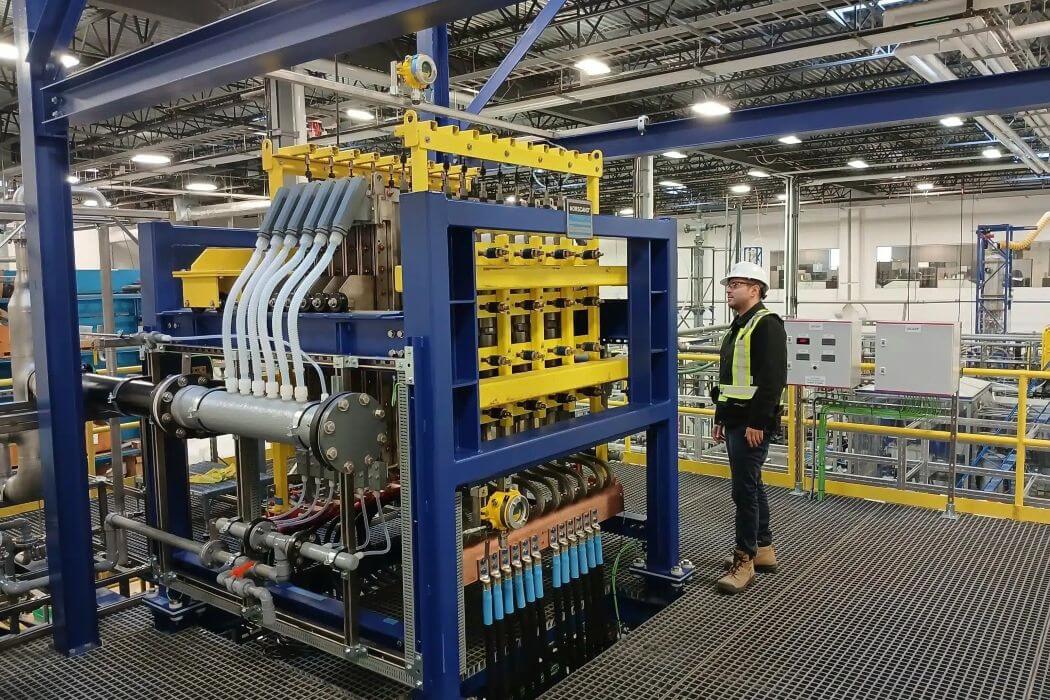
Vancouver's NORAM Electrolysis Systems pulled in $5.6 million from two government sources this week. The money splits between $3 million from Canada's National Research Council Industrial Research Assistance Program and $2.6 million from British Columbia's Innovative Clean Energy Fund. The stated goal: scale an electrochemical lithium refining platform that targets the battery supply chain's tightest pinch point.
The funding announcement landed Tuesday. NESI president and CEO Jeremy Moulson said the capital accelerates a technology platform essential to cleaner industrial processing. The company claims its next-generation system will double capacity while cutting power consumption and plant costs. That is the headline. The real question is whether the technology can move from pilot to commercial scale fast enough to matter.
The Lithium Refining Constraint
Lithium refining is not the glamorous part of the battery supply chain. It is often the slowest. Raw lithium from brine or hard rock must go through multiple chemical steps to reach battery-grade purity – typically 99.5% or higher. Traditional methods rely on chemical leaching, evaporation ponds, and high-temperature kilns. Those steps consume a lot of energy and produce waste streams that are expensive to treat.
NORAM's pitch is that an electrified process replaces those thermal and chemical steps with electrolysis. Run current through the solution, separate the lithium, skip the heat. Lower emissions, lower operating costs, and the ability to recover value from byproducts. The company says it has already commissioned commercial-scale lithium refinement infrastructure in Canada and Europe. Projects in South America and Asia are in the works.
The refining constraint is real. The 2025 Global Critical Minerals Outlook projects that lithium demand will drastically outweigh supply by 2035, driven by electric vehicle adoption and grid storage buildout. That deficit is the tailwind behind every lithium technology company today.
Electrochemical vs. Traditional Refining: The Better Read
The simple read: electrolysis beats chemical refining because it is cleaner and cheaper. The better market read is more careful.
Electrochemical separation is not a new idea. The energy cost is not trivial – electricity is not free, and the purity of the final product depends on membrane quality, current density, and feedstock consistency. Traditional refineries are proven at massive scale. An electrochemical alternative has to prove it can run 24/7 at comparable purity without membrane degradation or power spikes that erase the cost advantage.
NORAM says its next-generation platform improves performance and reduces power consumption. That is the claim. The proof will come when the scaled unit runs for months without a major outage. That is the difference between a pilot and a plant.
Confirming Factors for the NORAM Thesis
A few concrete milestones would separate this project from the pack of clean-tech pilots:
- A public capacity test. If NORAM publishes results showing the new platform hits double the output of current units at the claimed power consumption, that is a verifiable data point.
- A commercial offtake agreement. A battery maker or automaker signing a long-term deal for refined lithium from NESI's process would signal confidence in purity and consistency.
- An independent cost comparison. The company says lower plant costs. A third-party analysis showing capital cost per tonne below traditional refining would carry real weight.
What Would Weaken the Thesis
- Timeline delays. Any pushback on the commissioning schedule erodes the window before the 2035 demand deficit becomes acute.
- Membrane or energy issues. If the process needs more power than advertised or membranes degrade too fast, the economics break.
- Competing technologies advancing faster. Mangrove Lithium and Summit Lithium Technologies are also working on electrochemical and direct extraction methods. First to commercial scale wins a meaningful advantage.
The Funding Structure and Next Steps
The federal component runs through NRC IRAP, which typically funds technology development and demonstration stages. The provincial money comes from the ICE Fund, which supports clean energy projects in British Columbia. That dual-source structure gives NORAM some breathing room – federal money for R&D, provincial money for deployment.
$5.6 million is not a massive sum for industrial process scale-up. A single commercial-scale lithium refinery can cost tens or hundreds of millions to build. This round is seed-stage relative to that. The company will need follow-on capital, revenue from early plants, or a strategic partnership to reach the next level.
The Indirect Read-Through for Traders
NORAM is not publicly traded, so the angle is indirect. For a trader watching the lithium space, the read-through goes to lithium miners and refiners that could face competition or become acquisition targets if NORAM's process works. The same dynamic applies to technology suppliers: companies that make membranes or electrolysis equipment could see demand if electrochemical refining gains traction.
The 2035 demand deficit is the long-pole catalyst. The near-term decision point for NORAM is simple: show the new platform works at size, or risk becoming another interesting pilot that never scaled.