NevGold Hits 1.06 g/t Oxide Gold Outside Pit Shell at Limousine Butte
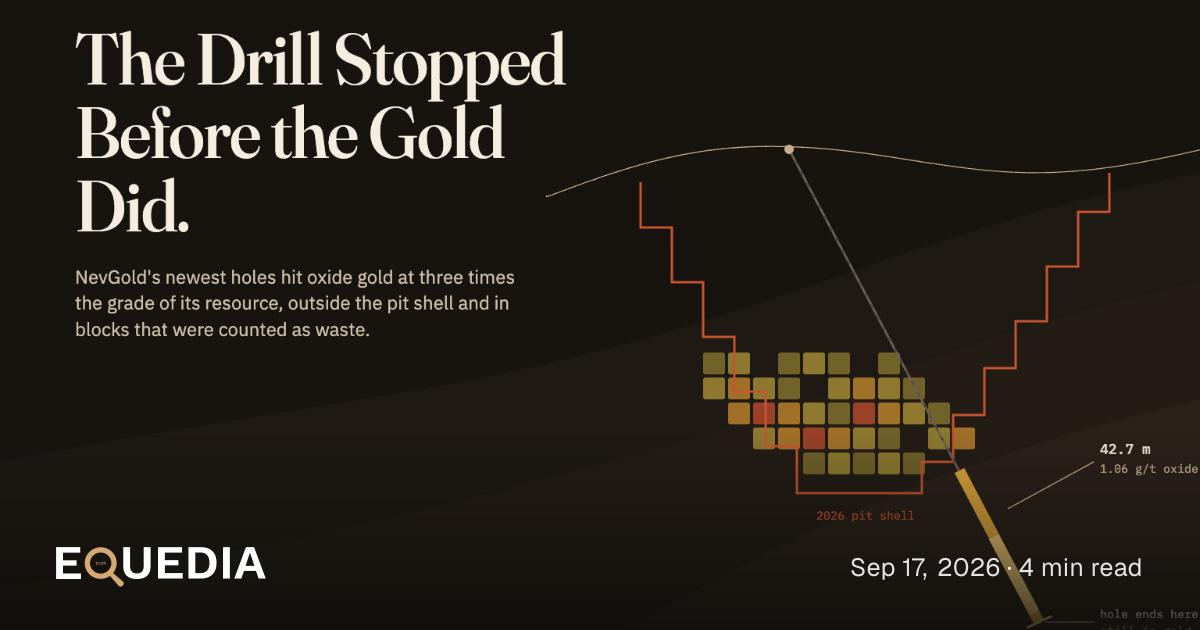
New assays from NevGold's 2026 program show oxide gold at roughly three times the grade of its maiden resource, both outside the pit shell and inside blocks once classified as waste.
Alpha Score of 43 reflects weak overall profile with moderate momentum, poor value, weak quality, poor sentiment.
NevGold Corp. (TSXV: NAU | OTCQX: NAUFF) released assays from four more holes in its 2026 drill program at the Limousine Butte project in Nevada, and two of them cut oxide gold at roughly three times the grade of the company's maiden resource, both outside the existing pit shell and inside blocks previously counted as waste.
Hole LB26-007 returned 42.7 metres grading 1.06 g/t oxide gold, including 18.3 metres at 1.89 g/t, between 242 and 285 metres down the hole. That interval sits outside the pit shell defined in the July 15 resource estimate. The hole ended in mineralization, with the final sample running 0.52 g/t, meaning the drill stopped before the gold did, NevGold said.
Hole LB26-004 returned 27.4 metres at 1.23 g/t oxide gold, including 3.0 metres at 5.00 g/t. This hole landed inside the pit shell, through blocks the July model had classified as unmineralized. NevGold said the hole "converted those blocks", rock counted as waste two months ago now has a claim to being ore.
The July resource averaged 0.37 g/t gold in the Measured & Indicated category and 0.32 g/t in the Inferred category. The 42.7-metre intercept at 1.06 g/t is roughly three times that average grade, and the 5.00 g/t stretch is more than thirteen times. When new holes come in above the model's average grade, a resource can grow on two fronts: more tonnes and a better grade per tonne, the company noted.
Grade also matters more at depth. Rock outside a pit shell has to justify the extra waste stripped to reach it, and a zone running one gram makes a stronger argument for a deeper pit than one running a third of that. Whether the LB26-007 intercept is captured in the next pit design depends on engineering studies, NevGold said.
The upper part of LB26-007 also returned 16.8 metres at 0.20% antimony near surface. That hole was an infill hole between existing holes to confirm the antimony zone, and it did, the company said. CEO Brandon Bonifacio attributed the pattern to two separate mineralizing events that deposited gold and antimony in the same area at different times, giving the deposit distinct gold-rich and antimony-rich zones.
NevGold estimates true widths at roughly 70% to 90% of the reported downhole lengths.
The company has more than $45 million in treasury and is funded for the next 12 to 18 months. A Preliminary Economic Assessment and engineering studies are in process. Only seven of the forty holes drilled this year have been reported. Assays are pending on the other thirty-three. Two rigs are turning, and drilling remains focused on the Bullet Zone and Armory Fault.
Drafted by a large language model from the source reporting linked above, then screened by automated publishing checks. It is not read by a journalist before publication. Some articles cite our Alpha Score. Verify prices and figures against the original source. Educational coverage, not personalized advice.