Easy net-zero gains are gone, executives said at the summit. Global circularity fell to 7% from 9% in 2018; leaders urge deeper supply chain and product shifts.
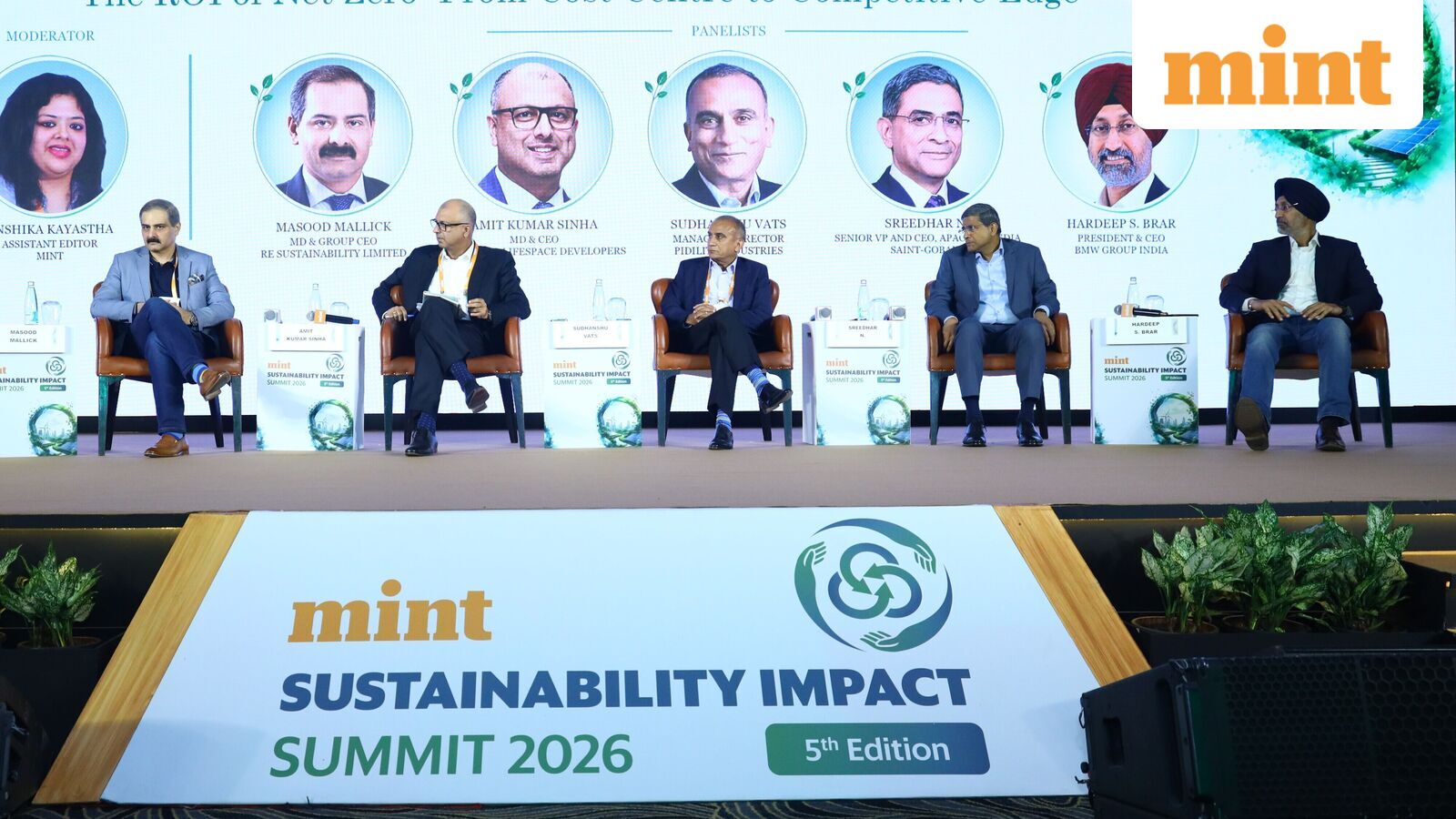
Executives at the Mint Sustainability Summit 2026 said the easy wins from decarbonization are largely exhausted. Sustainability has moved past compliance into strategy, they said during a session titled 'The ROI of Net Zero: From Cost Centre to Competitive Edge'. The next phase of value creation, they said, depends on circularity, partnerships, customer trust and long-term resilience, not quick operational fixes. The work now has to reach into supply chains, product design, business strategy, and after-sales economics, they said.
Masood Mallick, managing director and group CEO of Re Sustainability Ltd, opened with the numbers on global materials use. The world consumes about 100 billion tonnes a year, he said. Roughly 93 billion tonnes are extracted, and only 7% of that flows back into the economy through reuse, repair, recycling or remanufacturing. In 2018, the circularity rate was 9%. "We were more circular globally in 2018 than we are today," Mallick said.
He called sustainability a business continuity issue. Companies cannot keep doing what they do without controlling the supply chain, he said. "If your economic boundaries are broad enough in your supply chain and broad enough from a time standpoint, sustainability makes sense today. Not doing it does not make economic sense."
Amit Kumar Sinha, managing director and CEO of Mahindra Lifespace Developers, said sustainability can lower the cost of capital. The gains, he said, are thin. Some companies secure the benefit, he said; the advantage runs to tens of basis points, not 100 bps. The bigger prize, he added, lies in overall lifetime economics with the customer and the trust built by being a responsible business.
Moving beyond existing decarbonization targets is the next step, the executives said. Sreedhar N., senior VP and CEO for APAC and India at Saint-Gobain, said India's sustainability practices lag Europe because the cost pressure is missing. "I have seen what sustainability means in Europe because it costs. In India, it is still not costing us," he said. The cost pressure, he said, is why the number of things people do in Europe is far more mature than what is seen in India. He pointed to building insulation as one model India could replicate. Insulation can cut electricity bills by up to 40% in India, compared with savings of about 70% in Europe, he said.
Sudhanshu Vats, managing director of Pidilite Industries, said companies should treat sustainability as a partnership, not a transaction. "If we start looking at it as a partnership, that changes the paradigm," he said. He also urged buyers to weigh total cost of ownership, where a higher initial cost gets compensated over the life of the asset.
Hardeep S. Brar, president and CEO of BMW Group India, said the transition spans product design and service networks. Electric vehicles had to outperform conventional internal combustion engine models on key parameters, he said. "The customer does not want to compromise on performance," Brar said. He also said the rise of EVs is changing after-sales economics. Maintenance requirements are declining, and companies are reassessing the need for large service networks, he said.
Drafted by a large language model from the source reporting linked above, then screened by automated publishing checks. It is not read by a journalist before publication. Some articles cite our Alpha Score. Verify prices and figures against the original source. Educational coverage, not personalized advice.