National Fuel May Shed $5 Billion Gas Unit That Yields 69% of EBITDA
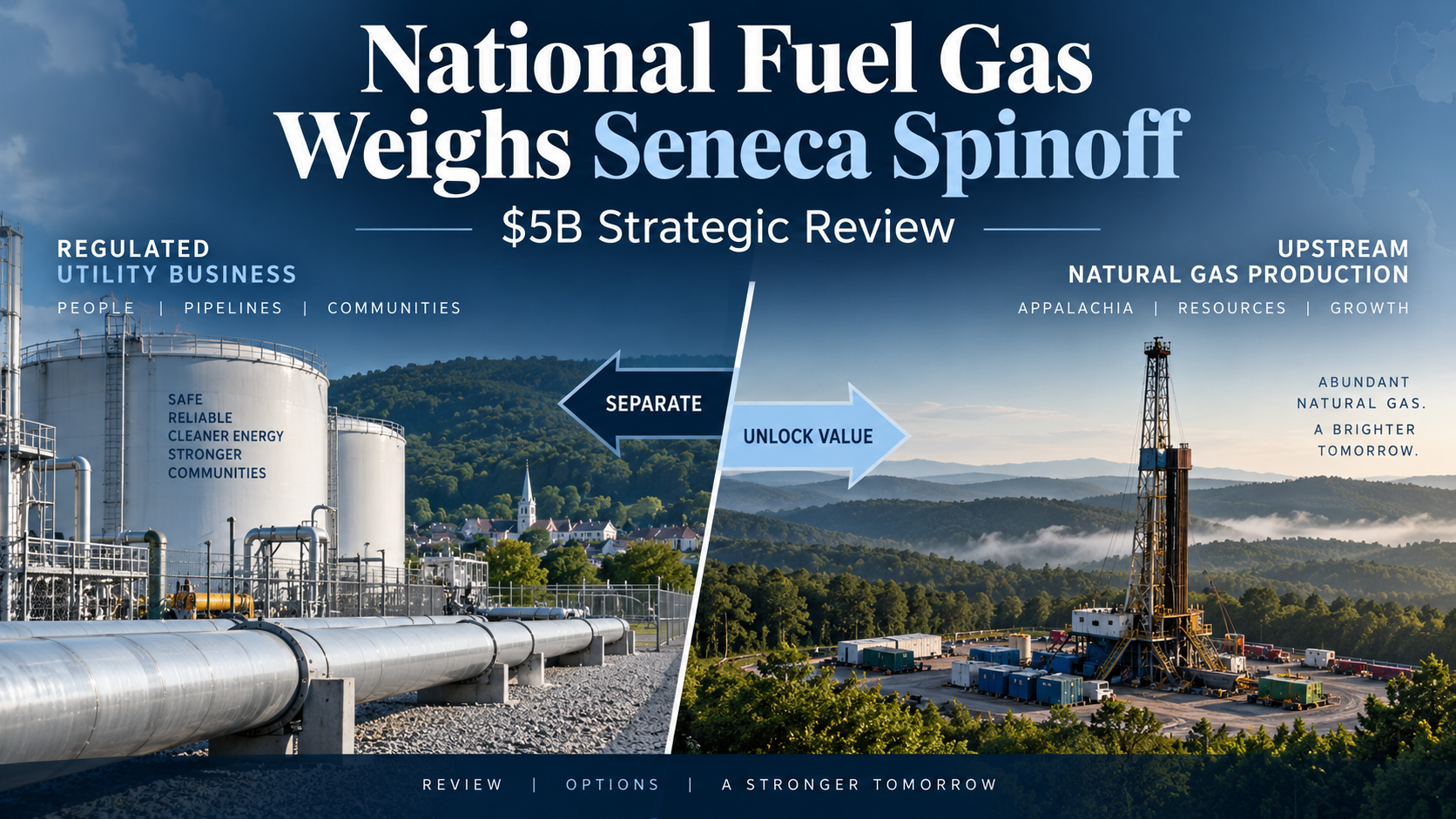
National Fuel Gas is exploring a potential sale or spinoff of its Seneca Resources upstream unit, which generates about 69% of adjusted EBITDA and may be worth $5 billion.
Reuters reported Wednesday that National Fuel Gas (NFG) is exploring strategic alternatives for what the company itself labels its Integrated Upstream and Gathering segment, which includes its Seneca Resources drilling arm and its midstream gathering network. The options include a sale, a merger, a partial transaction, or a spinoff as a separate publicly traded company, the news service said, citing people familiar with the matter.
The business being reviewed is by far the most important piece of the company. Upstream and Gathering accounted for about 69% of National Fuel's adjusted EBITDA over the trailing twelve months through June 30, according to a company investor presentation from July. Reuters reported that the unit could be valued at roughly $5 billion.
National Fuel's market capitalisation stood at roughly $7.7 billion as of July 27, the company's own presentation shows. The segment under consideration represents a large fraction of the group's total equity value, meaning this is not a routine portfolio trim.
The review is not yet a decision to separate. National Fuel has not publicly committed to a transaction. Reuters reported that the examination followed unsolicited third-party interest earlier this year. The company is weighing several structural outcomes, each with different consequences for shareholders.
Why the structure matters
National Fuel is unusual among regulated utilities because much of the company is a commodity-exposed upstream producer. Seneca Resources develops natural-gas reserves in Appalachia. National Fuel Gas Midstream owns the gathering infrastructure that moves gas from those wells.
For years the company argued that integration was a strength: Seneca produces the molecule, the gathering network moves it, interstate pipelines transport it, and NFG's regulated local utilities deliver it to homes and businesses. The July investor presentation described the structure as a core asset.
The strategic review tests whether that argument still holds.
A second move that reshapes the math
National Fuel is simultaneously moving in the opposite direction on the regulated side. The company agreed last year to buy CenterPoint Energy's Ohio gas utility for $2.62 billion in a transaction expected to close October 1, 2026. The deal will add roughly 337,000 customers to a base that currently totals about 756,000 in New York and Pennsylvania, bringing the combined count to roughly 1.1 million customers.
National Fuel has said the acquisition will roughly double its utility rate base. The price consists of $1.42 billion of cash and a $1.2 billion seller note. The company plans to replace that temporary financing with long-term debt, common equity and free cash flow.
A separation of the upstream-and-gathering business several years ago might have left the regulated utility stub too small for institutional investors to bother with. The CenterPoint purchase changes that maths. Even without Seneca, the remaining company would include the enlarged utility, National Fuel's interstate pipeline and storage operations, and several gas-expansion projects already underway.
What falls away and what stays
If National Fuel ultimately chooses a separation, the remaining company would shift from a utility with a large commodity-sensitive production arm to a pure-play regulated-and-infrastructure business. The largest EBITDA contributor would be gone. The earnings mix would change dramatically.
That could produce two cleaner securities for investors to analyse separately. Regulated gas utilities are valued on rate-base growth, allowed returns and dividend durability. E&P companies are valued on reserves, acreage, drilling economics and free cash flow. One company trying to do both often appeals to neither set of investors cleanly.
A wide range of possible outcomes
A sale would convert the business into cash that National Fuel could allocate to debt reduction, utility investment or other uses, subject to tax treatment and the eventual use of proceeds. A merger could give existing NFG shareholders an interest in a larger E&P company. A partial transaction could leave NFG with a retained stake. A public spinoff would create two separately traded companies and let each shareholder choose which they prefer to own.
Until National Fuel announces a structure, those outcomes are not interchangeable. Each has different tax implications, different implications for leverage and different effects on how the remaining company is valued.
Unresolved mechanics
Breaking the two businesses apart would involve real costs and complications. National Fuel Gas Midstream was built largely to handle Seneca's production. The company's interstate pipeline system also moves Appalachian gas, including volumes from Seneca's wells. A standalone Seneca would still need commercial relationships with infrastructure that could remain with NFG, or those assets would need to be moved along with the upstream company.
Debt allocation, corporate overhead, hedging contracts and the financing of the CenterPoint acquisition would all need to be resolved. Those details will determine whether any valuation improvement baked into a separation actually reaches shareholders.
For now, there is no announced transaction, no board-approved separation, no Form 10 filing and no distribution timetable. The news is that National Fuel is examining alternatives for its largest business. That is enough to put the stock on a watch list but not yet to model a spinoff that may never take the form Reuters sources described.
Drafted by a large language model from the source reporting linked above, then screened by automated publishing checks. It is not read by a journalist before publication. Some articles cite our Alpha Score. Verify prices and figures against the original source. Educational coverage, not personalized advice.