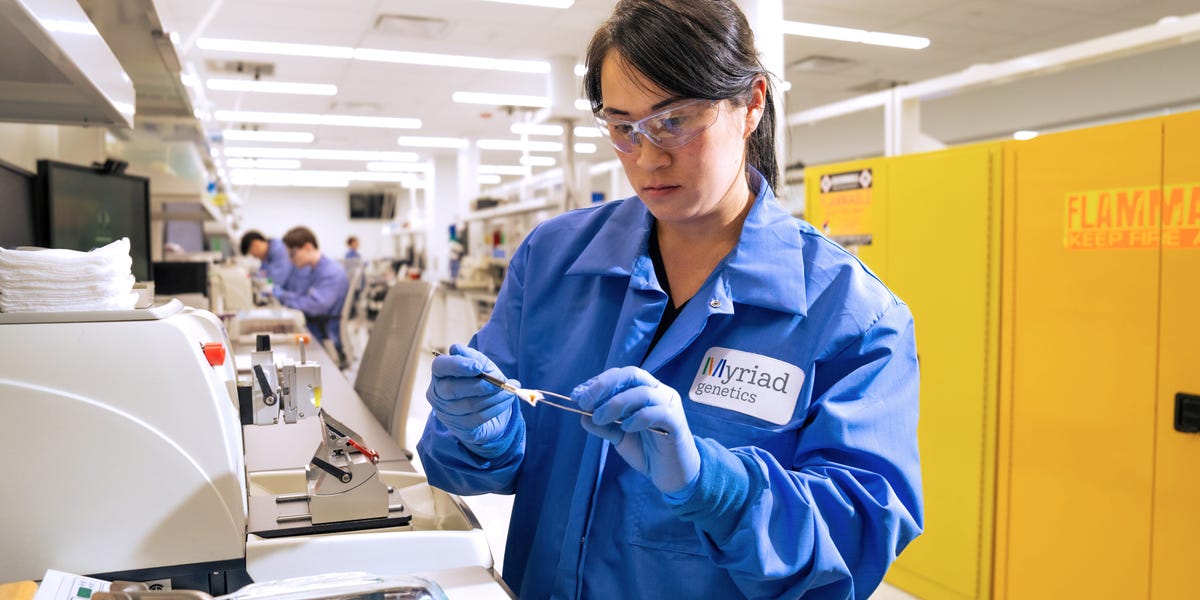
Myriad Genetics cut the time it takes to process a single diagnostic document from 10 minutes to 20 seconds after rebuilding its AI tool on Amazon Web Services' Bedrock platform. The Salt Lake City-based molecular diagnostics firm processes about 1.5 million tests a year for hereditary cancer, prenatal conditions, and tumor profiling. Faster document handling means faster reimbursement, a critical factor for a company that often waits up to 18 months to get fully paid for a single test order.
The faster processing accelerates repayment cycles, said Martyna Shallenberg, Myriad's senior director of software engineering. “The sooner we get cash, the better,” she told Business Insider.
Myriad first built an internal AI tool called Image Genius in 2024 with help from PwC. The system used AWS services Textract and Comprehend to classify pathology reports and extract data. The company rolled it out for its hereditary cancer business in the third quarter of 2024. By the fourth quarter, the system proved too expensive to maintain. Processing times were longer than expected, and the tool struggled to pull the right clinical information from dense reports, said Kevin Haas, Myriad's former chief technology officer.
“The inputs are as vast as the millions of samples we get every year,” Haas told Business Insider. The AI also had trouble distinguishing a testing order from a doctor's medical notes, Shallenberg added. “It was actually the hardest part of the process, separating those documents.”
In the first quarter of 2025, Myriad tried refining the model's prompts and feeding it more data. Results still weren't worth the cost. AWS Comprehend, which uses machine learning to identify clinical notes and insurance data, was “very expensive,” Shallenberg said.
Myriad pivoted to the AWS Generative AI Innovation Center that same quarter. By spring 2025, the two teams rebuilt Image Genius on Amazon Bedrock, which lets companies pick from foundation models by Anthropic, OpenAI, and Amazon's own Nova family. “Model choice is really important,” said Dr. Rowland Illing, AWS' global chief medical officer.
Engineering work wrapped up in the third quarter of 2025. The new Image Genius relaunched in the first quarter of 2026. The tool now saves staff an estimated 300 hours a month across about 9,000 prior authorizations in the women's health division, a Myriad spokesperson said. Prior authorization is the process where a doctor gets approval from an insurer before ordering a test. If it isn't obtained, the claim can be denied, delaying care or costing Myriad revenue.
Myriad plans to roll out the tool to its oncology and mental health units sometime in 2027. The project is now led by new CTO Raj Jampa, who joined in June 2026 after stints at Agilent Technologies, Exact Sciences, and Genomic Health. Jampa said his goal is to expand AI use across the entire revenue cycle, including eligibility verification, claims submission, denial management, and appeals handling.
The evolution of Image Genius shows how even a well-resourced internal AI project can hit cost and accuracy walls. Switching to a more flexible model marketplace fixed both. For Myriad, the payoff is measurable: faster cash, fewer manual hours, and a template for the rest of the business.