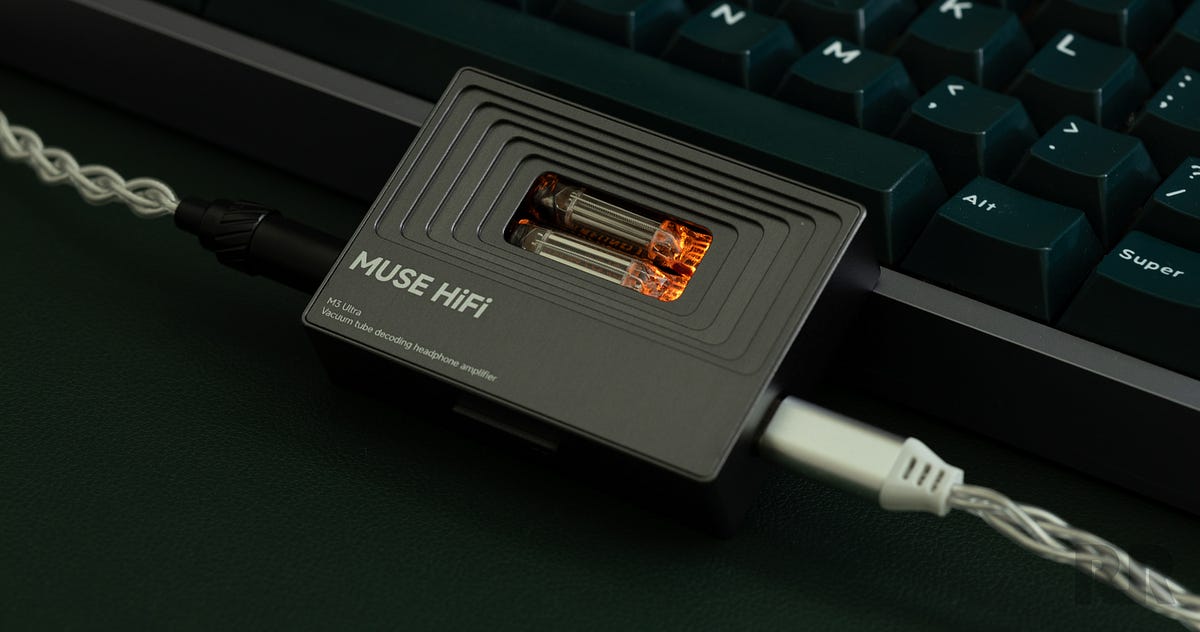
The Muse HiFi M3 Ultra costs $109.99 on HiFiGO. It packs an ESS ES9028Q2M DAC and a vacuum tube amp stage inside an aluminum chassis with a window that shows the glowing tube. Output power peaks at 480 mW, enough for most headphones. The technical specification that matters most for IEM users is not in the official spec sheet.
Using the load-resistor method, the reviewer measured 8.62 ohms on the 4.4mm balanced output and nearly 13.5 ohms on the 3.5mm single-ended output. Those are high numbers for a portable source. With low-impedance multi-driver IEMs, high output impedance shifts the frequency response. The change typically adds warmth and mid-bass presence. The effect is predictable but not uniform across different earphones.
The M3 Ultra does not ship with official output impedance specs from Muse HiFi. The home test reveals the real number. That matters because the tonal shift can be significant, especially with hybrids like the Xenns Mangird Top Pro or the Melody Wings Neptune.
With the Top Pro, a 16-ohm 10-driver hybrid, the 4.4mm output added lower-mid warmth that evened out the dry vocal presentation. Swapping to the 3.5mm output thickened the mids further, adding harmonic fullness to strings and lower vocals. The Top Pro's mid-bass scoop flattened noticeably. Bass felt slower and softer than with a solid-state source. That is the tradeoff for the tube warmth.
With the Neptune, a 19-ohm tribrid with a bone-conduction driver, the M3 Ultra filled out the lower register. The reviewer found the Neptune a bit thin on neutral sources. The M3 Ultra gave it weight below 400 Hz. On acoustic tracks like Jimmy Eat World's "Hear You Me," the guitar strumming had more dynamic space and body.
Build quality is solid for the price point. The aluminum chassis feels sturdy. The USB-C port and 3.5mm/4.4mm jacks are secure. The metal volume buttons rattle when shaken, a common issue in this bracket. One design caveat: the tube window exposes components to impacts and dust.
Muse HiFi uses digital noise cancellation and physical vibration dampening. The result is a near-silent background even with sensitive IEMs like the Campfire Audio Andromeda. No tube ringing when tapping the chassis. Output is dynamic, transients clean. Distortion stays inaudible at normal listening levels.
At $109.99, the M3 Ultra delivers genuine tube coloration with modern output power and a noise floor that rivals solid-state designs. The high output impedance is a feature for listeners who want to warm up their IEMs. It is not neutral. For those who want analog character without heat, noise, or fragility, the M3 Ultra offers a distinct signature at a price that undercuts most tube-portable alternatives.