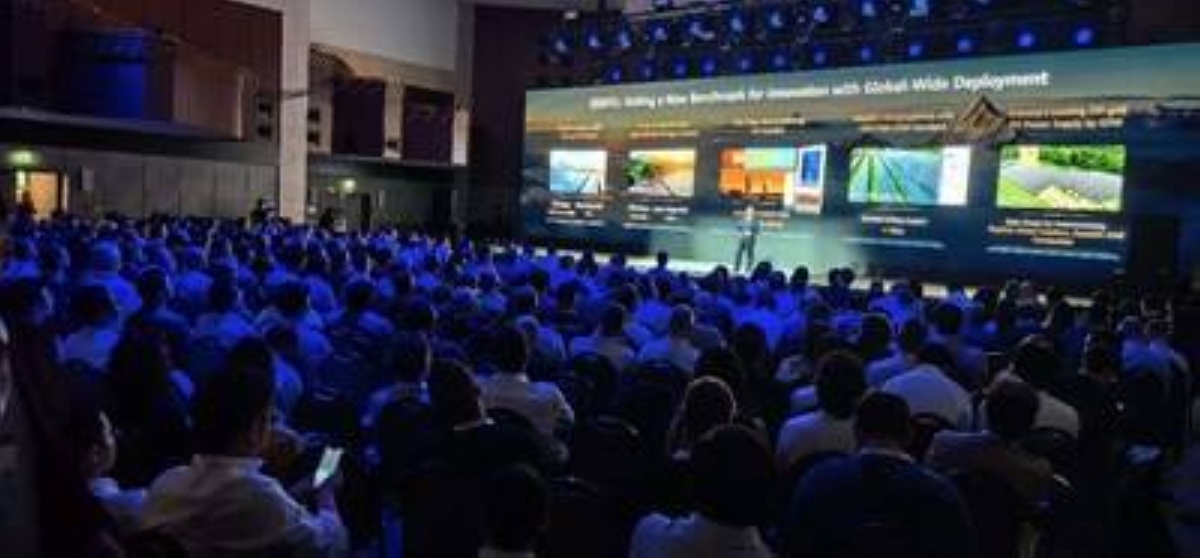
At Intersolar Europe in Munich, Huawei Digital Power unveiled its next-generation Smart String grid-forming ESS platform LUTERRA, alongside a residential product and a new service strategy. The company is betting that grid-forming capability – the ability for battery storage to actively support grid frequency and voltage, not just absorb or discharge power – will become a standard requirement as solar penetration rises.
Steven Zhou, president of Huawei's Smart PV & ESS product line, said future solar and storage systems must evolve into "grid-supporting assets." He cited flexibility, grid-forming capability and intelligence as essential features. The company has been investing in power electronics and AI to achieve plant-level grid forming, which Zhou said would "bring maximum value for customers while reinforcing grid stability."
The centerpiece is LUTERRA, an ESS platform that Huawei says delivers higher energy density from a single cabinet to arrays. Steve Zheng, president of Smart ESS Business, described four value pillars: optimal investment, higher returns, plant-level grid forming, and C2G safety – the last referring to cell-to-grid safety design. The platform is built on what Huawei calls five technology breakthroughs in power electronics and architecture, though the company did not detail each one.
For a utility or independent power producer evaluating storage vendors, the grid-forming claim is the differentiator. Most grid-scale batteries today are grid-following – they respond to signals from the grid. Grid-forming batteries can set their own voltage and frequency reference, which is critical for maintaining stability when solar and wind make up a large share of generation. Several grid operators in Europe and North America have begun requiring grid-forming capability for new storage projects. If LUTERRA delivers on that promise, it could narrow the gap between Huawei and established ESS suppliers in markets where the company is seeking a foothold.
Huawei also introduced LUTERRA S2, a residential PV and ESS system. Sun Power, president of the residential business, said the product is part of a vision for "the ultimate in smart home energy" and noted that Huawei's residential solutions already power more than 4.3 million households globally. That installed base gives Huawei a distribution and brand advantage in the home solar segment, though competition from Enphase, SolarEdge, and Tesla is intense.
On the service side, Allen Zeng, president of Technical Service & Operation, launched a strategy focused on "predictable returns" and full-lifecycle plant value. Zeng cited a new professional service system and platforms including a Huawei AI Assistant and EasyBuy portal, covering planning, construction, maintenance, optimization, and operation.
The announcements show Huawei's push to expand its digital power business beyond China into Europe and other regions, even as the company faces trade restrictions. Huawei did not disclose pricing or availability timelines for LUTERRA. Zeng said the service strategy would be deployed globally, starting with key markets.