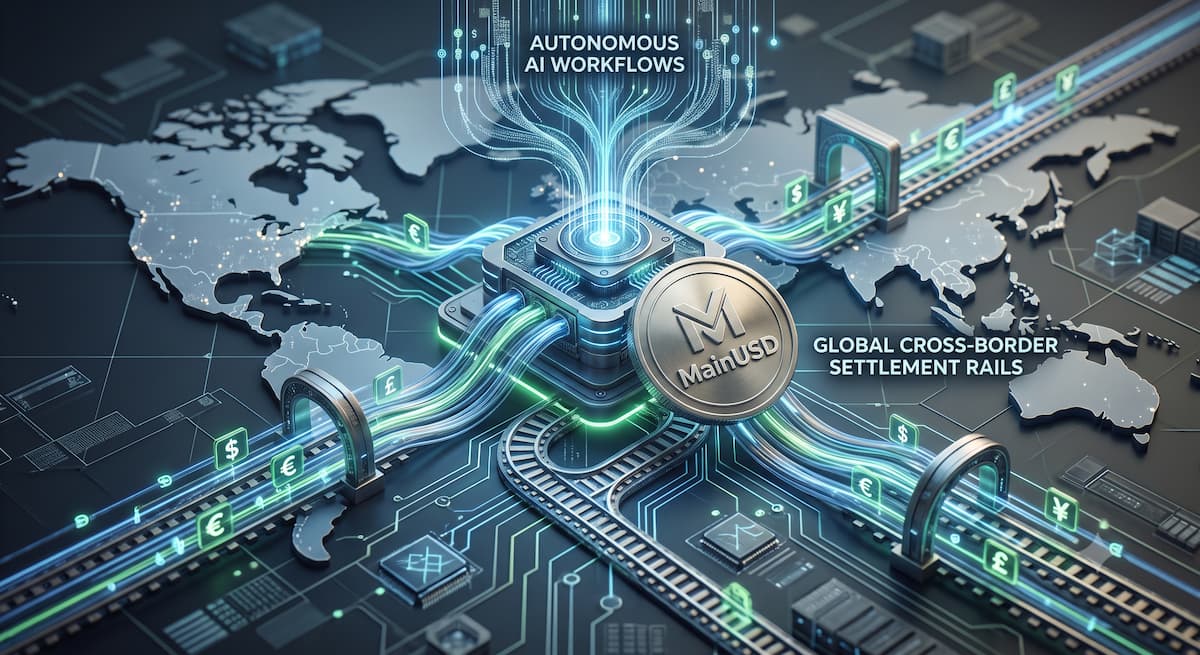
Mosta's MainUSD, issued with Brale, lets corporate clients hold and settle in a regulated digital dollar across 20+ blockchains, with native support for autonomous AI agent payments.
Mosta, an AI-native business banking platform, launched MainUSD on Tuesday. The stablecoin, issued in partnership with Brale, a U.S.-regulated stablecoin provider, gives corporate clients a programmable digital dollar embedded in their financial workflows.
The product targets a specific pain point: asset fragmentation. Multinational companies juggle disconnected wallets, volatile tokens, and separate bank accounts. MainUSD deploys across more than 20 blockchains – Ethereum, Solana, Base, Polygon, and Canton among them – letting merchants accept incoming digital assets, convert them into a single MainUSD balance, and hold them in one settlement layer. From that balance, companies can fund corporate cards, pay vendors, or execute mass international payouts.
Mosta also bridges the gap between decentralized ledgers and legacy banking. Users can route liquidity across 150 countries using either stablecoin rails or traditional clearers – SWIFT, SEPA, bank wires, ACH, and over 10 localized payment networks. The platform offers direct swaps down to 0% and plan-defined zero-fee structures for stablecoin on-ramp and off-ramp, undercutting typical international banking margins.
“Global businesses should not have to choose between the speed of stablecoins and the usability of traditional financial rails,” said Denis Spasio, co-founder at Mosta. “With MainUSD, Mosta customers can move between fiat and stablecoins whenever they need to, settle cross-border transactions instantly, and manage crypto payment flows through one financial operating layer.”
The distinctive angle is native support for agentic commerce. As autonomous AI agents handle procurement, supply-chain management, and automated purchasing, they need a machine-readable financial system. Through MainUSD, companies can issue controlled, automated corporate cards directly to agents connected via the Model Context Protocol (MCP). Those agents can then execute multi-step transactions, optimize outlays, and handle real-time vendor settlements under programmatic guardrails and human oversight.
Mosta operates with named, segregated accounts at Tier-1 partner banks, plus branded invoicing tools with automated reconciliation. MainUSD is designed to comply with the emerging GENIUS Act stablecoin framework as U.S. rules take effect. Brale handles reserve management, compliance, and issuance, letting Mosta clients scale on-chain operations without building that infrastructure from scratch.
“We built Brale to make it easy for companies like Mosta to launch their own stablecoins without having to build reserve management, compliance, and issuance infrastructure from scratch,” said Chase Merlin, head of product at Brale. “The demand for business-grade stablecoin settlement is accelerating, and MainUSD is a strong example of what that looks like in practice.”
The launch adds another regulated dollar token to a market already crowded with USDC, USDT, and bank-issued alternatives. What sets MainUSD apart is its explicit design for AI agent workflows – a use case that most stablecoin issuers have not addressed directly. If autonomous commerce grows as projected, the infrastructure layer that supports it could see disproportionate demand. Mosta is betting that the bottleneck is not technology but integration between stablecoins and corporate treasury systems.
Prepared with AlphaScala research tooling and grounded in primary market data: live prices, fundamentals, SEC filings, hedge-fund holdings, and insider activity. Each story is checked against AlphaScala publishing rules before release. Educational coverage, not personalized advice.