Back to Markets
Stocks● Neutral

Mortgage Rate Compression Meets Bond Market Disconnect

Mortgage Rate Compression Meets Bond Market Disconnect

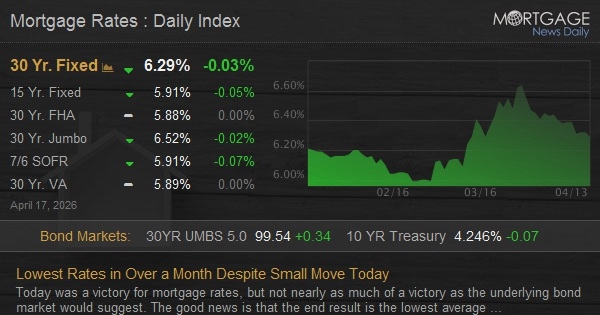
Mortgage rates have hit their lowest point in over a month, yet the decline lags behind the broader bond market rally, signaling persistent lender caution.

Mortgage rates reached their lowest levels in over a month today, marking a shift in the interest rate environment that follows recent bond market activity. While the decline provides a reprieve for borrowers, the movement in mortgage rates remains decoupled from the more aggressive shifts seen in the underlying bond market. This divergence suggests that lenders are maintaining wider margins despite the favorable trend in benchmark yields.

The Disconnect Between Bonds and Mortgages

Mortgage rates derive their pricing from mortgage-backed securities, which track closely with Treasury yields. Today, the bond market signaled a more significant rally than what was ultimately reflected in the daily mortgage rate averages. This gap indicates that lenders are not passing through the full extent of bond market gains to the consumer. The result is a slow-motion adjustment where mortgage rates are trending downward, but at a pace that lags behind the broader fixed-income recovery.

This pricing behavior often occurs during periods of high volatility or when lenders anticipate future shifts in liquidity. By keeping rates slightly elevated relative to bond yields, institutions protect themselves against rapid reversals in the market. For those tracking stock market analysis, this dynamic highlights the friction inherent in the housing finance sector, where retail rates are insulated from the immediate volatility of the secondary market.

Structural Constraints on Rate Velocity

Several factors contribute to the current sluggishness in mortgage rate adjustments:

  • Secondary market liquidity remains sensitive to ongoing shifts in the Federal Reserve's balance sheet strategy.
  • Lenders are balancing the need for competitive pricing against the risk of rapid prepayment cycles.
  • The spread between the 10-year Treasury and the 30-year mortgage rate remains historically wide.

These constraints mean that even as bond yields improve, the transmission mechanism to the average borrower is filtered through institutional risk management. Investors who follow Modernizing B2B Payment Infrastructure as a Competitive Moat understand that legacy systems in the mortgage space often prevent real-time pricing adjustments. The current environment is a clear example of how operational and risk-based buffers prevent the retail market from mirroring the efficiency of the bond market.

The Path Toward Further Normalization

The next concrete marker for this trend will be the upcoming release of inflation data and the subsequent reaction in the 10-year Treasury yield. If bond yields continue to stabilize at these lower levels, the pressure on lenders to compress their margins will increase. A sustained period of lower volatility in the bond market is the primary catalyst required to narrow the current spread.

Market participants should monitor the next round of mortgage application data to see if the recent rate dip triggers a meaningful change in borrower behavior. Until the spread between bond yields and mortgage rates begins to tighten, the headline rate will likely remain higher than the underlying bond market performance would otherwise dictate. The focus remains on whether the current floor in rates holds through the next major economic report.

How this story was producedLast reviewed Apr 17, 2026

AI-drafted from named sources and checked against AlphaScala publishing rules before release. Direct quotes must match source text, low-information tables are removed, and thinner or higher-risk stories can be held for manual review.

Editorial Policy·Report a correction·Risk Disclaimer