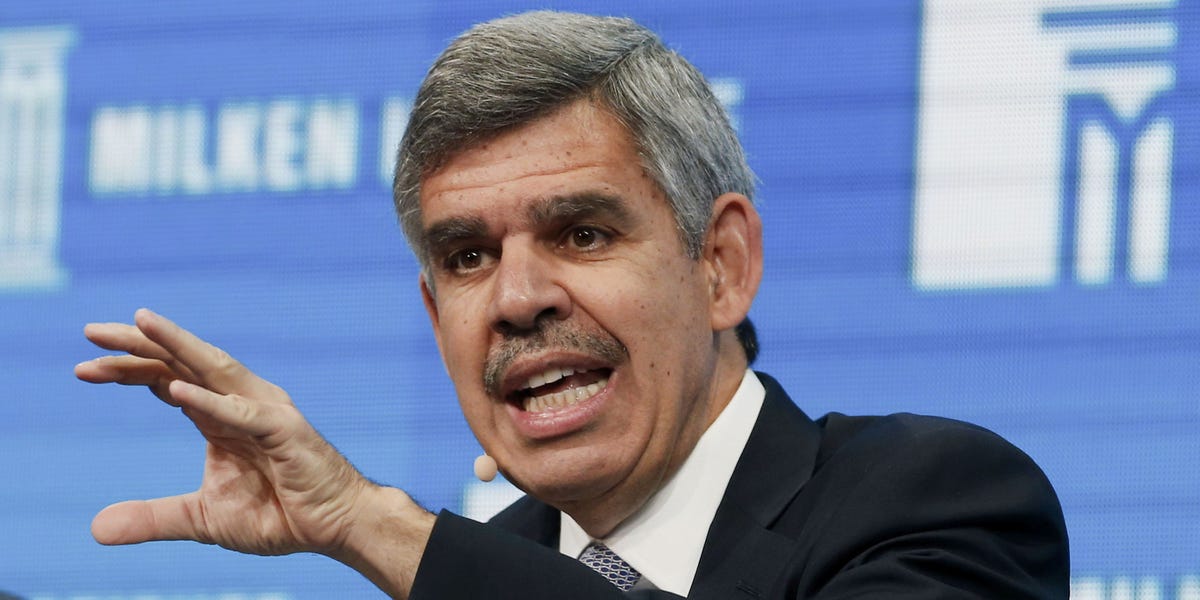
Mohamed El-Erian Flags 'Sobering' Economic Risks From Middle East Conflict

Mohamed El-Erian warned that ongoing Middle East conflict threatens to stifle global growth, reignite inflationary pressures, and constrain the efficacy of central bank policy.
Alpha Score of 14 reflects poor overall profile with poor momentum, poor value, poor quality. Based on 3 of 4 signals — score is capped at 90 until remaining data ingests.
Alpha Score of 45 reflects weak overall profile with strong momentum, poor value, poor quality, weak sentiment.
Alpha Score of 47 reflects weak overall profile with moderate momentum, poor value, moderate quality. Based on 3 of 4 signals — score is capped at 90 until remaining data ingests.
Alpha Score of 55 reflects moderate overall profile with moderate momentum, moderate value, moderate quality. Based on 3 of 4 signals — score is capped at 90 until remaining data ingests.
Mohamed El-Erian warned this week that the ongoing Middle East conflict presents a sobering outlook for the global economy. He identified five primary transmission channels through which the war threatens to disrupt financial stability and broader growth metrics.
The Transmission Channels of Risk
El-Erian’s assessment centers on the potential for the conflict to compress economic output while simultaneously complicating the work of central banks. His list of concerns highlights the fragility of the current recovery phase following years of post-pandemic adjustment.
- Growth: A contraction in regional trade and supply chain disruptions.
- Inflation: Potential for energy price spikes to reignite cost-push pressures.
- Inequality: Disproportionate impact on lower-income populations as essential costs rise.
- Public Finances: Increased fiscal burden as governments redirect capital toward defense and crisis management.
- Policy Constraints: A narrowing path for central banks to manage interest rates without triggering a recession.
Market Impact and Policy Constraints
For traders, the most immediate danger lies in the volatility of energy markets. The potential for supply disruptions remains the primary driver of risk premiums in crude oil profile. When geopolitical tensions escalate, the correlation between energy prices and broader equity indices like the SPX and IXIC often tightens, as markets price in higher input costs for manufacturers and retailers.
Central banks are currently attempting to navigate a soft landing, but El-Erian’s warning suggests that the room for error is shrinking. If inflation proves sticky due to supply-side shocks, the Federal Reserve and other major central banks may be forced to keep rates higher for longer, even if domestic growth begins to falter. This creates a difficult environment for fixed-income assets and growth-sensitive equities.
What Traders Should Watch
Market participants should pay close attention to the spread between long-term and short-term government bonds, as any sudden widening could indicate a shift toward a risk-off environment. Additionally, watch for any shifts in sentiment within commodities analysis, where energy prices act as a lead indicator for broader inflationary trends.
"The Middle East war could hit growth, fuel inflation, worsen inequality, squeeze public finances, and hamstring policymakers."
Geopolitical risk premiums are notoriously difficult to model. Unlike standard economic data releases, these events lack a predictable cadence, making hedging strategies essential for those with heavy exposure to energy-sensitive sectors. Keep a close eye on the CL futures contract; a sustained break above historical resistance levels would likely signal that the market is beginning to price in a more prolonged disruption to trade routes.
AI-drafted from named sources and checked against AlphaScala publishing rules before release. Direct quotes must match source text, low-information tables are removed, and thinner or higher-risk stories can be held for manual review.