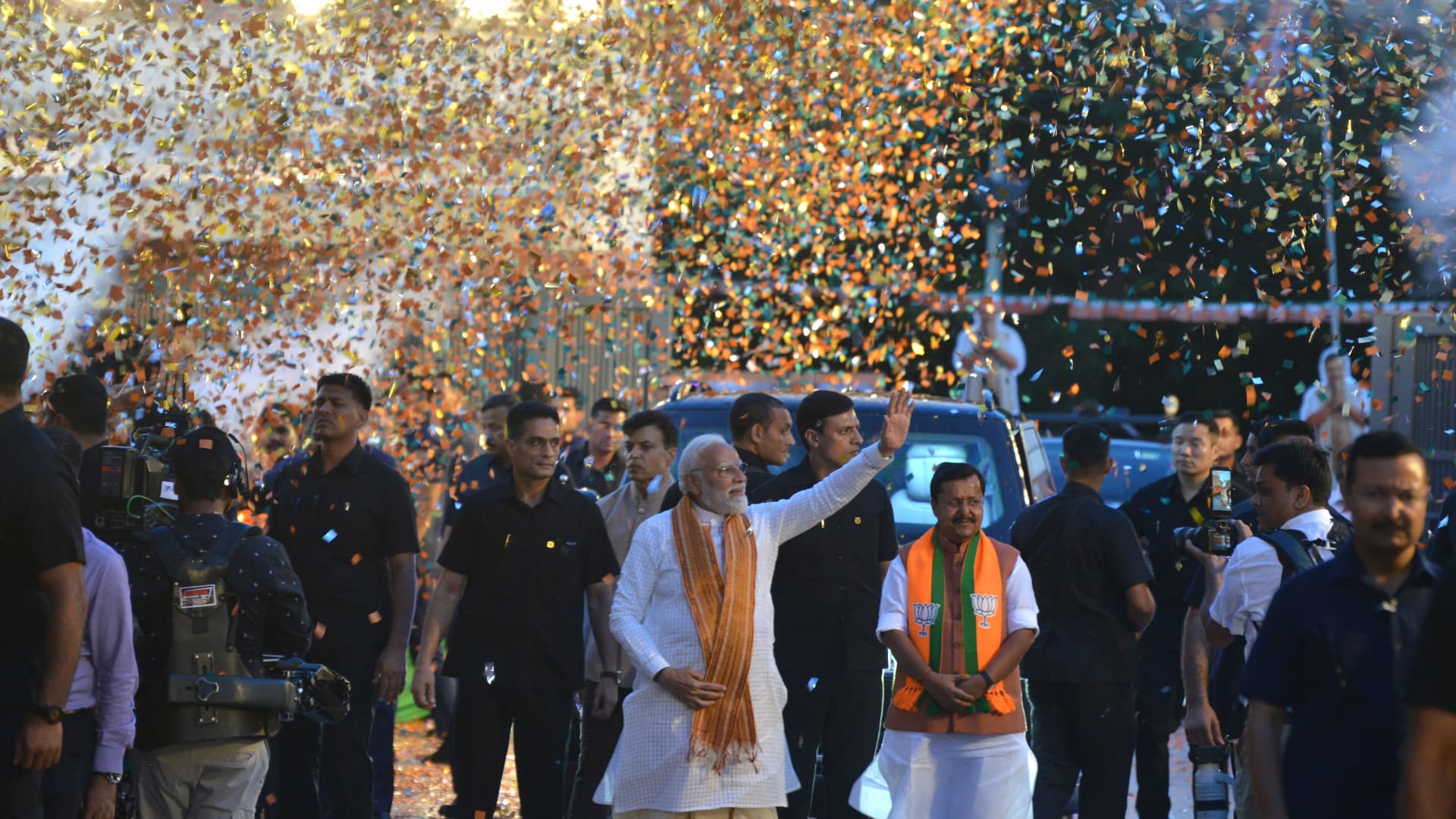
Modi's West Bengal win offers a path to fiscal reform, but $20 billion in foreign outflows since January highlights the need for structural policy shifts.
The Bharatiya Janata Party’s (BJP) decisive victory in West Bengal, where it secured 206 of 294 seats to form its first-ever state government, marks a significant shift in the political landscape for Prime Minister Narendra Modi. Following a period of coalition-dependent governance that began in June 2024, this electoral success provides a fresh mandate that may allow the administration to pivot away from the populist spending cycles that have characterized the last year. Markets are now assessing whether this political consolidation will translate into the structural reforms necessary to stabilize an economy currently grappling with the fallout of regional conflicts and capital flight.
For the past year, the Indian government has prioritized short-term stability over fiscal austerity, absorbing the impact of rising energy costs to shield consumers from inflationary pressure. By cutting central excise duties on fuel, the government has taken a substantial hit to tax revenues. This fiscal burden is compounded by widespread welfare initiatives, including state-level cash transfer programs that Bernstein Research estimated will cost up to 2.5 trillion rupees, or approximately $26.2 billion, representing 0.5% of GDP.
This spending profile has created a rigid fiscal environment. However, the political capital gained from the West Bengal win offers a potential exit ramp. As noted by Ashok Malik of The Asia Group, the government now possesses the political cover to rationalize these welfare expenditures and finally pass on energy costs to the consumer. The primary mechanism here is the reduction of the current account deficit, which is projected to widen through the fiscal year ending March 2027 due to energy price volatility and export disruptions stemming from the Middle East conflict. If the government uses this mandate to normalize fuel pricing, it could signal a return to fiscal discipline that investors have been missing.
While the political narrative has improved, the underlying capital flows remain deeply negative. Foreign portfolio investors have offloaded more than $20 billion in Indian equities since January, a figure that already surpasses the $18.9 billion in total outflows recorded throughout 2025. This exodus, coupled with net foreign direct investment flows hovering near all-time lows of $0.5 billion for the 12 months ending January 2026, has placed immense downward pressure on the rupee.
For investors, the critical question is whether this election result addresses the structural bottlenecks that have driven this capital away. The economy faces a dual challenge: a shrinking white-collar job market in the IT sector due to AI-driven automation and a manufacturing sector that has failed to absorb the labor force still dependent on agriculture, which accounts for 45% of the population but only 15-16% of GDP. The government’s previous attempt at agricultural reform in 2021 failed under public pressure, highlighting the execution risk associated with any major policy shift. For those tracking broader financial sector health, the MS stock page provides additional context on how global institutions are positioning amidst these shifting regional dynamics. With an Alpha Score of 65/100, MS remains a moderate indicator of institutional sentiment regarding emerging market exposure.
Despite the electoral momentum, the path to reform remains constrained by the parliamentary math. The BJP and its allies have achieved a near two-thirds majority in the upper house, but the lower house remains a hurdle for more aggressive legislative changes. The read-through for the broader stock market analysis is that while the "politics of good governance" may improve administrative efficiency and state-level coordination, it does not automatically guarantee the passage of controversial, high-impact reforms.
Investors should look for the first concrete sign of a policy pivot: the removal of fuel subsidies or a reduction in the unconditional cash transfer programs. If the government continues to prioritize populist measures despite its strengthened electoral position, it would suggest that the political mandate is being used for preservation rather than structural transformation. Conversely, a willingness to absorb the short-term political cost of energy price hikes would confirm that the administration is prioritizing long-term economic sustainability over immediate electoral popularity. The current environment remains one of high execution risk, where political victory is a necessary, but not sufficient, condition for a sustained market recovery.
AI-drafted from named sources and checked against AlphaScala publishing rules before release. Direct quotes must match source text, low-information tables are removed, and thinner or higher-risk stories can be held for manual review.