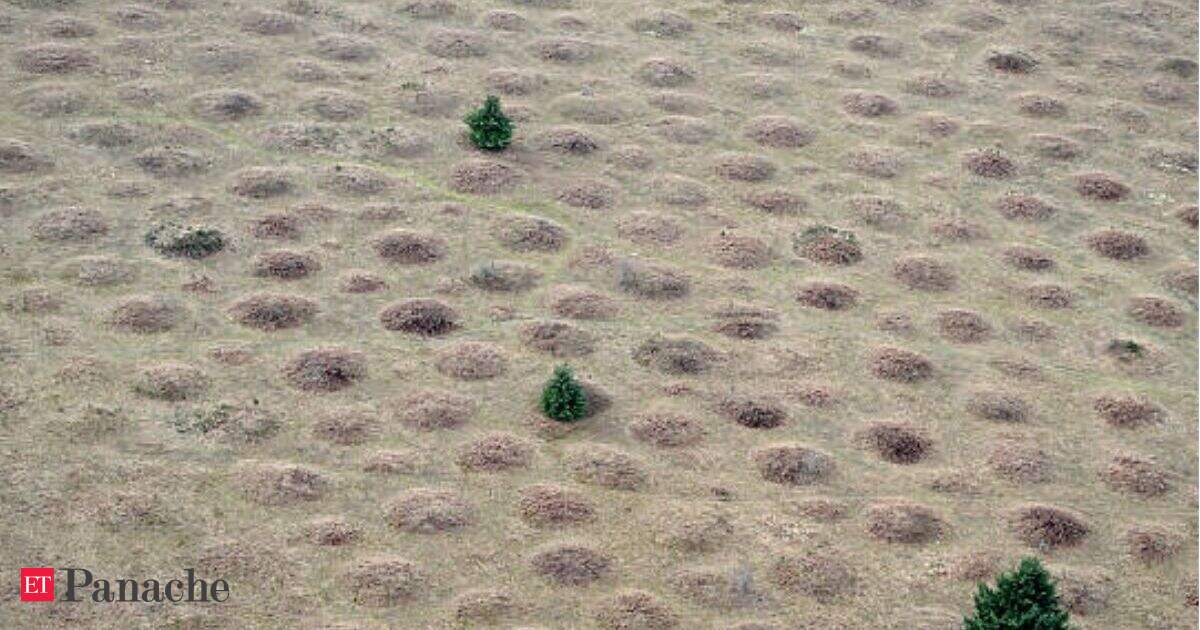
Thousands of 30-foot mounds across Washington, Oregon, and Idaho form a pattern that looks like a giant fingerprint. A century of study has not solved the Mima mounds mystery.
A stretch of the American West looks like the Earth has goosebumps. Thousands of evenly spaced mounds, some 30 feet tall, cover hundreds of miles across Washington, Oregon, and Idaho. Scientists call them the Mima mounds.
The pattern is so uniform that aerial photos look like a giant fingerprint pressed into the soil. After more than a century of study, no one can say exactly how they formed.
Early theories suggested glaciers left them. Others pointed to gophers. One researcher in the 1950s argued that native peoples built them as burial sites.
A 2014 study in Geomorphology offered the strongest evidence yet. The mounds appear only in areas that experienced repeated freezing and thawing during the last ice age. The process, called frost heaving, pushes soil upward into organized patterns, much like the stone circles found in Arctic regions.
That is the leading hypothesis today. It has not been proven. The mounds are protected by law, so digging for soil samples is restricted. Without core samples, the frost-heave theory remains just that.
Local landowners have their own explanations. Some say the mounds are ancient fish nests from a prehistoric seabed. Others swear they are the work of giant earthworms. No evidence supports either claim.
What is certain is this. The mounds are not recent. Radiocarbon dating of organic material found inside them puts their age at 10,000 to 15,000 years, roughly the end of the last ice age. That timing aligns with the frost-heave window.
A team from the University of Washington plans to revisit the site next summer with ground-penetrating radar. They hope to map the subsurface structure without disturbing the mounds. If the radar shows layered soil consistent with freeze-thaw cycles, the case strengthens. If it shows something else, the mystery persists.
For now, the goosebump landscape of the Pacific Northwest remains one of American geology's oldest unsolved puzzles. The next answer will be written in the dirt, not in a lab.
Drafted by a large language model from the source reporting linked above, then screened by automated publishing checks. It is not read by a journalist before publication. Some articles cite our Alpha Score. Verify prices and figures against the original source. Educational coverage, not personalized advice.