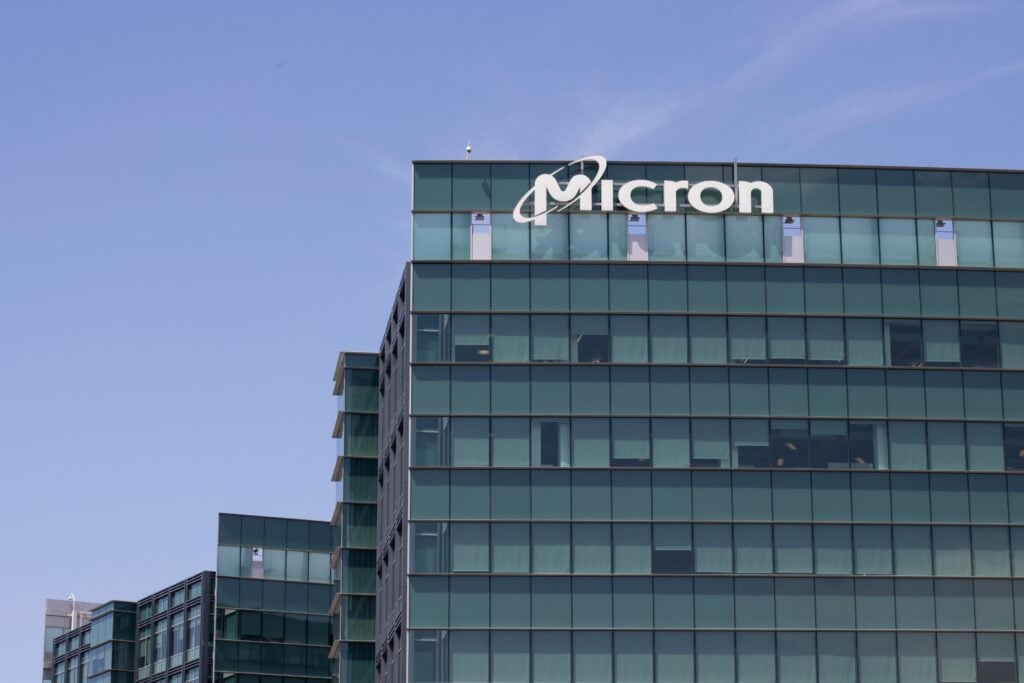
Micron Technology (MU) crossed a $1 trillion market capitalization for the first time Tuesday, jumping as much as 21% after UBS tripled its price target to $1,625 from $535. The move follows a weekend rally where President Donald Trump name-dropped the chipmaker, reviving speculation that Washington could take an equity stake in the only major US-based memory producer.
The rally is not just political noise. UBS analyst Timothy Arcuri’s new target, the highest among 46 brokerages covering the name, implies a valuation near $1.8 trillion within a year. The note points to long-term supply deals that lock in volumes and partially fix prices, a structural shift in a business known for violent boom-and-bust cycles.
The $1 Trillion Milestone and the UBS Note That Tripled
Arcuri’s $1,625 target is more than three times his prior $535 estimate and more than double the next highest Street target. The upgrade rests on Micron’s ability to secure multi-year contracts with fixed pricing components. Those contracts could smooth the earnings volatility that has historically kept the stock at a discount.
The Supply Deal Thesis
Micron’s historically volatile earnings have punished investors during memory downturns. The UBS note argues that long-term supply agreements with customers – likely including Nvidia (NVDA) and Advanced Micro Devices (AMD) – change the risk profile. If those contracts hold, Micron’s revenue becomes more predictable, justifying a higher multiple. The risk is that memory demand is inherently cyclical. A downturn would break the fixed-price framework.
The Trump Factor and Government Stake Odds
Trump’s public praise came Friday in Suffern, New York. “Micron, boy Micron’s great, they’re investing hundreds of billions,” he said. The comment revived speculation that the US government could take an equity position in Micron, following the precedent set with Intel (INTC) last year. Trump also disclosed buying between $50,000 and $100,000 of Micron stock in March.
A Kalshi market asking which companies the US will buy into this year gives Micron odds of 40%. Defense firm Anduril is at 30%. Meanwhile, D-Wave and Rigetti both trade above 90% after the Trump administration reportedly moved to award $2 billion to nine companies in the quantum sector. The government’s willingness to take direct stakes in strategic technology companies is now a live variable for Micron’s valuation.
HBM: The Product Driving the Memory Shortage
Micron’s key product right now is high-bandwidth memory (HBM), a stacked chip that sits beside processors in Nvidia (NVDA) and Advanced Micro Devices (AMD) accelerators and feeds them data fast enough to run large AI models. Demand has outrun supply. Micron has said its entire 2026 HBM output is already sold, and the shortage has pushed DRAM prices sharply higher.
The Memory Oligopoly
Micron is one of only three large memory makers globally, alongside South Korea’s SK Hynix and Samsung, and the only major US-based producer. That scarcity is part of why a government stake is even on the table. The stock has more than tripled in 2026 on the memory shortage tied to the AI buildout.
What the Supply Deals Mean for Earnings
The UBS note emphasizes that long-term supply deals lock in volumes and partially fix prices. If those contracts hold, Micron’s historically volatile earnings could become more predictable, justifying a higher multiple. The risk is that memory demand is inherently cyclical – a downturn would break the fixed-price framework.
The Valuation Trap: 8.4x Earnings on a Cyclical Memory Business
Even after the run, Micron trades at roughly 8.4 times expected earnings versus 21.1 for the S&P 500. The low multiple reflects the memory market’s history of boom-and-bust cycles. Investors are pricing in the possibility that the current shortage is temporary.
What Confirms the Thesis
- HBM pricing holds or increases through 2026.
- Government stake materializes, providing a valuation floor.
- Micron secures additional long-term contracts with fixed pricing.
What Weakens the Thesis
- DRAM prices reverse as supply catches up.
- AI server buildout slows, reducing HBM demand.
- Government stake speculation fades without action.
AlphaScala’s proprietary Alpha Score rates NVDA at 72/100 (Moderate) and AMD at 59/100 (Moderate), reflecting the sector’s elevated valuation risk. Both are key customers for Micron’s HBM, so any slowdown in their AI spending would directly hit Micron’s revenue.
The Practical Takeaway for Traders
Micron’s $1 trillion milestone is driven by a concrete catalyst – HBM supply sold out through 2026 – and a speculative overlay of government involvement. The UBS target provides a near-term valuation anchor. The stock’s low earnings multiple signals that the market is not yet convinced the memory cycle has structurally changed. Watch for HBM pricing data and any official statement from the White House on a potential stake.
For more on the sector, see our stock market analysis and the NVIDIA profile.