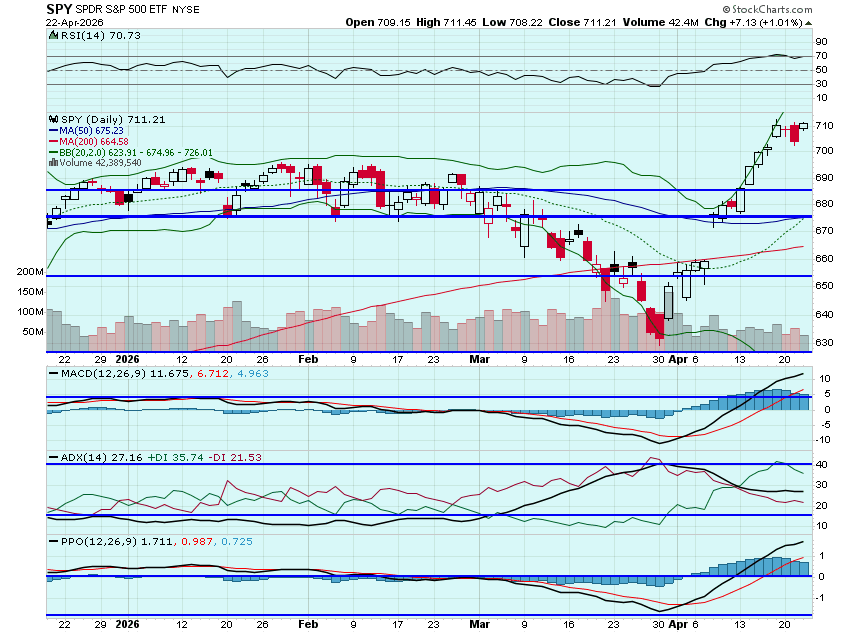
Market Momentum and the April 23rd Pivot

The S&P 500 hit all-time highs on Wednesday, decoupling from weaker international markets and forcing a re-evaluation of sector-specific valuations.
Alpha Score of 45 reflects weak overall profile with strong momentum, poor value, poor quality, weak sentiment.
Alpha Score of 69 reflects moderate overall profile with strong momentum, moderate value, strong quality, moderate sentiment.
Alpha Score of 55 reflects moderate overall profile with moderate momentum, moderate value, moderate quality. Based on 3 of 4 signals — score is capped at 90 until remaining data ingests.
Alpha Score of 43 reflects weak overall profile with weak momentum, weak value, poor quality, moderate sentiment.
The S&P 500 reached new all-time highs on Wednesday, closing up 1.05% as investors pushed through a mixed global backdrop. While Asian markets retreated overnight and European indices struggled to find footing, the domestic rally suggests a renewed appetite for risk assets despite the lack of clear macroeconomic tailwinds. This divergence between domestic strength and international hesitation defines the current trading environment.
Sector Performance and Divergence
The rally is characterized by a rotation that favors domestic growth over global cyclical exposure. Investors are currently weighing the impact of regional weakness against the resilience of the U.S. technology sector. As capital flows into domestic indices, the pressure mounts on companies to justify their valuations through operational efficiency rather than mere multiple expansion. This shift is particularly evident in the technology sector, where ON stock page currently holds an Alpha Score of 45/100, reflecting a mixed outlook as the firm navigates supply chain constraints and shifting demand cycles.
Financials remain a critical component of the current market structure. The performance of firms like ALL stock page, which maintains an Alpha Score of 69/100, provides a barometer for the broader financial sector's ability to manage interest rate volatility and underwriting risks. The relative strength of these firms compared to their international peers suggests that domestic balance sheets are currently perceived as more robust, even as global liquidity conditions tighten.
Structural Shifts in Capital Allocation
The current market environment is forcing a re-evaluation of how capital is deployed across different asset classes. As discussed in our recent analysis on the navigating the SaaS valuation reset, the era of indiscriminate growth is giving way to a focus on sustainable margins and cash flow visibility. This transition is not limited to software; it is a broader theme affecting how investors approach stock market analysis across all sectors.
Investors should look for the next marker in the form of upcoming earnings guidance and central bank commentary. The divergence between the U.S. rally and the weakness in overseas markets will likely be tested by the next round of labor market data and inflation reports. If the domestic market continues to decouple from global trends, the focus will shift toward whether this is a sustainable trend or a temporary liquidity-driven anomaly. The next concrete indicator will be the upcoming corporate filing cycle, which will provide the first look at how companies are managing input costs in this high-valuation environment.
AI-drafted from named sources and checked against AlphaScala publishing rules before release. Direct quotes must match source text, low-information tables are removed, and thinner or higher-risk stories can be held for manual review.