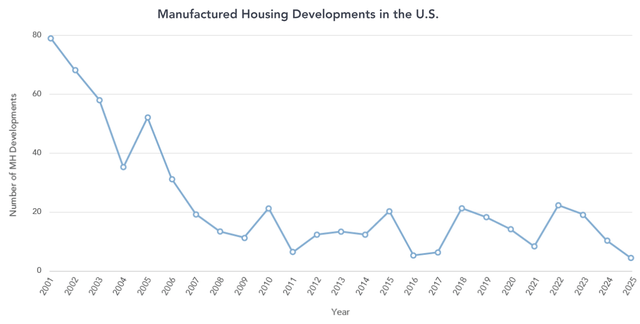
The manufactured housing sector has transitioned from a niche real estate sub-asset to a focal point for investors seeking defensive yield. Recent shifts in housing affordability and supply constraints have elevated the profile of companies like Equity Lifestyle Properties and Sunoco LP. These firms operate within a business model defined by high barriers to entry and recurring revenue streams that remain largely insulated from broader residential market volatility.
Operational Moats in Land-Lease Models
The core value proposition for manufactured housing REITs lies in the land-lease structure. Unlike traditional residential developers, these companies own the underlying land while residents own the homes situated on those lots. This arrangement creates a sticky tenant base, as the cost and logistical complexity of relocating a manufactured home are prohibitive. Consequently, these REITs maintain high occupancy rates even during periods of economic contraction.
For ELS stock page, the focus remains on premium lifestyle communities that cater to a demographic with high income stability. The model relies on consistent rent escalations that often track with or exceed inflation. Meanwhile, SUN stock page operates at the intersection of energy distribution and infrastructure, providing a different risk profile while maintaining the same focus on essential, long-term asset utility. These companies benefit from a structural undersupply of new sites, which prevents the market from becoming overbuilt.
Valuation and Capital Allocation Trends
Investors are currently evaluating how these REITs manage capital expenditures against the backdrop of elevated interest rates. Because the sector is capital-intensive, the cost of debt remains a primary determinant of future growth. Companies that have locked in long-term, fixed-rate financing are better positioned to pursue acquisitions or site expansions without diluting shareholder value.
AlphaScala data currently tracks various sectors to identify shifts in momentum. For instance, ON stock page holds an Alpha Score of 46/100 and a Mixed label, reflecting the broader volatility found in the technology sector compared to the relative stability of real estate investment trusts. While technology stocks often trade on speculative growth, the manufactured housing sector is priced based on the predictability of cash flows and the scarcity of developable land.
The Path Toward Future Yield
The next concrete marker for this sector will be the upcoming quarterly disclosures regarding rent growth and occupancy trends. Investors should look for evidence of sustained pricing power in the face of cooling broader housing markets. If these REITs continue to show low turnover rates, it will reinforce the thesis that their business models are decoupled from the cyclical nature of traditional single-family home sales.
Monitoring the pace of new site development will also be critical. Regulatory hurdles and zoning restrictions act as a natural barrier to entry, protecting existing players from new competition. As the industry moves into the next fiscal cycle, the ability to maintain margins while navigating interest rate fluctuations will define the winners in this space. The sector remains a case study in how structural supply constraints can create durable, long-term value for patient capital.