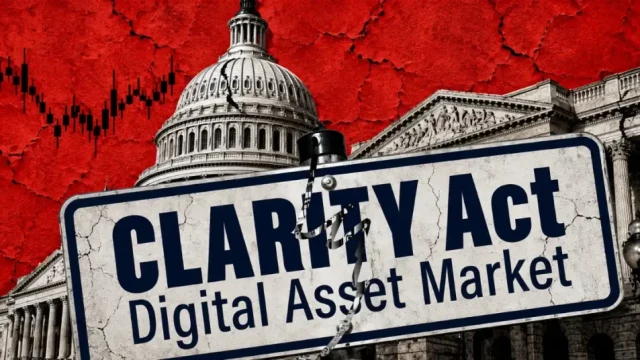
Senator Cynthia Lummis took the Senate floor to warn that further delay on the Digital Asset Market Clarity Act amounts to a deliberate decision to kill the bill. The Wyoming Republican said she would keep speaking on the bill through the following day, describing it as good for the country, for consumers and for lawmakers on both sides of the aisle.
Lummis said she struggles to understand what more Democrats could want after 11 months of negotiations that gave the other side nearly everything requested. The bill now runs 616 pages. It cleared the Senate Banking Committee in May on a 15-9 bipartisan vote.
The bill's roots trace back to 2020, when Wyoming's state legislature built a legal framework for digital assets. Lummis wanted to keep those companies in Wyoming and in America. Her partner on the project has been Democratic Senator Kirsten Gillibrand of New York.
The first version of the Lummis-Gillibrand Responsible Financial Innovation Act appeared in June 2022 at 68 pages. A 2023 version grew to 274 pages with additional provisions on mixers, customer agreements and crypto ATMs. The current version includes Title One with 33 Democrat-driven edits, tighter definitions, an SEC certification process, new anti-evasion authority and a cut to the annual fundraising cap from $75 million to $50 million with a $200 million lifetime ban on felons convicted of fraud or money laundering using the framework.
Three entirely new titles were added at Democrats' request, contributing 23 sections aimed at illicit finance. These cover standards for determining when a DeFi platform is genuinely decentralized, sanctions compliance requirements, and new authority to target platforms facilitating money laundering tied to Russia, Iran and North Korea. The bill also adds $150 million in new FinCEN funding, mandatory Treasury and GAO studies on mixers and financial stability risk, and federal protections for digital asset ATMs.
On the CFTC side, Lummis counted more than 30 Democrat wins. They include a private right of action for consumer protection violations, memecoins brought under CFTC jurisdiction, conflict-of-interest rules stronger than the House-passed version, and $150 million in new CFTC appropriations.
The biggest concessions, Lummis said, came on ethics. She took Democrat concerns directly to President Trump, who voluntarily agreed to the strongest ethics provisions in U.S. history. The provisions include a first-of-its-kind ban on the president, vice president, every member of Congress, federal judges, and their spouses issuing or sponsoring a digital asset for consideration. Trump agreed to place his existing digital assets into a blind trust or divest. The attorney general is directed to enforce violations with civil penalties. Exchanges face civil penalties up to $250,000 per violation per day. Violating officials must give up all profits plus a penalty of up to 10% of what they received or $500,000, whichever is greater.
Lummis said she and Senator Bernie Moreno were surprised the president accepted terms this strict, yet Democrats still say the bill isn't ready. She compared the situation to the children's book where giving a mouse a cookie leads to a demand for milk.
She asked her Democratic colleagues directly what specific provision remains missing, requesting a section number rather than a general objection. Continued delay without a specific ask, she said, amounts to a deliberate decision to run out the clock and kill the bill rather than record a no vote.
Industry support includes Goldman Sachs GS and Fidelity. The National Fraternal Order of Police endorsed the bill last Friday, reversing months of concern that the legislation would restrict crypto crime investigations. The CLARITY Act odds sink to 27% after Senate delays crypto bill as the legislative clock winds down. If the bill does not come to a vote before the session ends, it will die.