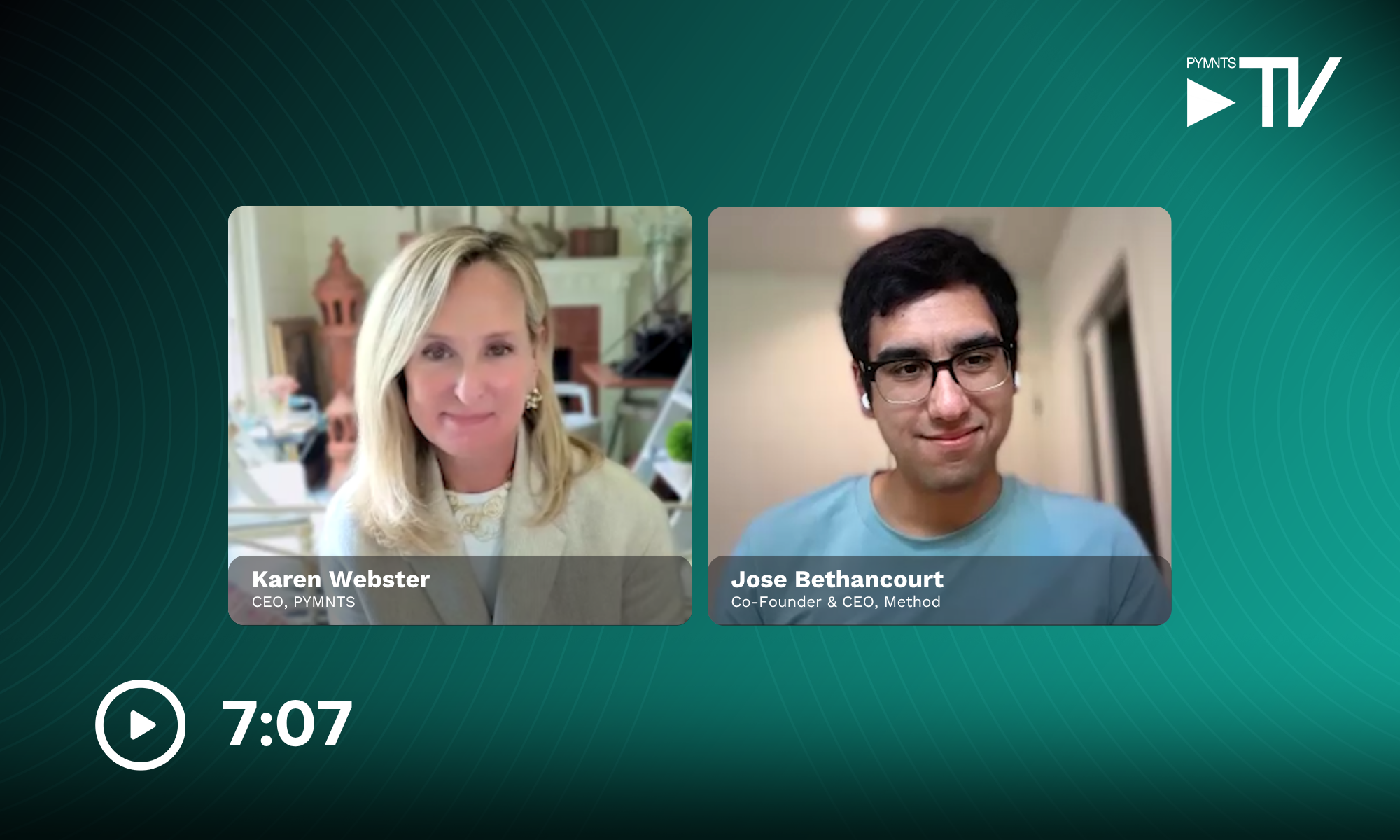
Method Financial CEO Jose Bethancourt says lenders miss borrowers who improve or deteriorate after origination. A pilot with a major mortgage lender showed a 40% boost in debt consolidation eligibility.
A consumer's financial picture starts aging the moment a loan closes. The lender that wrote it often does not see the next change until the borrower misses a payment.
Method Financial CEO Jose Bethancourt called that timing gap the central problem in consumer lending today. In a Monday conversation with PYMNTS CEO Karen Webster, he described a market where institutions compete aggressively to acquire borrowers but stay blind to what happens to them afterward.
"Millions of Americans are in this debt cycle," Bethancourt said.
An app shows a due date. It does not tell a consumer whether refinancing would cut the cost of what they already owe, or whether another part of the household balance sheet has opened a better option. The lender's own underwriting picture, current on closing day, decays immediately.
The result is a missed set of opportunities on both sides. A borrower who pays down debt and improves a credit profile may qualify for cheaper money without ever returning to the institution that turned them down. A customer paying high rates somewhere else sits as a refinancing prospect the existing lender does not know it has.
In the other direction, the same information gap is worse. A borrower who cancels autopay, lets utilization climb or lets payment-to-minimum ratios slide is not yet in default. None of those events alone triggers a missed payment. All of them tend to precede one.
"Everyone's trying to acquire more" customers, Bethancourt said. Institutions are hunting for "positive signals" that identify consumers they can serve, and trying to reach them before a competitor does.
Method's Portfolio Intelligence, announced late last month, is built to address that blind spot. The product tracks more than 90 financial-health signals after origination and notifies lenders when a borrower crosses criteria the institution sets. Consent is captured at origination. Bethancourt said monitoring can continue without asking the borrower to reconnect accounts repeatedly.
Method leaves the definition of a relevant event to the lender. That might be becoming eligible to refinance, or improving enough to justify revisiting a rejection.
An eight-week pilot with a major mortgage provider produced a 40% increase in borrowers qualifying for debt consolidation and a 27% increase in HELOC-eligible borrowers, the company said. Those were customers the lender had already paid to acquire and had already classified as ineligible. Falling utilization, declining balances and improving payment behavior turned them back into prospects.
Webster called the two sides of that proposition "grow and protect." Bethancourt acknowledged that demand today leans toward grow. Lenders are buying a pipeline before they buy an alarm. The same information supports the other case. When a borrower deteriorates, the lender has an opening to offer a payment plan or another response to financial distress.
The timing is the entire point. A lender that learns a borrower is straining while the account is still current has a conversation available to it. A lender that learns it from a missed payment has a collections problem. The distance between those two outcomes is a few weeks of signal.
Acquisition lift is a good quarter. Loss avoidance is what a portfolio manager gets asked about when the cycle turns.
None of it works without the underlying data plumbing, and that plumbing came from a much smaller problem. Bethancourt and co-founder Marco Segura left college with roughly $100,000 each in student loans, he said, and no clear sense of who serviced them, what the rates were or how to manage them. They built an app for themselves and found that displaying the debt was the easy part. Connecting reliably to the information underneath it was not. That connectivity became Method's B2B business.
Method can identify liabilities without asking a consumer to hand over individual account passwords. It works with mobile network operators to confirm that a phone number belongs to the consumer and that the consumer is physically holding the device. The company layers in Touch ID, Face ID and mobile-network signals alongside KYC and CIP procedures.
"We had to figure out a way where we could still keep that high security and high fidelity that we need" in an era of AI and cyberattacks, Bethancourt said.
That architecture also intersects with the unsettled Section 1033 debate on consumer financial data rights. Bethancourt said Method considers access to financial data a consumer right while accepting that the institutions supplying it incur costs, and noted the company already compensates some data providers, including credit bureaus.
Consumers want better terms on debt they already carry. Lenders want performing customers, and a second chance at the ones they lost. Knowing what changed after the loan was made is what tells either side it's time to talk. Knowing it early is what determines whether the conversation is an offer or a workout.
Drafted by a large language model from the source reporting linked above, then screened by automated publishing checks. It is not read by a journalist before publication. Some articles cite our Alpha Score. Verify prices and figures against the original source. Educational coverage, not personalized advice.