Commodities● Neutral
KU Stadium's Wheat Columns Solve a Crane-Access Nightmare
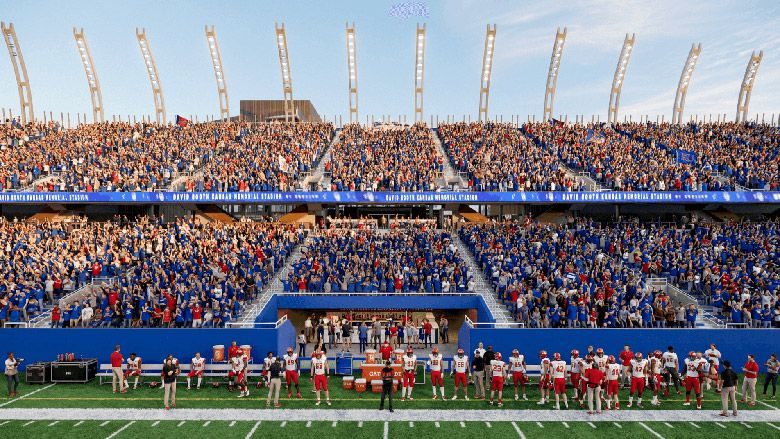
Clark-JE Dunn accelerated 19 wheat columns months early after old light towers blocked crane access inside the rebuilt bowl. The $450M Gateway District project stays on track for KU's Sept. 4 night game.
Continue with
The 19 wheat-inspired light columns now standing above the University of Kansas' David Booth Kansas Memorial Stadium started as an architectural tribute. They ended up solving a logistics problem that could have delayed the $450-million Gateway District redevelopment by a full season.
Clark-JE Dunn, the joint venture running Phase 2 of the project, topped out more than 1,200 tons of structural steel on the east side of the new stadium bowl in early July. That milestone also marked the installation of the permanent lighting system. The columns, rising as high as 135 ft above the field, encircle the horseshoe-shaped stadium on the north, east and west sides. Each supports six to 12 light fixtures.
The original plan kept two existing east-side light towers in service during construction. They were supposed to come down after the 2026 season. As the permanent steel design advanced, the team realized the towers would sit in the same footprint as the new structure. Removing them later would require crane access inside the rebuilt bowl, which would be nearly impossible.
Rather than delay construction or risk disrupting night games, the joint venture accelerated fabrication and installation of the 19 permanent wheat columns months ahead of schedule. The team removed the old towers, reused existing light fixtures on the new columns, relocated electrical equipment and temporarily energized the permanent lighting system in time for the 2026 season.
Lighting arrays were assembled and aimed at ground level. Crews used two cranes in a coordinated lift to hoist the fully assembled structures into place above the field.
"As we advanced the east bowl, it became clear the original light towers and the new structure wanted to occupy the same space," said Chris Desko, project executive for the Clark-JE Dunn joint venture. "By pulling the permanent lighting and its supporting steel forward in the sequence, we solved a major access challenge before it existed and kept KU's 2026 season under the lights."
The compressed schedule left little room for error. David Young, project director for the joint venture, said the team had less than eight months from demolition to lighting.