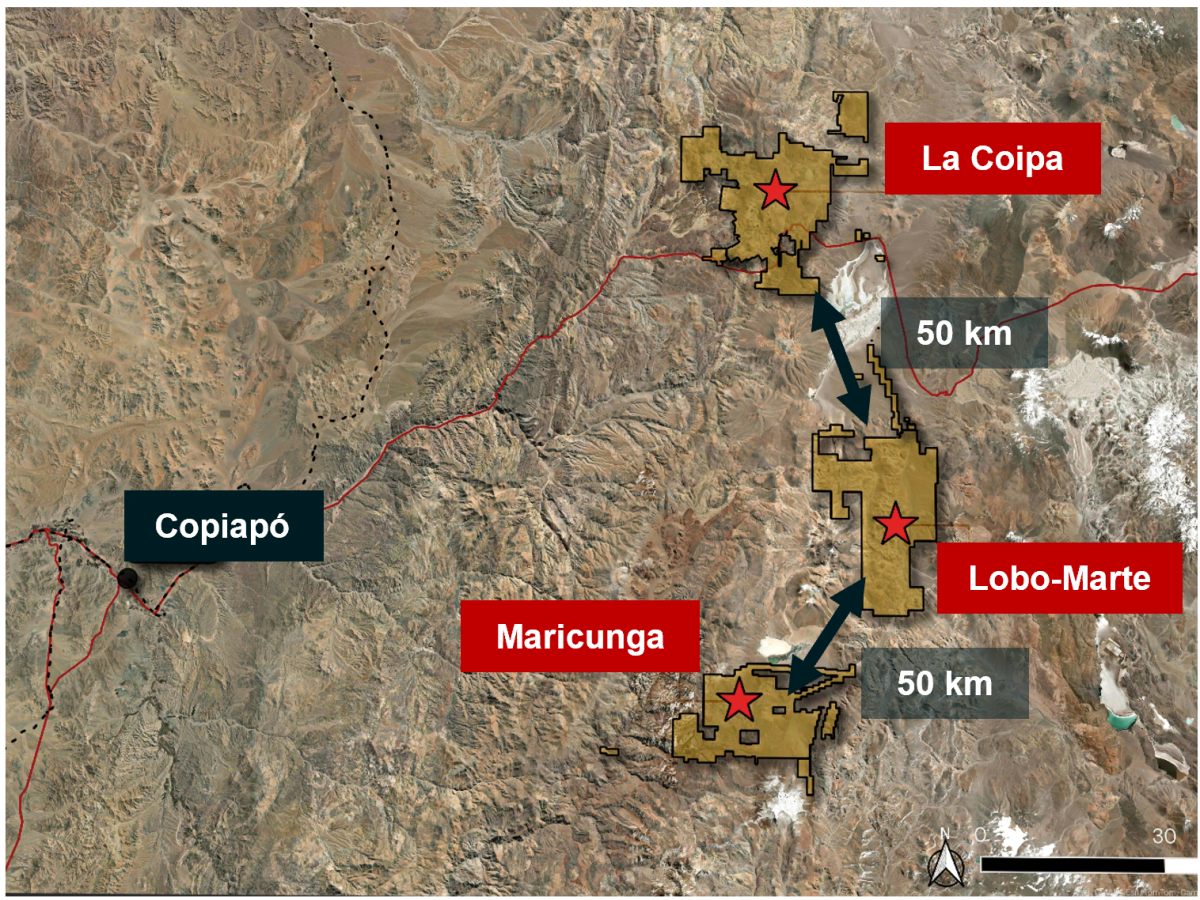
Kinross Gold Corp. released an updated feasibility study for its Lobo-Marte project in Chile, laying out expected annual production of about 350,000 ounces of gold at an all-in sustaining cost of roughly $1,000 per ounce. The project carries an estimated net present value of $4.3 billion, based on the 2021 feasibility study adjusted for inflation and an enhanced execution plan.
CEO J. Paul Rollinson called Lobo-Marte “an exciting, high-quality development opportunity” that would extend Kinross’s presence in Chile well into the 2040s. The initial mine plan calls for 4.6 million ounces over 15 years, with a larger resource base that could support further expansion. Rollinson said the project’s combination of scale and low operating and capital costs “generates attractive returns and underscores its potential to become a cornerstone asset.”
The project sits in the Maricunga belt and includes two open pits, Lobo and Marte, mined sequentially. Kinross plans a conventional truck-and-shovel fleet operating at a peak mining rate of 50 million tonnes per year. The strip ratio is 2.0:1, which helps keep mining costs low at an average $3.25 per tonne. Ore will be processed through a heap leach facility with a 35,000-tonne-per-day crushing circuit, an ADR plant for gold recovery, and a SART plant to recover copper. Kinross has experience with heap leach and SART technology from its operations in Chile and the United States. The expected heap leach recovery rate is 69%, and processing costs are forecast at $12.30 per tonne. Covered overland conveyors will move ore from the primary crushers to the secondary and tertiary crushing circuit, reducing the environmental footprint.
Key infrastructure includes a 75-kilometre access road, a 60-kilometre power line, and a 40-kilometre pipeline to connect the project to Kinross’s existing well field that supplies water to the La Coipa operation. Initial capital costs are estimated at $1.8 billion, covering mining equipment, the heap leach and processing facilities, camp construction, power lines, and other supporting infrastructure. Kinross said it plans to fund the project from operating cash flows, consistent with its disciplined capital allocation approach. The company will provide a full capital cost update once detailed engineering is substantially complete.
Permitting is the critical path. The project’s environmental impact assessment was accepted for review by Chile’s environmental regulator, SEA, in the second quarter of 2026 and is now moving through the regulatory process. Kinross said it incorporated environmental and community considerations directly into the project design, including measures to protect water resources and local wildlife, reduce dust, and centralize infrastructure to limit the footprint. Detailed engineering and procurement are underway, with first production targeted for the early 2030s.
The current mine plan covers only a portion of the broader mineralization. Proven and probable reserves stand at about 6.7 million ounces, supporting the 15-year mine life. The company said the pits were designed in a lower gold price environment and do not capture the full extent of the mineralized system. Mineralization remains open in several areas, and some resources lie outside the current reserve pit shells. Kinross believes there is potential for future pit expansions and reserve growth as higher gold prices, ongoing technical work, and future drilling are incorporated into planning. Once the project is in production, exploration will focus on resource conversion, extensions of the Lobo and Marte deposits, satellite targets, and other mineralized areas that could leverage the planned infrastructure.
Kinross said it recently welcomed Chile’s President, José Antonio Kast, to its Copiapó office to discuss the company’s long-term commitment and its development pipeline in the Atacama Region. The company emphasized its relationships with Indigenous communities, particularly the Colla communities around Lobo-Marte. The project is expected to support about 2,800 construction jobs at peak and around 1,000 operational jobs, plus indirect roles. Since 2010, Kinross has generated $4.9 billion in socioeconomic benefits in Chile. Ninety-nine percent of its procurement is done in the country, almost half in the Atacama Region. Social programs in education, culture, sports, health, and the environment reach roughly 60,000 people each year.
First production from Lobo-Marte is expected in the early 2030s.