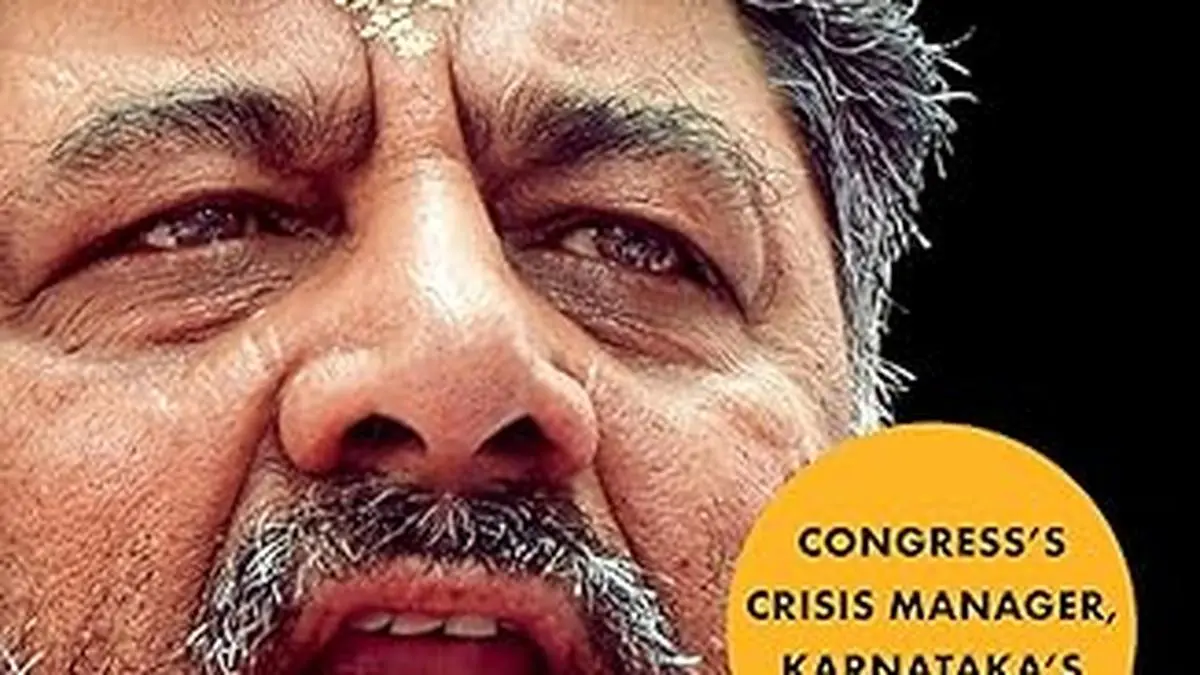
Rasheed Kidwai's new book on DK Shivakumar arrives at a moment the Congress party's internal maneuvering has finally settled. After nearly three years of speculation, the high command persuaded Siddaramaiah to step down and elevated Shivakumar as Karnataka's Chief Minister in June. The book traces his journey from student politics to the state's highest office. For long-time observers of Karnataka politics, much of the material feels familiar. The Ahmed Patel Rajya Sabha election of 2017 and the Eagleton Resort episode get more space than they probably warrant.
Kidwai argues that Shivakumar has emerged as the tallest Vokkaliga leader after former Prime Minister HD Deve Gowda. That conclusion looks premature. Deve Gowda is 93 and in the twilight of his career. His son HD Kumaraswamy remains an active and influential force. Kumaraswamy has already served twice as Chief Minister and has an equally strong claim to leadership within the community.
The book is inconsistent on demographic estimates. It cites Lingayats as constituting 21 percent of Karnataka's population at one point. Elsewhere it places the figure between 11 and 17 percent. Vokkaligas are variously estimated at between 10 and 15 percent. Some uncertainty is understandable because successive governments have refused to release the state's caste survey. The reluctance is widely attributed to concerns that the actual demographic weight of the dominant communities may differ significantly from long-held assumptions.
Kidwai may overstate the centrality of Siddaramaiah and his co-option of the AHINDA coalition in explaining Congress's success. Karnataka has historically been one of the Congress's strongest states. Even when the BJP formed governments, the Congress often secured a higher share of the popular vote. In 2008 the Congress polled marginally more votes than the BJP. The BJP formed its first government anyway. The pattern repeated in 2018, when the Congress again secured a higher vote share but emerged with fewer seats because of the first-past-the-post electoral system.
Equally debatable is the suggestion that Congress has sought to shift Karnataka's politics from caste-based mobilisation to issue-based politics. The state's electoral politics continues to be deeply shaped by identity. The BJP has attempted to consolidate voters around religious identity. The Congress has focused on caste coalitions while relying heavily on support from minority communities.
One charming anecdote recounts Shivakumar's sister Manjula showing her palm to a fortune-teller. She told her brother about it. He retorted, "Why show your palm to know your future? You should shape your own future." The sentiment sits uneasily with Shivakumar's own well-known belief in astrology and fortune-telling. Exploring that contradiction would have enriched the narrative.
The book also creates an impression that Shivakumar emerged from an impoverished rural background. That portrayal is only partly accurate. Shivakumar has acknowledged on several occasions that his family was relatively well-off. His education at National Public School and Vidyavardhaka Sangha, among Bengaluru's better-known schools at the time, suggests a family with considerable means.
Similarly, the book portrays Shivakumar as an unwavering loyalist of the Gandhi family throughout his political career. The reality is somewhat more nuanced. In 1994, after being denied a Congress ticket, he contested as an Independent and won. He eventually returned to the party fold.
One notable omission is the controversy surrounding the proposed 114-foot statue of Jesus Christ at Kapalabetta in Kanakapura. On Christmas Day 2019, Shivakumar participated in the foundation-laying ceremony and contributed over ₹10 lakh to the project. The BJP alleged that the site was a hill sacred to Lord Shiva and that government land had been illegally earmarked for the monument. The project became embroiled in legal disputes and faded from public attention. Given its political significance, the episode deserved at least a detailed discussion.
There are factual inaccuracies. On page 51, Veerappa Moily is described as a Vokkaliga leader. He belongs to the Devadiga community.
While the book briefly touches upon Shivakumar's business interests in education and real estate, it stops well short of examining the remarkable expansion of his wealth. His declared assets increased from ₹251.51 crore in his 2013 Assembly election affidavit to ₹1,413.8 crore in 2023. That makes him one of India's wealthiest elected politicians. A dedicated chapter examining this aspect of his public life would have substantially strengthened the book.
Where Kidwai is at his best is in narrating developments within the Congress at the national level. His account of the Indira Gandhi era and the political maneuvering within the party's central leadership is engaging, authoritative and highly readable.
The book is a timely read. It provides useful insights into Shivakumar's political evolution. It falls short of offering the definitive biography that such an important political figure deserves. That may be inevitable. Shivakumar's tenure as Chief Minister has only just begun. The most consequential chapters of his political life may still lie ahead.