KFC 4.9% and Burger King 6.3% Break a Multi-Quarter Slump
The March quarter earnings calls from India's three major quick-service restaurant operators delivered a clear break from the softness that defined most of FY26. Devyani International, the KFC franchisee for India, reported same-store sales growth of 4.9% – the strongest in 14 quarters. Restaurant Brands Asia, which runs Burger King India, posted 6.3% SSSG, its best in 12 quarters. Westlife Foodworld, the McDonald's operator for West and South India, managed 1.5% SSSG with overall revenue up 9% year-on-year.
Management across all three cited two common drivers: GST rationalisation on certain menu items and a sharper focus on value pricing for dine-in channels. The numbers suggest the India QSR space may be emerging from a demand trough. The divergence. The question is whether this is a structural turn or a one-off base-effect catch-up.
KFC's Dine-In Focus Drives the Rebound
Manish Dawar, President & CEO of Devyani International, attributed the performance to tailored offers and price points aimed at attracting dine-in traffic. On the earnings call he said, “KFC (India) delivered a positive SSSG of 4.9 percent for the March quarter, the strongest performance in the last 14 quarters, reaffirming both the resilience of the brand and the long-term opportunity in the market. This momentum translated into nearly 15 percent year-on-year growth for KFC, with Q4 revenues of ₹586 crore.”
KFC's revenue growth outpaced SSSG by a wide margin. New store openings contributed heavily. The company plans to add 100-110 net new KFC outlets in FY27, a pace that implies continued capital deployment into tier-2 and tier-3 cities. Dawar's explicit mention of dine-in tailoring signals a structural change. Delivery aggregators' take rates compress margins. Any shift back to higher-margin dine-in consumption improves unit economics. If the 4.9% SSSG was driven disproportionately by dine-in, the quality of earnings is higher than a delivery-led number of the same size.
Burger King's Supply Chain and Menu Innovation
Rajeev Varman, Whole-time Director and Group CEO of Restaurant Brands Asia, said Burger King India's 6.3% SSSG was “the highest growth over the last 12 quarters.” He cited three pillars: supply chain strategy, menu innovation, and digital initiatives.
Burger King added 68 new stores in India in FY26 and targets 60–80 new restaurants annually going forward. The 6.3% SSSG is particularly notable because it came during a quarter when many competitors discounted heavily. Varman's emphasis on energy efficiency suggests management is also focusing on store-level margin protection, not just top-line growth. The combination of menu innovation and supply chain discipline reduced reliance on deep discounting.
McDonald's: 1.5% SSSG but Footfall Shows Life
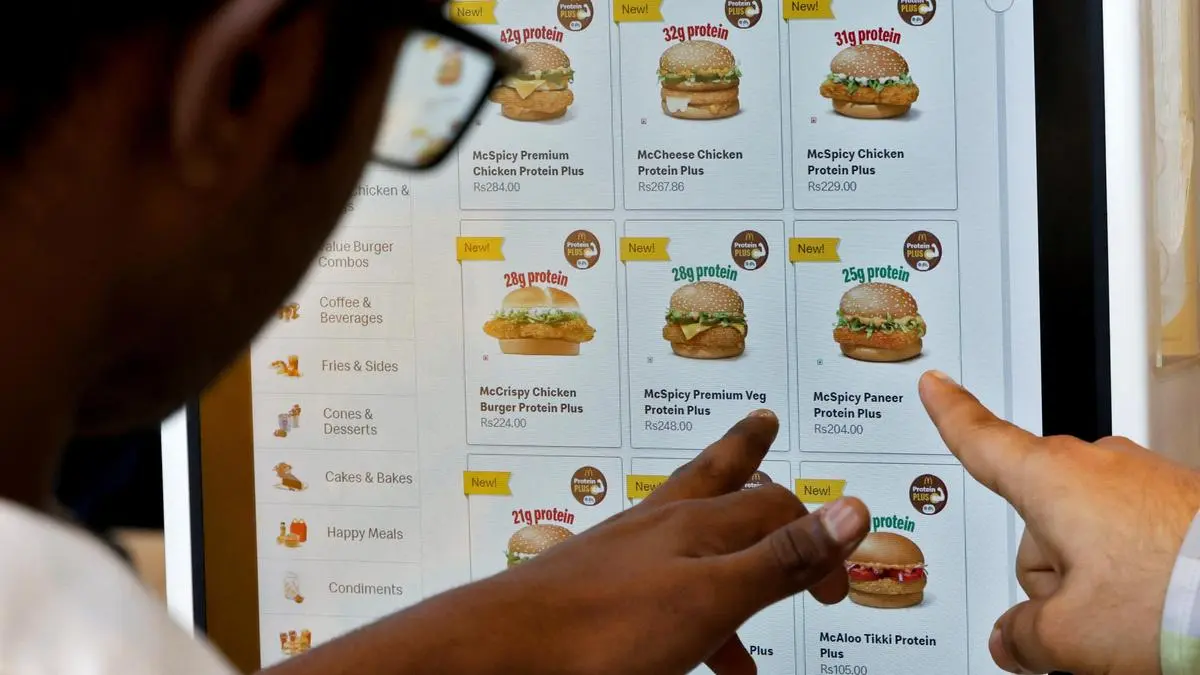
Westlife Foodworld's 1.5% SSSG looks pedestrian next to KFC and Burger King. CEO Akshay Jatia highlighted an underlying improvement: “What is particularly reassuring is the underlying improvement in footfall trend with positive growth all three months of the quarter. Similar momentum is continuing into April as well, setting the base for a good start to the new fiscal year.”
Revenue growth of 9% versus 1.5% SSSG implies new stores drove most of the increase. Westlife plans to open 60-plus restaurants annually, all equipped with digital design and McCafé concepts. Jatia's comment that April is continuing the trend gives some forward visibility. The 1.5% SSSG remains the laggard among the three. Investors need to watch whether McDonald's can convert footfall improvement into comp growth above 2% in coming quarters.
Comparison of March Quarter Performance
| Brand (Operator) | Q4 SSSG | Revenue Growth YoY | New Store Target FY27 |
|---|
| --------------------- | | | |
| KFC (Devyani International) | 4.9% | ~15% | 100–110 |
| Burger King (Restaurant Brands Asia) | 6.3% | Not disclosed | 60–80 per year |
| McDonald's (Westlife Foodworld) | 1.5% | 9% | 60+ per year |
Key insight: The GST base effect boost will fade by H2 FY27. Sustained SSSG above 3% for KFC and above 5% for Burger King would confirm structural demand. McDonald's needs SSSG above 2.5% to narrow the gap.
GST Rationalisation: Arithmetic or Real Demand?
All three operators referenced GST rationalisation as a tailwind. The Indian government reduced GST on certain food items from 18% to 5% for items priced below a threshold. This likely improved average ticket sizes for value menus. The SSSG numbers may partly reflect this arithmetic rather than pure volume growth. Investors need to watch whether SSSG sustains in June and September quarters once the base effect normalises. If comps slip back to near zero, the rally in these stocks will lose its anchor.
The mechanism works both ways. A one-time price reset lifts comps for two quarters. After that, operators must prove they can grow traffic without a tax cut. KFC and Burger King have the strongest chance given their focus on dine-in and menu innovation. McDonald's faces a harder path because its India menu is more skewed toward value items that already benefited from lower GST.
Store Expansion Plans Signal Confidence for FY27
Despite the uncertain sustainability of SSSG, all three operators are doubling down on store growth capital. Devyani International plans 100-110 net new KFC outlets in FY27. Restaurant Brands Asia targets 60-80 new stores per year and added 68 in FY26. Westlife Foodworld plans 60-plus restaurants annually, each with digital design and McCafé.
This pace suggests management sees structural demand growth in India's under-penetrated QSR market. India has roughly 4,000 organised QSR outlets for KFC, Burger King, and McDonald's combined. Compare that to China's 10,000+ per brand. Store expansion alone can support revenue growth of 10-15% annually even without SSSG. The risk is that overexpansion in tier-2 cities dilutes same-store metrics if unit-level volumes disappoint.
Valuation Context: QSR Alpha Score 47 vs MCD 37
AlphaScala's proprietary scoring system provides a risk-adjusted lens for the two global parent companies exposed to this India story:
- QSR (Restaurant Brands International Inc.) – Alpha Score 47/100, labelled Mixed, sector Consumer Discretionary, stock page /stocks/qsr
- MCD (McDonald's Corporation) – Alpha Score 37/100, labelled Mixed, sector Consumer Discretionary, stock page /stocks/mcd
The 47 score for QSR reflects the parent of Burger King and KFC (through franchise operations). The 37 for MCD suggests higher global headwinds. India represents a small portion of each company's global revenue. The sequential improvement in same-store sales may provide an upside surprise for QSR's consolidated India segment. MCD's India franchisee showed slower momentum. The Alpha Scores imply that QSR has a better risk-reward setup for investors betting on India QSR recovery. Both remain in the Mixed zone.
For broader sector context, see the /markets/stocks page.
Watchlist: What Confirms or Weakens the Setup
What would confirm the thesis:
- KFC India SSSG remains above 3% in Q1 FY27.
- Burger King India maintains >5% SSSG while adding stores at the 60-80 pace.
- Westlife Foodworld reports a sequential acceleration in SSSG above 2.5%.
- Industry footfall data shows sustained growth in dine-in for QSR.
What would weaken the thesis:
- A sharp reversal in SSSG as GST rationalisation base effects fade in H2.
- Rising input costs for chicken, potatoes, or edible oils that force menu price increases.
- Delivery aggregator discount wars that pull traffic back from dine-in.
- Westlife McDonald's SSSG drifting below 1% for another quarter.
The March quarter data resets the India QSR narrative after several quarters of tepid demand. The combination of GST rationalisation, value pricing, and store expansion creates a plausible path for sustained growth. The 1.5% SSSG at McDonald's and the reliance on new-store math rather than organic comp growth at Westlife keep the risk balanced. For watchlist builders, the next quarter's same-store sales and store opening pace will determine whether this is a structural turn or a one-off catch-up. The Alpha Score data provides a framework for relative positioning: QSR's 47 vs MCD's 37 suggests that investors with a bullish view on India QSR have a better risk-adjusted option in Restaurant Brands International than in McDonald's, given the latter's slower India franchise momentum.