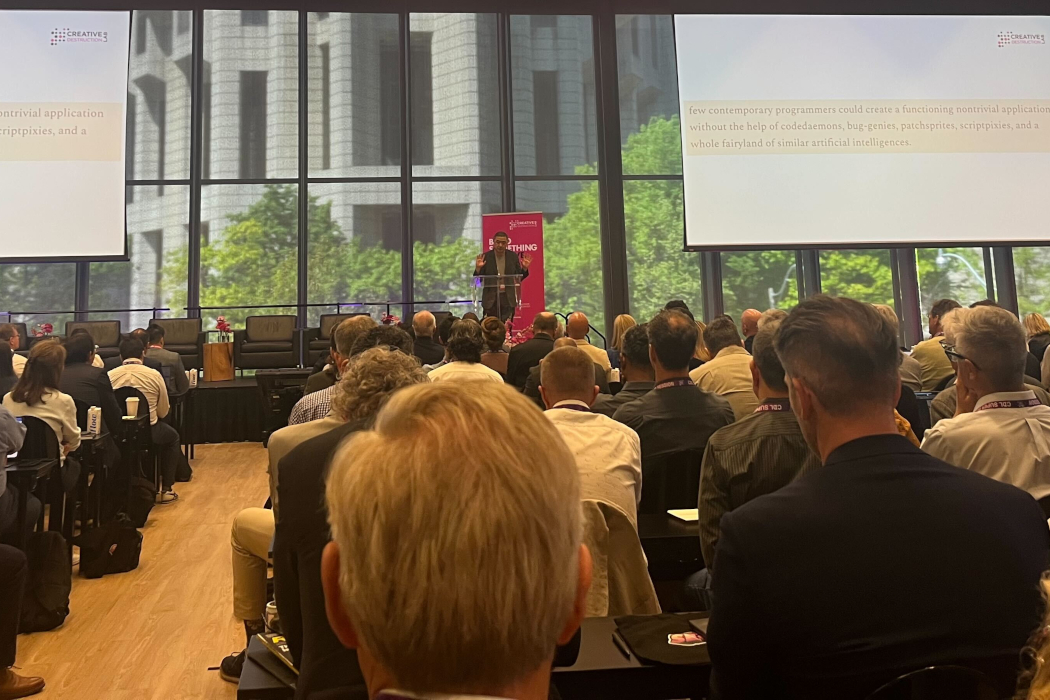
Award-winning speculative fiction author Ken Liu dismissed the threat of low-quality AI-generated content during a talk at Creative Destruction Lab's Super Session at Toronto Tech Week. Liu, who holds both Hugo and Nebula awards, argued that humans already "live in a world of slop." His framework offers a practical lens for separating AI content generation companies into two distinct investment categories.
Liu's Distinction Between Coding and Storytelling
Liu said he uses AI for coding but finds the idea of asking AI to write stories "revolting." The reasoning maps directly onto the market. In software engineering, Liu said, "the coding is not the point, the application is." Execution is separable from the idea. In art, however, "the idea and the execution are synonymous."
This line creates a natural split. Microsoft (MSFT) sells GitHub Copilot and Google (GOOGL) offers Codey – both tools where the AI automates execution toward a human-defined goal. Adobe (ADBE) generative fill in Photoshop also fits: it automates a step, not the creative vision. These companies sell productivity augmentation.
On the other side sit platforms that automate the idea itself. OpenAI ChatGPT, Anthropic Claude, and Google Gemini all offer story generation. Jasper and Writer sell finished marketing copy or articles. Liu's view implies that the market for such output will stay small because the output lacks what humans find meaningful.
Why Photography History Supports the Framework
Liu compared the AI slop explosion to the introduction of photography. Photography enabled mass production of images with minimal human input. Yet human appreciation for art did not collapse. "We have already survived a massive, massive change in our visual environment, and we have not lost appreciation for art, so I don't think AI slop will transform that in any fundamental way."
The read-through is that the demand for human-created premium content will persist. Investors may be overestimating the disruption to publishers, platforms, and creators who can certify human authorship.
Which AI Content Companies Face Commoditization Risk
The naive view holds that AI slop destroys the value of all written content. The better market read, following Liu's logic, is that the flood of low-quality AI output increases the premium on verified human creation and curation.
Execution-tool providers retain pricing power. Their product is a means to an end the user controls. Microsoft, Google, and Adobe all fall into this camp. Their revenue depends on enterprise productivity, not on selling finished content.
Pure AI text generation companies face a structural limit. If the market eventually prices these as utilities with low margins, the path to monetization narrows. Consumer backlash, which Liu attributes to machines doing work that gave humans meaning, may further suppress willingness to pay.
Three Confirming Signals for Investors
- Valuation divergence between AI tool companies (e.g., Microsoft, Adobe) and pure content generation platforms (e.g., Jasper, Writer). If the latter trade at steep discounts, the market is already pricing commoditization.
- Enterprise adoption of human-reviewed AI workflows versus fully autonomous content production. If companies pay a premium for a human in the loop, that aligns with Liu's distinction.
- Consumer engagement data showing that time spent with AI-generated fiction or articles remains low relative to human-authored work. Liu explicitly said "the jury's still out on how many of us are interested in actually engaging with it."
Premium on Human-Authored Content: Confirmed Peers
The sector readthrough points to companies that certify human source or curation. Apple (AAPL) Books could lean into human-curated recommendations. Substack and similar newsletter platforms that emphasize writer identity may benefit. Spotify audiobooks may see a human-narrated premium.
These companies are not directly exposed to the commoditization risk Liu describes. Their value proposition relies on the authenticity of the creator, not on the volume of produced content.
Risk to the Thesis
Counterevidence would include a sustained increase in time spent on AI-generated content or a willingness to pay for it. If OpenAI launches a successful paid fiction service, that challenges Liu's assumption. Another risk is that AI slop makes it so hard to find human content that the premium for human creation becomes theoretical.
What this means: The AI content generation sector should be analyzed as two separate markets. The execution-tools segment – coding, design assets, productivity – has a clearer path to monetization. The idea-generation segment – stories, articles, creative writing – faces a structural demand ceiling regardless of how good the technology gets. Investors should look for companies that can certify the human source and charge accordingly.
For a broader stock market analysis perspective, the AI content debate fits into a pattern of overhyped disruption. The recent AI Search Visibility Tool Launches at $59 illustrates how the market already prices tool-level value, not narrative-level value.