Stocks● Neutral
Kashmir's lost fur trade gets a second life—from sheep, not wild animals
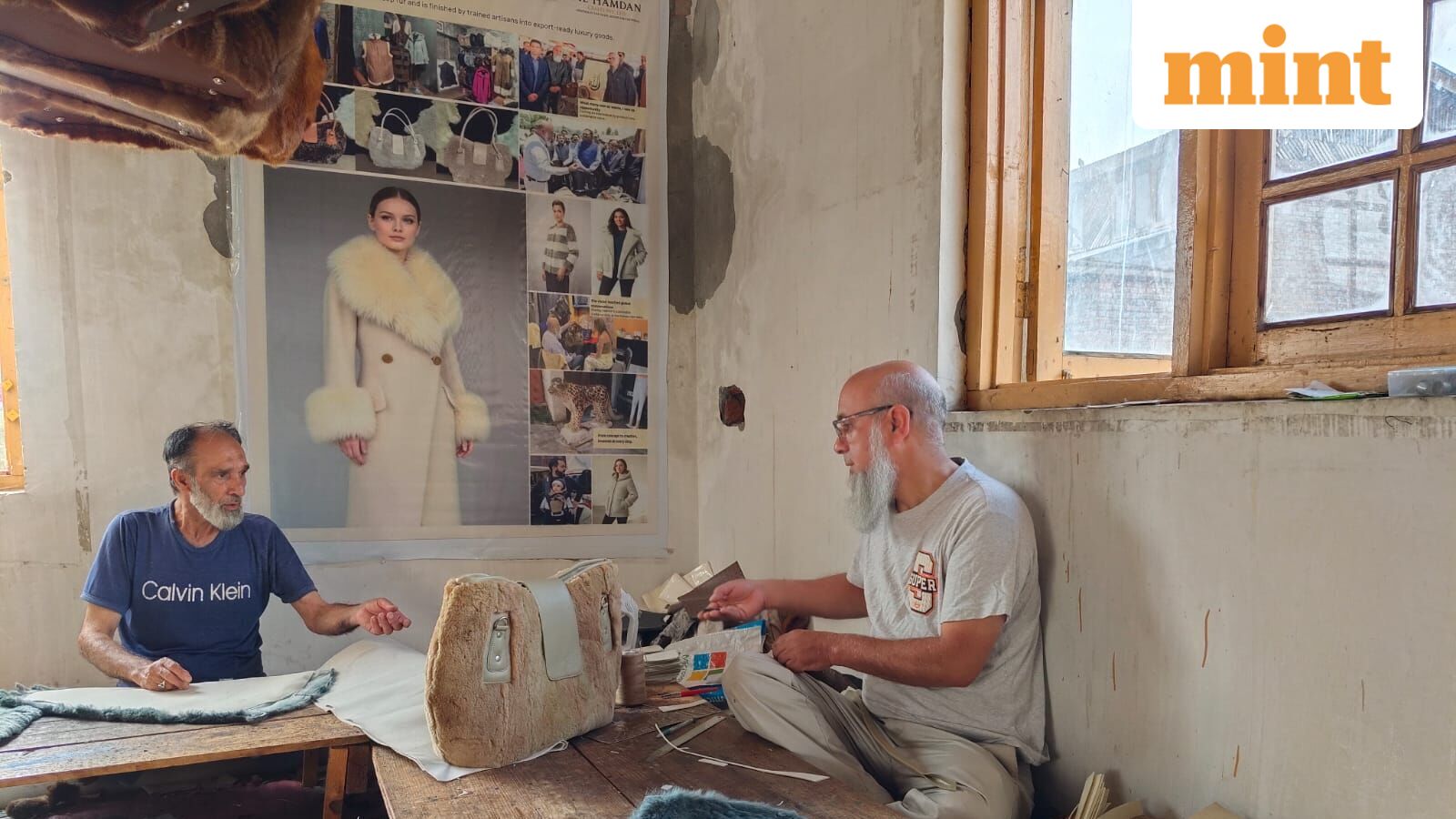
Tahir Ahmad Kalwal's workshop turns sheep pelts into fur-like jackets and coats. SKUAST Kashmir is backing the effort, but the missing cluster leaves trained artisans with no steady work.
Continue with
Srinagar: Tahir Ahmad Kalwal runs his fingers over freshly processed sheep pelts spread across wooden tables in a small workshop on Srinagar's 90 Feet Road. Around him, men and women sort, cut and stitch the material into jackets, coats, caps, bags, orthopaedic items and home decor pieces.
Kalwal, 58, estimates that only around 45 artisans in Kashmir remain active in fur work today. His own workshop and network involve ten workers, many of them women. “These artisans have golden hands but they are getting spoiled due to less government support in Kashmir,” he told Mint.
He returned to the Valley during the first wave of the covid-19 pandemic in 2020 and began collecting discarded hides, experimenting with local production. What has changed since is the emergence of institutional backing around what had, until recently, been one man's effort.
Kalwal, who studied up to the 12th grade, was sent to Delhi during the early years of militancy in Kashmir in 1989. A family friend introduced him to fur work, even though no one in his family had been associated with the trade. “Once I returned I started a workshop in Srinagar,” he said.
His efforts eventually caught the attention of the Sher-e-Kashmir University of Agricultural Sciences and Technology (SKUAST) Kashmir. Kalwal presented his work to the university around 2022 and became a master trainer, with structured training taking shape from 2023 onwards.
Under its holistic Agriculture Development Program (HADP), the university has been working on wool and pelt processing through Project 27, the Promotion of Wool and Pelt for Effective Processing and Marketing. About nine men and women have received specific training through the effort. In October last year the university also ran a six-month skill-development program covering products such as jackets, rugs and home decor.
Dr Asif Hassan, who heads the division of livestock products technology at SKUAST-Kashmir, told Mint that the university is trying to move the effort beyond individual craftsmanship into research, training and product development. “Kalwal is an artisan. He gets processed pelts as raw material and then creates different articles by hand. We are working around R&D to upgrade the craft further,” Hassan said.
The university has supplied sewing machines to Kalwal under a memorandum of understanding. He has since taken his products to exhibitions and received a ₹5 lakh seed grant from the J&K Entrepreneurship Development Institute (JKEDI), under its ₹20 lakh entrepreneurship support program. Even so, the effort remains closer to proof of concept than a functioning commercial industry.
The raw material driving the revival is also different from what powered the old industry. Kalwal works mainly with sheep and goat pelts, with Kashmir Merino emerging as an important option–a dual-purpose breed developed by crossing exotic lines.
Dr Rafiq Ahmad Shah, a former director of the sheep husbandry department in Kashmir, said Kalwal has developed techniques to give sheep pelts the appearance of wild-animal fur. Finished products resemble more conventional luxury fur while using domestic sheep skin as the raw material. “He is working like killing one bird with one stone,” Shah told Mint, referring to the opportunity to add value to an otherwise low-value sheep pelt while creating an alternative to wild-animal fur.
The approach gives Kashmir a chance to build a product around a local livestock resource instead of depending on imported pelts. Kashmiri Merino offers something imported material cannot: a local raw material that can become a distinctly Kashmiri product. Kalwal compared its fine quality to 22-karat gold and believes it deserves its own distinct brand identity.
Kashmir has the raw material and the artisans. It lacks much of the middle of the value chain–the stage where a discarded hide turns into something a furrier can work with. Raw pelts have to be preserved, salted, semi-processed and tanned before they become usable material. At the Industrial Growth Centre in Lassipora, Pulwama, some hides undergo semi-processing for fur. Many are converted into wet-blue leather, covering only one part of the chain. “Hair and tan units are getting replaced with cold store units. It is astonishing that on one side the government is trying to revive this industry and on the other, full processing units do not come,” Kalwal said.
For now, Kashmir remains dependent on only a few base processing centres. There is no complete processing unit in the Valley. Once a pelt leaves the hair and tanning stage, it goes directly to artisans for fur work, skipping everything a more developed industry would normally do in between.
Hassan said building a complete processing facility is essential if the industry is to move beyond individual artisans. “Instead of simply sending the pelts to different places for manual tanning, our motive is to develop the processing and product-making ecosystem here so that the fur industry can thrive,” he explained.