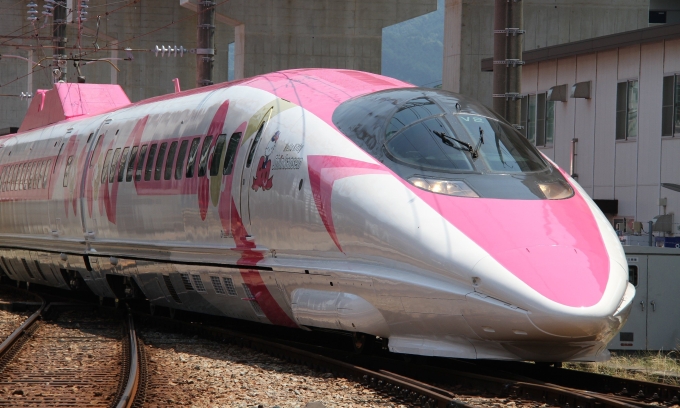
Final Departure: Hello Kitty Shinkansen Ends Eight-Year Run
Fans holding cameras and Hello Kitty merchandise packed the platform at a western Japan station to witness the last departure. The crowd waved and called out “thank you” as the train pulled away. About 1 million passengers rode the pink train since its June 2018 debut, according to Kyodo News. The final Hello Kitty service departed Shin-Osaka at 11:37 a.m. on schedule, bound for Hakata one last time per J-CAST News.
JR West Fleet Replacement Drove the Retirement
500-Series Shinkansen: Engineering Icon Reaches End of Life
The retirement is less about Hello Kitty than the train beneath the wrapping. JR West is phasing out the entire 500-series Shinkansen fleet. Introduced in 1997, the 500-series was the first Shinkansen to run at 300 kph in regular passenger service. Its long, tapered nose and near-cylindrical body were engineered to cut noise and air resistance at high speed. Only nine sets were ever built. The design became a favorite among rail enthusiasts.
As N700-series trains took over premium routes, JR West pulled the 500-series from Nozomi service in 2010 and reassigned it to slower all-stations Kodama runs on the Sanyo Shinkansen line. The Hello Kitty train ran once a day as a Kodama service linking Shin-Osaka with Hakata. It stopped at major western Japan cities including Kobe, Himeji, Okayama and Hiroshima.
N700 Replacement Offers Efficiency Gains
The N700-series trains offer higher passenger capacity, better energy efficiency, and compatibility with modern signaling systems. JR West plans to retire all remaining 500-series sets by 2027. The operator will replace them with shortened eight-car N700-series trains. This standardization reduces maintenance costs and frees up track slots for more frequent services.
Key differences between the two series:
- Top speed: 300 kph (500) vs. 330 kph (N700)
- Original configuration: 16 cars (500) vs. 16 cars (N700, now 8 for replacement)
- Units built: 9 (500) vs. over 100 (N700)
- First introduced: 1997 (500) vs. 2007 (N700)
The Hello Kitty service used a 500-series set. Its retirement is a direct consequence of the fleet renewal plan.
Themed Trains as Marketing Assets
Hello Kitty's Two Dedicated Cars and Tourism Role
JR West launched the Hello Kitty train in collaboration with Sanrio in 2018. Two of its eight cars carried dedicated themes: an exhibition car and gift shop showcasing regional products, and a passenger car decorated from seats to ceiling with the character. The standard station-arrival chime was replaced with a Hello Kitty melody. The train was part of a broader effort to draw tourists to western Japan.
Themed Shinkansen have become a recurring marketing tool for Japan's regional rail operators. JR Kyushu launched a Shinkansen decorated with Nintendo's Super Mario characters in late 2025.
Sanrio's Licensing Model Stands Apart
Hello Kitty, created by Sanrio in 1974, remains one of the world's most commercially valuable characters. Its presence spans theme parks, fashion, and licensing deals across dozens of countries. The retirement of one themed train does not materially affect Sanrio's revenue or brand equity.
Practical rule: Themed trains are temporary marketing assets. When the underlying hardware reaches end-of-life, the character branding retires with it.
500-Series Double Life: From Evangelion to Hello Kitty
The same train set had an earlier life as a pop-culture icon. From 2015 it ran in a livery themed around the anime “Evangelion”, marking the Sanyo Shinkansen's 40th anniversary. That makeover lasted three years before the Hello Kitty design in 2018. The dual life of this single train set shows how JR West used character branding to refresh older equipment.
| Feature | 500-Series | N700-Series (Replacement) |
|---|
| Top Speed | 300 kph | 330 kph |
| Cars per Set | 16 (original) | 8 |
| Units Built | 9 | Over 100 |
| First Introduced | 1997 | 2007 |
| Planned Retirement | By 2027 | Active service |
What Comes Next for JR West's Themed Train Program
JR West has not announced whether another themed train will succeed the Hello Kitty service on the Sanyo Shinkansen line. The operator may apply a new character livery to the incoming N700-series trains. No such plans are public. The 500-series set itself is likely to be scrapped or preserved, depending on JR West's policy.
For investors analyzing Japanese rail operators, the fleet replacement cycle is a known factor in stock market analysis. JR West's capital spending on new trains will continue through 2027. Sanrio's licensing revenue stream remains unaffected by the loss of one physical vehicle. The crowd on the platform in western Japan waved and called out gratitude. That sentiment will not show up in any earnings report. The underlying logic of the retirement – hardware age, efficiency gains, operational standardization – is the kind of factor that does.