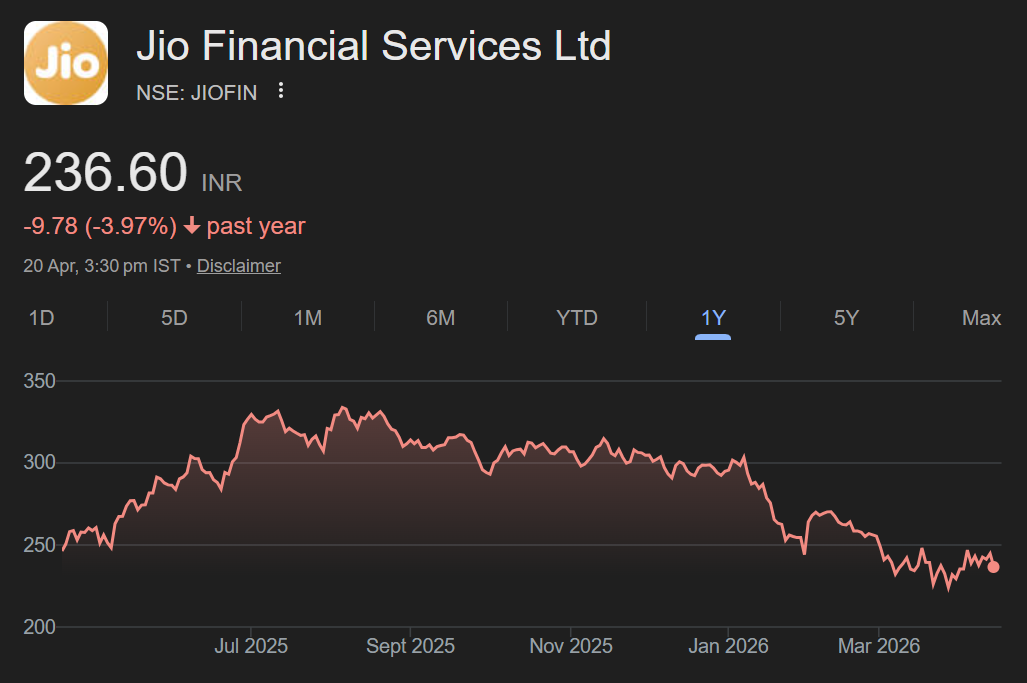
Jio Financial Services has entered a new phase of its operational narrative as the company accelerates its credit-led growth strategy. The shift centers on the company's ability to leverage its digital ecosystem to scale lending products, moving beyond its initial role as an investment holding entity. By focusing on a valuation metric tied to the 2027 fiscal year, the market is beginning to price in the long-term potential of its core financial services expansion rather than just its existing balance sheet assets.
Credit Scaling and Operational Expansion
The core of the current narrative is the transition toward a credit-heavy business model. Jio Financial Services is actively ramping up its newer business lines, which are designed to integrate directly into its existing user base. This strategy relies on the company's unique position to capture data and deploy financial products at scale. The recent performance indicates that the firm is successfully moving through the initial stages of this ramp-up, though results remain mixed as the company balances aggressive growth with the inherent risks of a new credit portfolio.
For investors, the focus is on how quickly these newer segments reach profitability. The integration of digital lending into the broader ecosystem provides a distinct advantage in customer acquisition costs compared to traditional financial institutions. As these credit products gain traction, the company's revenue mix is expected to shift, reducing its reliance on legacy investment income and increasing its exposure to interest-based earnings.
Valuation Metrics and Future Benchmarks
The current valuation is anchored to a price-to-book value ratio based on 2027 estimates. This forward-looking approach suggests that the market is discounting near-term volatility in favor of a multi-year growth trajectory. By evaluating the company at 1x FY27E P/BV, the focus shifts toward the sustainability of its capital deployment and the quality of its loan book as it matures over the next several years.
AlphaScala data currently tracks various sectors with distinct performance profiles, including Agilent Technologies, Inc. at an Alpha Score of 55/100, Target Corporation at 64/100, and LiveRamp Holdings, Inc. at 56/100. These scores reflect the moderate volatility and sector-specific challenges inherent in current market conditions. Similar to these entities, Jio Financial Services must demonstrate consistent execution to maintain its current valuation premium as it scales its credit operations.
The Path Toward Maturity
The next concrete marker for the company will be the disclosure of credit quality metrics in subsequent quarterly filings. Investors should monitor the non-performing asset ratios and the speed of loan book expansion as primary indicators of operational health. Any deviation from the projected growth rate in the credit segment will likely force a reassessment of the current valuation multiples. The company's ability to maintain its digital infrastructure while managing credit risk will determine whether it can sustain its current growth runway or if it will face headwinds as the portfolio ages. Further stock market analysis suggests that the success of this transition remains the primary driver for long-term price discovery.