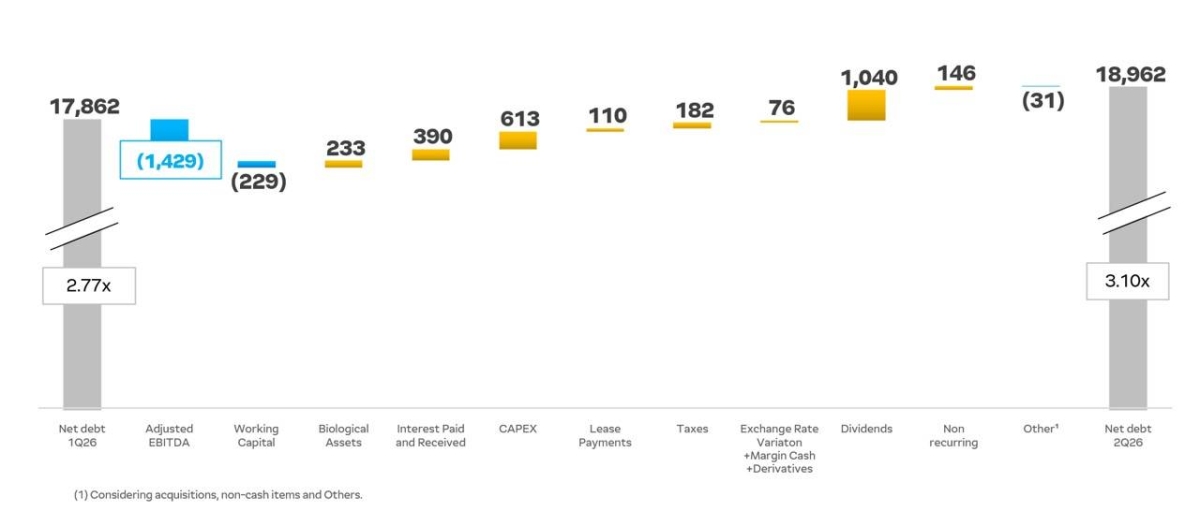
JBS N.V. (NYSE: JBS) reported a net loss of $102 million for the second quarter, weighed down by one-time items including antitrust settlements and costs tied to debt tender offers. Adjusted net income came in at $218 million, or $0.20 per share, the company said Monday.
The non-recurring charges included $172 million in premiums, interest, and costs related to the bond and debenture tender offers, $133 million in antitrust settlements, and an $81 million gain from the final calculation of the bargain purchase price on the Mantiqueira Alimentos acquisition.
Net leverage ended the quarter at 3.1x, slightly above the company's long-term target. JBS also joined the Russell 1000 and Russell 3000 indices during the quarter, a milestone CEO Gilberto Tomazoni said contributes to stock liquidity and expands the shareholder base. The company paid a $1 billion dividend in the period.
Beef North America
JBS Beef North America posted record sales for the quarter, with cutout values remaining at historically high levels on resilient U.S. consumer demand. Live cattle prices rose faster than cutout values, reflecting low cattle availability, which kept industry spreads under pressure. Live cattle imports from Mexico remained restricted during the quarter, further tightening supply, though the company expects a gradual resumption starting Aug. 24.
In response, JBS announced the closure of two plants: one in Souderton, Pennsylvania, and another in Memphis, Tennessee. Production will shift to other U.S. facilities, minimizing the impact on sales. JBS also merged its Fed Beef, Regional Beef, and Case Ready units into a single structure, Beef USA.
Pilgrim's Pride and Pork
Pilgrim's Pride saw firm chicken demand across all regions. U.S. fresh volumes rose on stronger retail and foodservice demand, though profitability declined year-over-year on lower commodity pricing. Margins improved sequentially on productivity gains and plant upgrades. Prepared Foods delivered profitable growth with both sales and margins up.
In Europe, retail volumes to key customers grew faster than the grocery channel, helping offset pressured pork margins from higher UK imports, added costs from the Middle East conflict, and softer foodservice traffic. In Mexico, volumes rose across fresh and prepared products.
JBS USA Pork reported flat revenue versus a year earlier. Domestic demand softened as inflation pressured consumers. USDA data show pork exports up 4.7% year-over-year from January through May. JBS USA Pork, described as the company's most resilient unit, maintained profitability within its historical range.
International and Brazil
JBS Australia's net sales grew on higher prices and volumes. Beef revenue rose on strong domestic and export demand, more than offsetting a 24% year-over-year increase in cattle costs. The weaker U.S. dollar relative to the Australian dollar continued to weigh on translation into U.S. dollars.
JBS Brazil also reported record second-quarter sales, driven by higher prices and volumes in both export and domestic markets. Exports were boosted by demand to fill the Chinese quota. Domestic beef sales benefited from World Cup-related marketing and stronger commercial execution. Average live cattle prices rose 12% year-over-year to about R$353 per arroba, yet the company still posted its highest EBITDA for a second quarter.
Seara reported 18% sales growth, with an adjusted EBITDA margin of 14.9%. Export growth was driven by higher fresh poultry volumes, including sales to the Middle East despite the conflict. In Brazil, Seara expanded its value-added portfolio and processing capacity.
Cash Flow and Liquidity
Free cash flow improved by $185 million year-over-year to a positive $130 million, helped by a $600 million improvement in receivables from higher discounting and advance payments from Chinese customers, and a $390 million increase in payables. Those gains were partially offset by a $324 million decline in adjusted EBITDA, a $129 million increase in net cash interest expenses, and a $163 million increase in capex.
Average debt term reached 15.3 years at an average cost of 5.7%. In August, JBS raised its revolving credit facility from $3.5 billion to $4.2 billion while cutting the all-in cost, lifting total liquidity to $7.7 billion.
The company's JBS stock page tracks its performance. For broader market context, see stock market analysis.