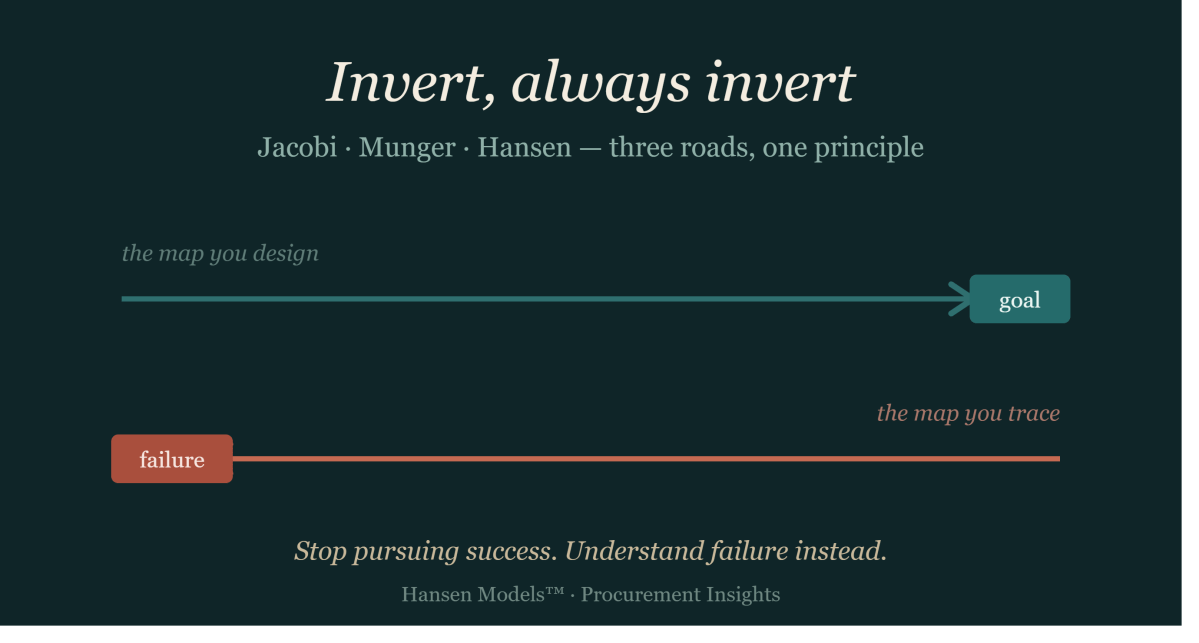
Carl Gustav Jacob Jacobi did not solve elliptic integrals by pushing harder through the standard formulas. He flipped them – man muss immer umkehren, “invert, always invert” – and opened an entire new field of mathematics. Charlie Munger, Warren Buffett’s partner at Berkshire Hathaway, took the same maxim and turned it into a decision tool: do not ask how to succeed, ask how to fail, then steer clear of every way.
I arrived at the same principle from a third direction, and I did not know either of them when I got there. The kinship is real, but the operations are different, and I want the differences clear before I claim the company.
Jacobi inverted equations. The forward path through his integrals was blocked by complexity; he restated each problem in its inverse form, and the path that was invisible from the front became obvious from the back. Munger inverted to avoid hypothetical failure: imagine every way this could go wrong, and do not go there. My method starts from a failure that is already occurring – an observed, present breakage – and traces its mechanism backward, step by step, to the real cause.
When a defence maintenance operation was delivering parts on time only 51 percent of the time against a 90 percent requirement, I did not start from the target and build toward it. I started from the breakage and followed the answer out of procurement, into the service department, back through the suppliers and the border, and finally into finance – where the real cause was hiding. Munger’s inversion is preventive. Mine is diagnostic. He inverts to avoid failure. I trace into a failure that has already occurred, to find what caused it.
Three different operations. One shared idea, and it is Jacobi’s: some problems cannot be solved forward.
Most people think in one direction – forward, from where they are toward where they want to be. For a great many problems, that works. There is a category of problem where the forward path actively hides the answer. In mathematics, Jacobi found it in the integrals. In investing and life, Munger found it in the human tendency to chase success while walking into avoidable traps. In enterprise systems – the world I have spent three decades in – I found it in failure diagnosis: you cannot find the cause of a failure by starting from the outcome you wanted, because starting from the desired outcome makes you build a case for it, and the real cause is the thing that case is designed not to see.
I have called this the difference between an equation-based approach and an agent-based one. The equation-based approach starts from the successful goal and builds forward toward it. It commits you, structurally, to being right about the path you chose. Every fact gets sorted into “helps me reach the goal” or “obstacle.” You are no longer investigating; you are defending a destination. The agent-based approach starts from where the thing is failing and traces backward – and because you began at the breakage, not the goal, you have nothing to defend. You follow the evidence wherever it leads, even out of your own department, even to a cause you never suspected.
Jacobi would recognize that. It is his maxim, applied to systems instead of integrals. The forward path obscures; the backward path reveals. He said it about elliptic functions. Munger said it about avoiding ruin. I say it about diagnosing why an operation is failing.
None of us learned it from the others. I developed and proved my method in 1998, with funding from the Government of Canada’s Scientific Research & Experimental Development (SR&ED) Program, years before I encountered either man’s work. A principle that surfaces independently in pure mathematics, in investing, and in enterprise diagnosis, across two centuries and three people who never compared notes, is not a preference. It is closer to a law.
I do not borrow their pedigree. I cannot borrow what I never had – I did not stand on their shoulders because I did not know they were there. I am telling the story so that if you are one of the people who scratches their head when I say start at the failure and work backward, it may help to know the instinct is not idiosyncratic. It is the same instinct that let Jacobi crack problems that would not yield to the forward formulas, and the same one that kept Munger out of traps that took down cleverer investors.
Invert, always invert. Jacobi meant it about equations. Munger meant it about avoiding failure. I mean it about tracing failure to its root. Three roads, no map shared between them, arriving at the same place – which is the surest sign the place is real.
For the full 1998 case that first proved the method, with the diagram that makes the difference visible, I have laid it out here: The Map You Design and the Map You Trace.