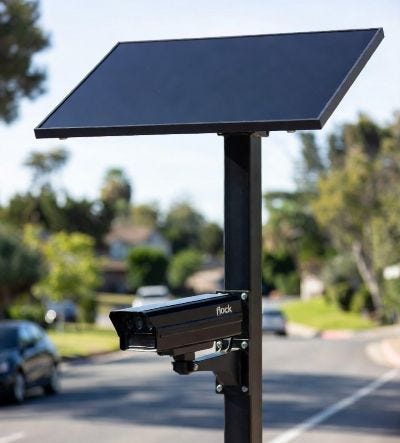
Flock Safety's network of 100,000+ license plate cameras logs every driver, raising Fourth Amendment concerns that echo Orwell's 1984. Police misuse is already documented.
In George Orwell's 1984, the citizens of Oceania live beneath a single unblinking gaze. Posters on every wall declare "Big Brother Is Watching You," and telescreens record every movement, ensuring that no one is ever truly alone. The genius of the Party's surveillance was not that it caught criminals. It was that it made privacy itself impossible, and in doing so, made freedom impossible. Orwell understood that a population that is always watched is a population that can always be controlled.
Nearly eight decades after the novel's publication, Americans should ask an uncomfortable question: is Flock Safety building the infrastructure of Big Brother in our own neighborhoods?
Flock Safety operates one of the largest networks of automated license plate readers (ALPRs) in the United States. Its cameras, mounted at neighborhood entrances, intersections, and city streets, photograph every passing vehicle, log its plate, and record its make, model, color, and distinguishing features. That data is timestamped, stored for a limited period, and made searchable across thousands of jurisdictions. A single camera is unremarkable. A national network of tens of thousands of them, quietly stitching together the movements of millions of drivers who are suspected of nothing, is something else entirely. It is a machine for reconstructing anyone's travel history on demand.
The parallel to Orwell is not that Flock cameras peer into our living rooms. It is subtler and, in some ways, more insidious. The telescreens of 1984 were feared because citizens never knew when they were being watched, so they always behaved as if they were. Mass ALPR surveillance produces the same chilling logic. When every trip to a doctor's office, a church, a protest, a political meeting, or a gun store is captured and retained, law-abiding people begin to weigh whether their perfectly legal movements might someday be misread, misused, or leaked. Orwell called this self-policing instinct the essence of totalitarian control. There is an echo of the Ministry of Truth in marketing language that brands dragnet surveillance as "public safety."
Let me be fair to the other side: the case for these cameras is real. Flock's network has helped recover stolen vehicles, generate leads in violent crimes, and locate missing people. For a police chief with limited officers and an unsolved case file, a tool that turns every road into a witness is genuinely tempting. The question has never been whether the tool sometimes works. The question is whether a dragnet that logs everyone, everywhere, with no warrant standing between an officer and your travel history, is a price a free society should pay.
We no longer need to speculate. Police misuse is already documented. The Institute for Justice has tracked at least 18 cases of officers using ALPR systems to stalk romantic partners and rivals. In Georgia, a Braselton police chief was arrested for allegedly using Flock cameras to harass a former romantic partner; officers in Coffee County and Albany have faced charges or termination for similar abuses. These were not hackers or foreign adversaries. They were the watchers themselves. Communities are responding. Oak Park, Illinois, terminated its contract after data was improperly searched for immigration enforcement. Dozens of cities have now canceled Flock agreements, and just days ago the Los Angeles Police Department, one of Flock's largest customers, let its contract expire, citing civil liberties and data-control concerns. The presumption of innocence quietly erodes into a presumption of trackability.
Here, though, the comparison to 1984 must end, and it must end in our favor. Winston Smith tried to rebel. He kept his diary, loved in secret, and clung to the belief that two plus two equals four. In the end, Big Brother broke him. Law-abiding American citizens do not have to share that fate. We have a Constitution, independent courts, and the Fourth Amendment. The Supreme Court has already recognized, in cases like Carpenter v. United States, that the warrantless aggregation of a person's movements over time raises profound constitutional concerns. Communities are pushing back, lawsuits are being filed, and courts are listening. We can win this battle where free people are supposed to win it: in court, under law, in the open.
Orwell wrote 1984 as a warning, not a prophecy. 2026 does not have to end like 1984.
Drafted by a large language model from the source reporting linked above, then screened by automated publishing checks. It is not read by a journalist before publication. Some articles cite our Alpha Score. Verify prices and figures against the original source. Educational coverage, not personalized advice.