An insurtech operator argues carriers waste money on AI by treating it as a tech rollout instead of changing how people work. The fix: redesign processes alongside tools.
The insurance industry's push to adopt AI is failing to deliver returns because carriers are treating digital transformation as a technology project, not a people project, according to a commentary from an insurtech operator who previously worked at global insurers.
The author, who moved into insurtech after a career inside carriers, argues that many insurers invest in AI simply because competitors are doing it. The result is a mismatch between the tool and the actual problem. The recommended first step is to name a specific operational challenge: underwriters spending too much time processing submissions, brokers waiting too long for decisions, or manual processes creating inconsistency.
Starting with a clear problem turns AI into a tool for solving real workflow issues. The author says the opposite scenario is common: new technology sits alongside existing processes instead of replacing them. Employees end up working across multiple systems, duplicating tasks or manually correcting automated outputs. "AI cannot fix a broken process on its own," the author wrote. "If organizations simply bolt automation onto inefficient workflows, they automate the dysfunction rather than removing it."
The insurers seeing the strongest returns are those that redesign their processes alongside the technology. The author calls this ensuring that people and technology evolve together.
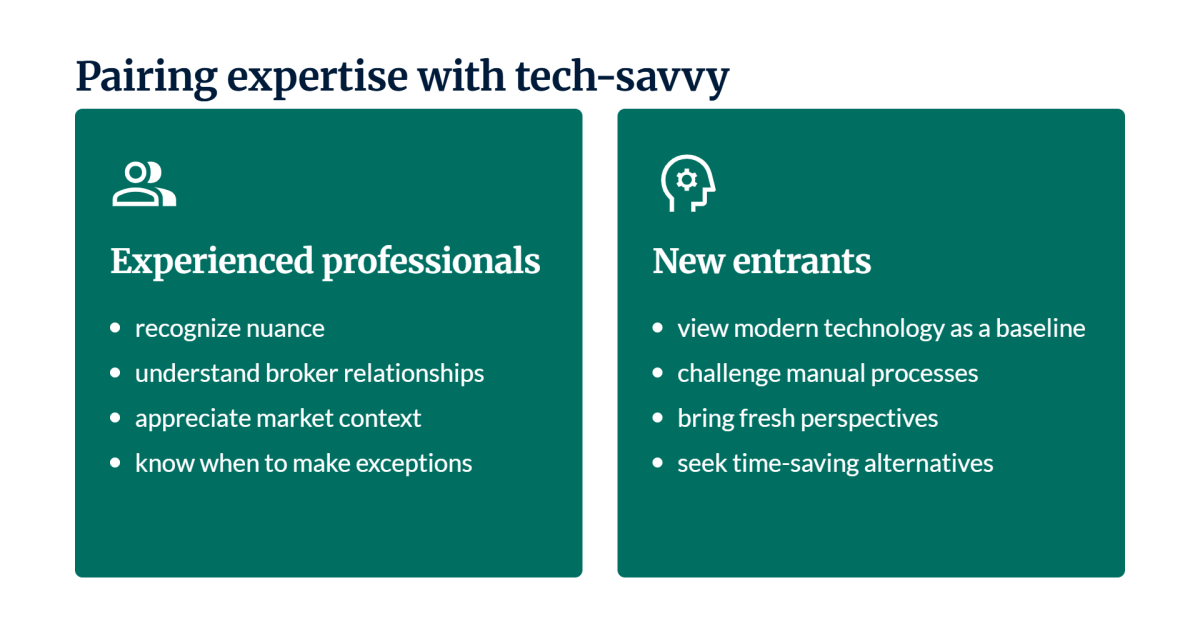
A second force reshaping the industry is generational. Millennial and Gen Z employees, who have grown up with intuitive digital tools, treat technology as a baseline expectation, not an added benefit. They are more willing to ask why a process remains manual or why information must be entered multiple times. The author calls this pressure productive friction, because it pushes legacy carriers to revisit long-standing assumptions instead of accepting "this is how we've always done it."
Experience still matters. The commentary notes that seasoned underwriters bring judgment, commercial awareness, and market knowledge built over years of handling complex risks. They understand broker relationships and know when exceptions need to be made. The author says the best results come from teams where employees comfortable experimenting with new tools work alongside people who know where the real risk sits. One group asks whether a process could work differently; the other asks how to preserve the judgment that makes underwriting effective.
For insurers, the read-through is straightforward. The number of AI tools deployed is not the measure. The measure is whether those tools genuinely improve the way people work. The commentary argues that insurers that combine fresh thinking with decades of experience will lead over the next decade. "AI cannot fix a broken process on its own," the author wrote. The investment becomes a catalyst for changing how the entire organization works, not just another technology line item.
Drafted by a large language model from the source reporting linked above, then screened by automated publishing checks. It is not read by a journalist before publication. Some articles cite our Alpha Score. Verify prices and figures against the original source. Educational coverage, not personalized advice.