Indigenous AI Builders Embed Data Sovereignty Into Platforms
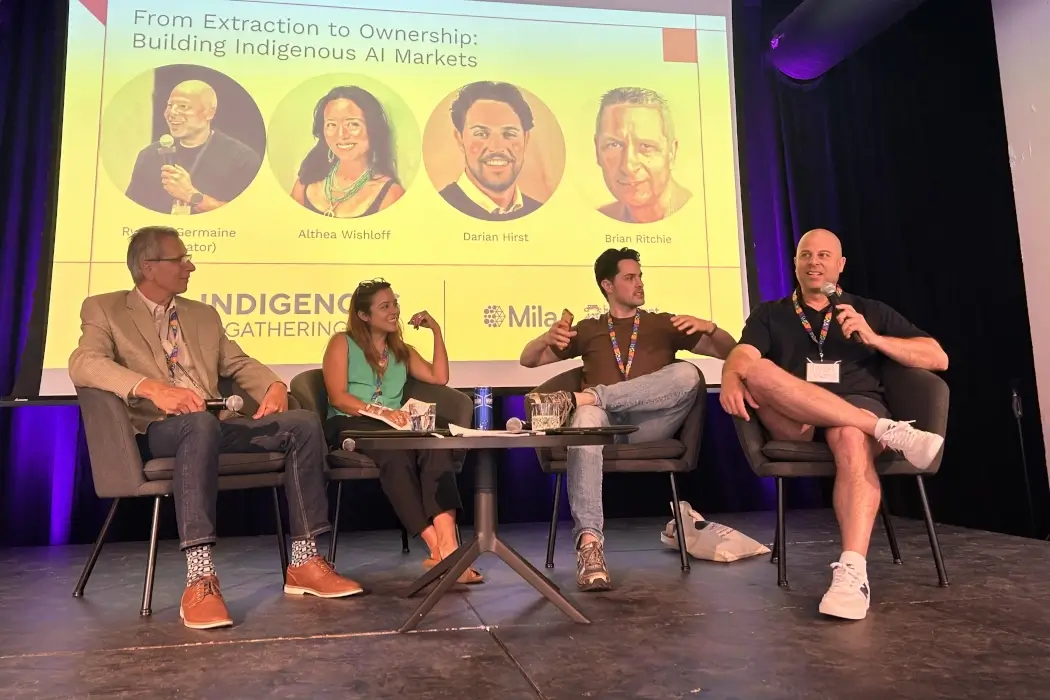
At Mila's Indigenous AI Gathering, developers presented tools that run locally, with no data leaving the community. 'Our community's data is already on this pathway,' said Krystal Tsosie.
Indigenous technologists are building AI platforms that keep data inside community networks, rejecting the extraction model that dominates the tech industry. At the Indigenous AI Gathering at Montreal's Mila research institute this week, developers presented tools designed to run entirely on local infrastructure, with no data leaving the community.
The two-day conference featured participants from the Indigenous Pathfinders in AI program, a seven-week machine learning course focused on Indigenous-centered approaches. They pitched platforms that embed data sovereignty into the architecture from the start.
"The essential problem that we come across in AI is: where are you getting the data, and how are you making sure that's community-informed and consented?" said Ali Lang, a senior accessibility analyst (Indigenous) at the CBC who co-created the K-12 education platform Portage during the program. "There's a data governance onboarding layer that's our foundation."
Portage stores cultural knowledge and student data locally. Other pitches included Landlens, which analyzes the cumulative impact of land developments using public data, and SAI Cheese, a preventative dental care app that keeps health data on-device.
The data extraction problem is acute in healthtech. Krystal Tsosie, a geneticist at Arizona State University and member of the Diné/Navajo Nation, described how for-profit companies use Indigenous health data to build innovations that the same communities cannot afford to access.
"[Data] determines what the system sees, what it optimizes for, who benefits, and who is harmed," Tsosie said. "Our community's data is already on this pathway, and the question is whether or not our community governs what it becomes."
Tsosie called for research models where samples and data stay on ancestral lands and research questions come from community members. Community benefit, she said, should be the design goal, not an afterthought.
Canada has a long history of federal misuse of Indigenous data for surveillance and erasure. That led to standards such as the First Nations Principles of OCAP (ownership, control, access, possession), which govern how data can be used. At the Mila event, AI and digital innovation minister Evan Solomon acknowledged the "scar tissue" between the government and Indigenous communities on data use. Solomon was gifted a braid of sweetgrass by University of Calgary doctoral candidate and Mila fellow Mick Elliott, who said it carried a "great weight and responsibility" toward Indigenous people.
Michael Running Wolf, co-founder of Mila's First Languages AI Reality (FLAIR) program, acknowledged that building AI might seem unattractive given how large tech companies have used the technology for exploitative purposes. The goal of having more Indigenous representation in AI, he told the audience, "isn't to contort ourselves, so that we break ourselves."
"It's that we demonstrate the flexibility of our culture and the behaviour as representatives of our culture," he said.
Drafted by a large language model from the source reporting linked above, then screened by automated publishing checks. It is not read by a journalist before publication. Some articles cite our Alpha Score. Verify prices and figures against the original source. Educational coverage, not personalized advice.