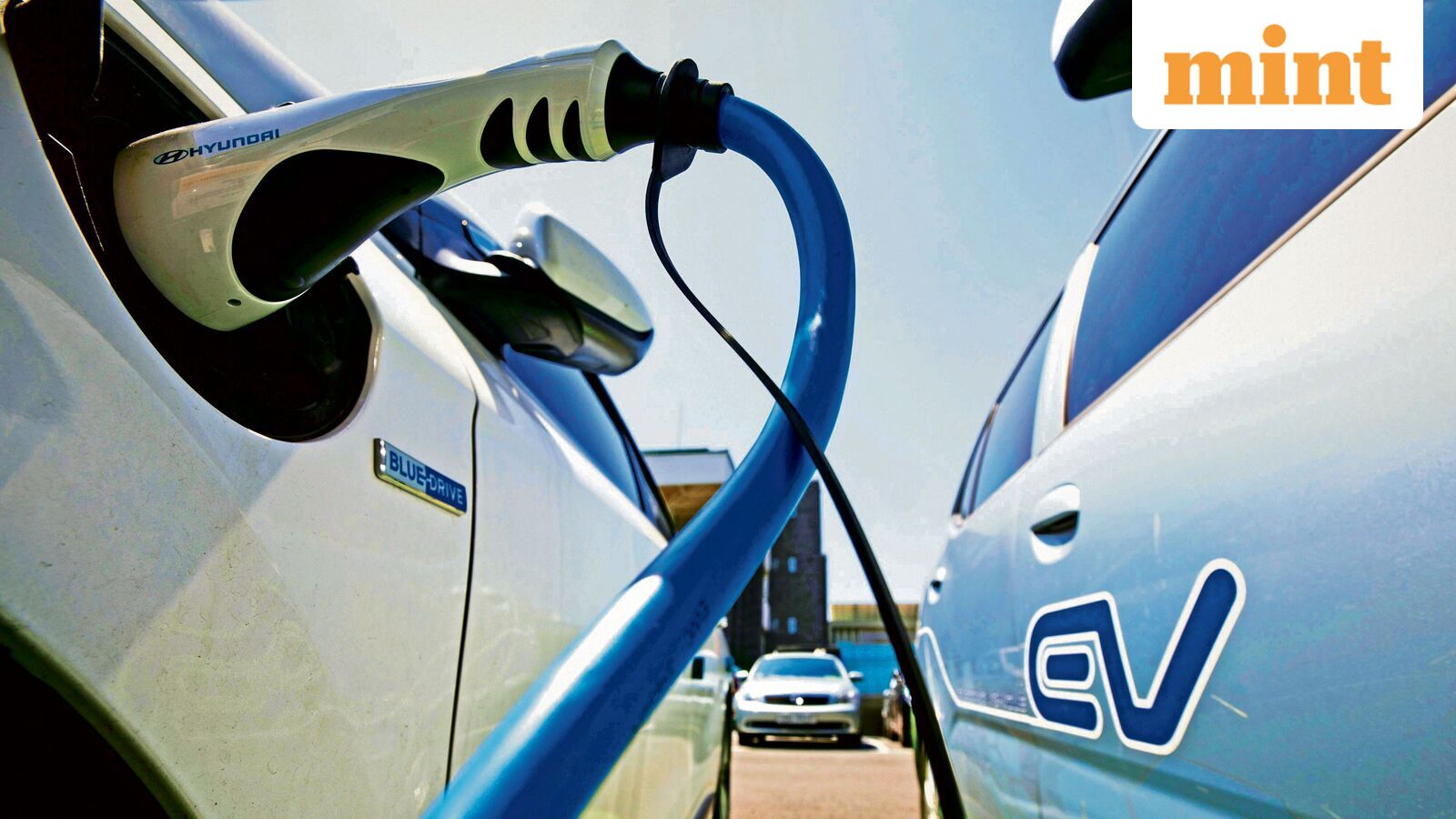
State-run banks and financial institutions have proposed changes to India's priority sector lending (PSL) framework to create specific lending categories for electric vehicles, charging infrastructure and climate-transition projects, according to two government officials and a document reviewed by Mint.
The proposals, discussed at a two-day public sector bank (PSB) confluence in New Delhi, include lending limits of up to ₹2 lakh for electric two-wheelers and ₹20 lakh for electric four-wheelers purchased for personal use. They also propose limits of ₹25 crore for charging and battery-swapping infrastructure and ₹50 crore for commercial electric-vehicle fleet operators.
Currently, under the Reserve Bank of India's PSL framework, domestic scheduled commercial banks must meet a PSL target of 40% of adjusted net bank credit or credit equivalent of off-balance sheet exposures, whichever is higher. Electric vehicles do not have a separate category under the existing framework. Retail EV purchases can qualify for PSL treatment only when the borrower is an eligible micro, small and medium enterprise, while charging and battery-swapping infrastructure has no specific PSL provision.
The PSBs have also proposed a ring-fenced climate and transition sub-target within the existing 40% PSL requirement. Under the proposal, 2% of ANBC could be designated as a "Climate and Transition Sub-Target" without increasing the overall 40% PSL requirement. Eligibility could be based on the finance ministry's climate finance taxonomy and the RBI's interim list.
Another proposal seeks to introduce technology-differentiated lending limits for renewable energy projects. The existing ₹35 crore limit for solar photovoltaic projects would be retained, while the limit for wind and small hydro projects would be increased to ₹75 crore. An overall ceiling of ₹100 crore per borrower from the banking system has also been proposed.
The differential limits are intended to address the differing capital requirements of renewable technologies. The ₹35 crore cap can support roughly 8-10 megawatts of solar capacity but materially less wind and small-hydro capacity, according to the proposal.
The proposals have not yet been accepted by the government or incorporated into the PSL framework. Queries emailed to the ministry of new and renewable energy, the RBI and the finance ministry remained unanswered till press time.
India has more than 2.8 million registered electric two-wheelers, around 800,000 electric three-wheelers and nearly 200,000 electric passenger vehicles, according to Vahan-based data. Retail sales in FY26 stood at 14,01,818 electric two-wheelers, 8,30,819 electric three-wheelers and 1,99,923 electric passenger vehicles, according to the Federation of Automobile Dealers Associations.
"Only around 20% of vehicles are purchased outright, while nearly 80% are financed," said Amit Bhatt, managing director for India at the International Council on Clean Transportation, adding that access to retail credit remains a persistent bottleneck for EV adoption in India. Bhatt welcomed the proposal to bring EVs under the PSL framework and said extending the benefits to charging and battery-swapping infrastructure is equally important.
Tirath Khaira, director at Smarten Power Systems, said the proposals are timely because India's energy transition needs credit frameworks to keep pace with the technologies driving it. "A more responsive financing environment can give businesses greater confidence to invest, scale and plan for the long term," Khaira said.
The climate and renewable energy proposals come as India seeks to accelerate its clean-energy transition towards its stated target of 500 gigawatts of non-fossil-fuel-based electricity generation capacity by 2030. As of July 31, 2026, the country had 291.73 GW of installed renewable-energy capacity, data from the MNRE showed.
The proposed changes come at a time when the 12 state-owned banks are in a stronger financial position to expand lending. Their aggregate business rose 12.8% year-on-year to ₹283.3 trillion as of March 31, 2026, with deposits increasing 10.6% to ₹156.3 trillion and advances growing 15.7% to ₹127 trillion, according to finance ministry data. The gross non-performing asset ratio fell to 1.93%, while the net NPA ratio declined to 0.39%. Aggregate operating profit reached ₹3.21 trillion, while net profit rose 11.1% year-on-year to a record ₹1.98 trillion.