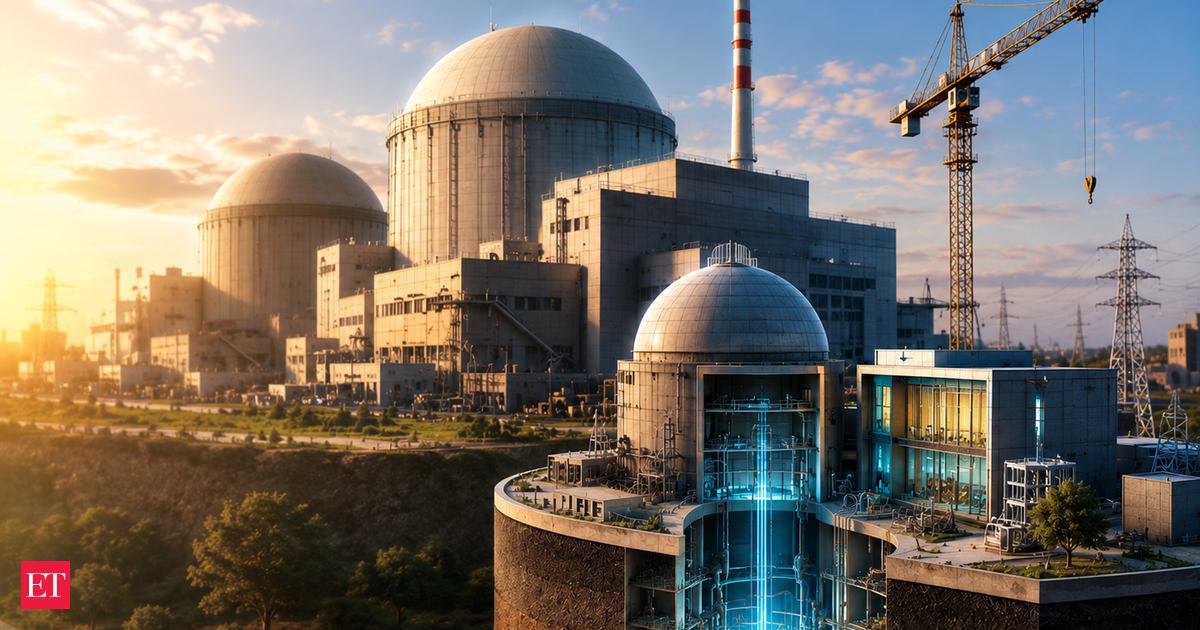
India's Parliament cleared the SHANTI Act this week, a law that opens the country's civilian nuclear sector to private companies for the first time. The legislation replaces the Atomic Energy Act of 1962 and the Civil Liability for Nuclear Damage Act of 2010, two statutes that had effectively barred private investment in nuclear power generation, fuel processing, and waste management.
Under the new framework, private firms can own and operate nuclear plants. The government retains control over uranium enrichment, reprocessing, and export licensing. The shift is designed to accelerate a nuclear expansion that has stalled under state ownership.
India's nuclear capacity stands at roughly 8 GW today, a fraction of the 500 GW total power generation target for 2030. The government wants to reach 22 GW of nuclear capacity by 2032. State-owned Nuclear Power Corporation of India has struggled to finance new projects. The SHANTI Act is meant to bring in foreign and domestic capital.
Equipment manufacturers have already signaled they will scale up production. Larsen & Toubro and Bharat Heavy Electricals said they plan to increase output of reactor vessels, steam generators, and cooling systems, according to company statements.
The Australia uranium supply deal, signed alongside the act, guarantees feedstock for the expanded fleet. Australia holds about 28% of global uranium reserves. India's current reactors use imported fuel from Kazakhstan and Russia. The agreement locks in a long-term supply that reduces vulnerability to geopolitical disruptions.
A more immediate effect may be on project timelines. India has six reactors under construction, all delayed by years. Private participation allows the government to offload construction risk to companies that have built similar projects overseas. The first private-sector plant is expected to come online by 2030, a 700-MW pressurized heavy water reactor at a site in Andhra Pradesh, according to the Department of Atomic Energy.
Critics argue the law does not go far enough. The liability cap for nuclear damage remains at 1500 crore rupees, a figure that some insurers say is too low to attract international operators. The act also preserves the government's monopoly on fuel reprocessing, which private companies say limits their ability to manage the full fuel cycle.
The broader direction is clear: India's nuclear expansion is no longer a purely state-led project. For investors, the clearest read-through is to companies that supply components and services. The equipment cycle for a 22 GW fleet requires roughly 12-15 pressure vessels, 24 steam generators, and associated turbine systems. That order book is now open to private bidders, not just NPCIL. The uranium supply deal also shores up the outlook for fuel-cycle companies, though most are still government-owned.
The Atomic Energy Regulatory Board is drafting new safety guidelines for private operators, a process that will set the compliance bar for all entrants. Until those rules are published, the exact scope of private participation remains uncertain. The legal framework is now in place, and the equipment orders are starting to flow.