Over 54 million pending cases in Indian courts create a drag on GDP and deter foreign investment. AI tools may help reduce delays, but structural reforms remain slow.
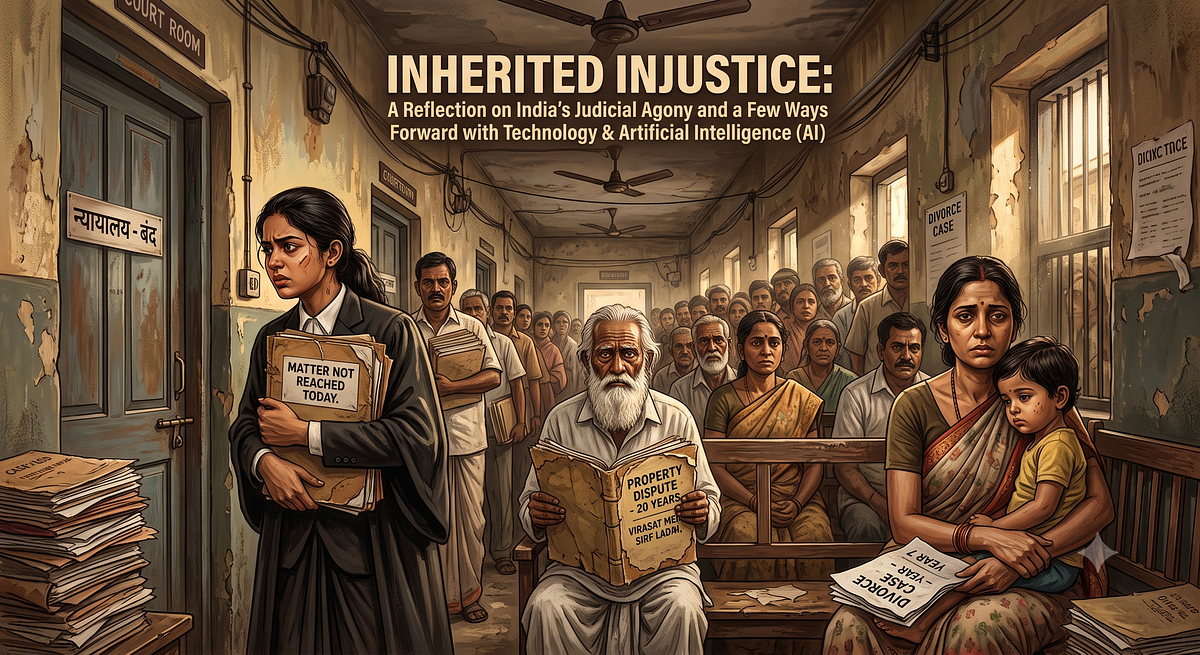
A mother in Vasai, Maharashtra, told her 11-year-old she hopes he never needs a courtroom or a hospital. Seven years into a divorce she did not choose, she stood in a crowded corridor at 11:30 a.m. Her matter would not be heard that day. Probably not that month.
Further down the same corridor sat a man decades into a property dispute his father passed to him. Asked how long he had been fighting, he said: "Twenty years. Now the only inheritance I can leave my son is this fight itself."
That is the human cost of India's judicial delay. The economic cost is measurable.
As of mid-2026, more than 54 million cases were pending across Indian courts, according to the National Judicial Data Grid. That number has grown roughly 80% in a decade. District and subordinate courts, the first rung most litigants ever encounter, carry nearly 48 million of them. Over 170,000 cases have been pending for more than thirty years – longer than many litigants have been alive.
India has about 21 judges per million people, against a Law Commission recommendation of 50. Vacancy rates hover around a third of sanctioned High Court posts. While a case sits unresolved, more than three in four prisoners in Indian jails are undertrials – people the courts have not yet convicted, some of whom will spend more time waiting for trial than they would have served if found guilty.
Economists estimate judicial delay costs India between 1.5% and 2% of GDP each year, in stalled investment, tied-up capital, and lost working days. The World Justice Project's 2025 Rule of Law Index ranks India 114th of 143 countries on civil justice.
The state is India's single largest litigant, involved in roughly half of all pending cases. A meaningful share of those are appeals filed reflexively, to avoid an official being questioned for not appealing, rather than on the merits. The bar itself contributes: adjournments sought as routine practice, not necessity, are a recognized source of delay.
Police investigations frequently lack forensic infrastructure and training to build a case that holds up. Weak evidence does not just lose cases; it drags them out for years while everyone waits for a file to become strong enough to argue.
Three ideas target the district-court layer where 48 million cases sit.
First, procedural compliance automation for police. Public dashboards already exist for aggregate conviction rates. A more useful target is procedural compliance: was the charge-sheet filed on time, was evidence digitally timestamped, were witness statements handled correctly. That alone would remove a category of adjournments that exist only because nobody can prove what stage a case is at.
Second, a case-management commissioner using existing Code of Civil Procedure provisions. Courts can already appoint commissioners for narrow tasks – recording evidence, local investigation. That mechanism could be extended: advocates, compensated with a modest honorarium, narrow the contested issues in an application and compile a clean case file, while the sitting judge still signs the actual order. Recent, varied trial-court experience, verifiable through e-Courts appearance data, is a better eligibility filter than years of enrollment.
Third, filling judicial vacancies remains the hardest work. Technology can absorb what is mechanical so judges, lawyers, and clerks can spend attention where judgment matters.
Justice is not only about who wins or loses. It is about whether it arrives in time to matter – before a childhood is shaped by a courtroom instead of a home, before a father's only legacy to his son is an unfinished fight.
Drafted by a large language model from the source reporting linked above, then screened by automated publishing checks. It is not read by a journalist before publication. Some articles cite our Alpha Score. Verify prices and figures against the original source. Educational coverage, not personalized advice.