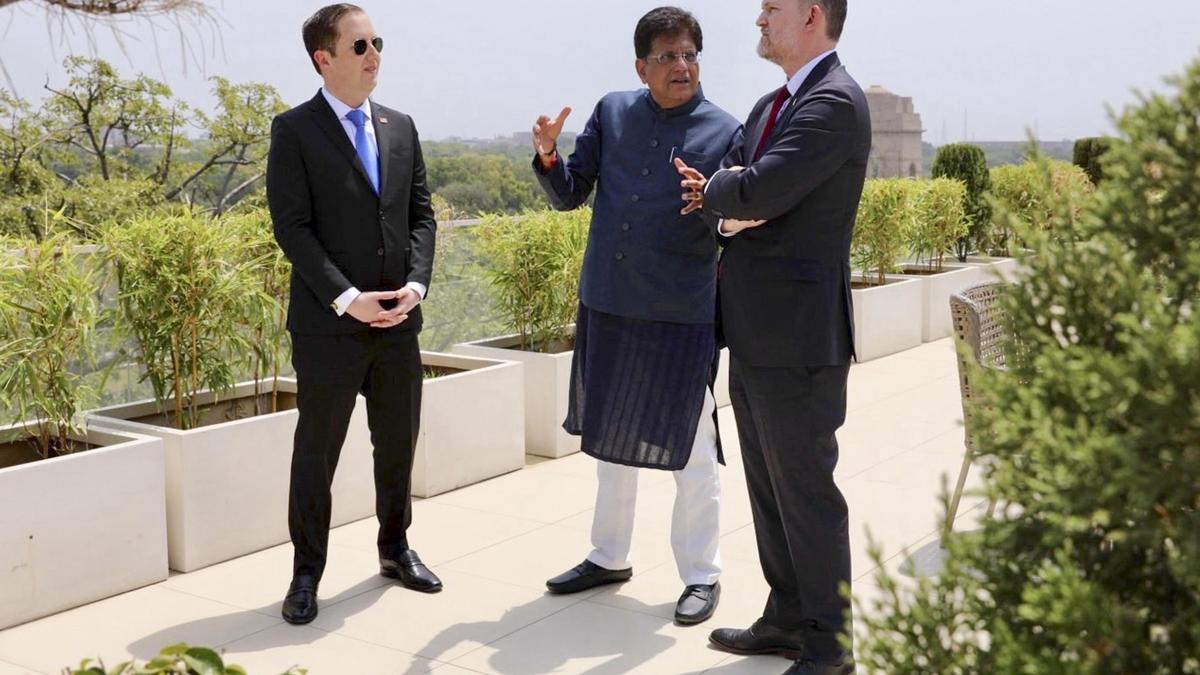
Goyal and Greer met in Delhi after the U.S. Supreme Court overturned 50% tariffs, leaving a 10% flat levy on all countries. India's tariff advantage over rivals is gone.
Commerce Minister Piyush Goyal and U.S. Trade Representative Jamieson Greer started bilateral talks in New Delhi on Tuesday, aiming to finalize a first-phase trade deal that the U.S. Supreme Court effectively rewrote two months ago.
The February framework had the U.S. cutting tariffs on Indian goods to 18% from 50%, including dropping 25% levies tied to Indian purchases of Russian oil. The Supreme Court struck down those 50% tariffs on Feb. 20. The White House replaced them with a uniform 10% levy on all countries under Section 122 of the Trade Act, set to expire July 24.
That shift erased India's tariff advantage. Under the old framework, India would have faced 18% while rivals like Vietnam, Bangladesh, and Indonesia paid 19-20%. Now every country pays the same 10%, said a person familiar with the negotiations. The February joint statement contains a clause allowing either side to modify commitments if the other's tariff schedule changes.
Both sides are now reworking the deal's numbers.
President Donald Trump said June 17 that the two countries are "very close" to finalizing the agreement. Goyal said June 5 he expected the first phase to be executed by mid-July. Tuesday's talks followed chief negotiator-level discussions on June 2-4 in the capital.
Commerce Secretary Rajesh Agrawal and India's chief negotiator Darpan Jain attended the meeting at Vanijya Bhawan. Agrawal said June 15 that the ministers' discussions would focus on giving "final touches" to the framework.
Under the February terms, India committed to eliminating or reducing tariffs on all U.S. industrial goods plus a wide range of agricultural products including dried distillers' grains, red sorghum, tree nuts, fresh and processed fruit, soybean oil, wine and spirits. New Delhi also offered to buy $500 billion of U.S. energy products, aircraft, precious metals and coking coal over five years.
The talks face complications beyond the tariff math.
The USTR launched two Section 301 investigations on March 11 and 12 covering about 60 economies. One examines alleged excess industrial capacity. The other looks at forced-labor concerns in global supply chains. India was included in both. The parallel tracks could give Washington leverage or create friction, depending on how aggressively the USTR pursues them.
India's trade surplus with the U.S. shrank to $34.4 billion in the 2025-26 fiscal year from $40.9 billion the prior year. Exports grew just 0.9% to $87.3 billion while imports rose 16% to $52.9 billion. The U.S. remains India's second-largest trading partner.
The July 24 expiry of the Section 122 tariff creates a hard deadline. If the framework deal is signed by mid-July, the current 10% levy gives way to a new schedule. If it is not, the old tariffs are off the table and the uniform 10% charge continues until it expires or gets replaced.
Prepared with AlphaScala research tooling and grounded in primary market data: live prices, fundamentals, SEC filings, hedge-fund holdings, and insider activity. Each story is checked against AlphaScala publishing rules before release. Educational coverage, not personalized advice.