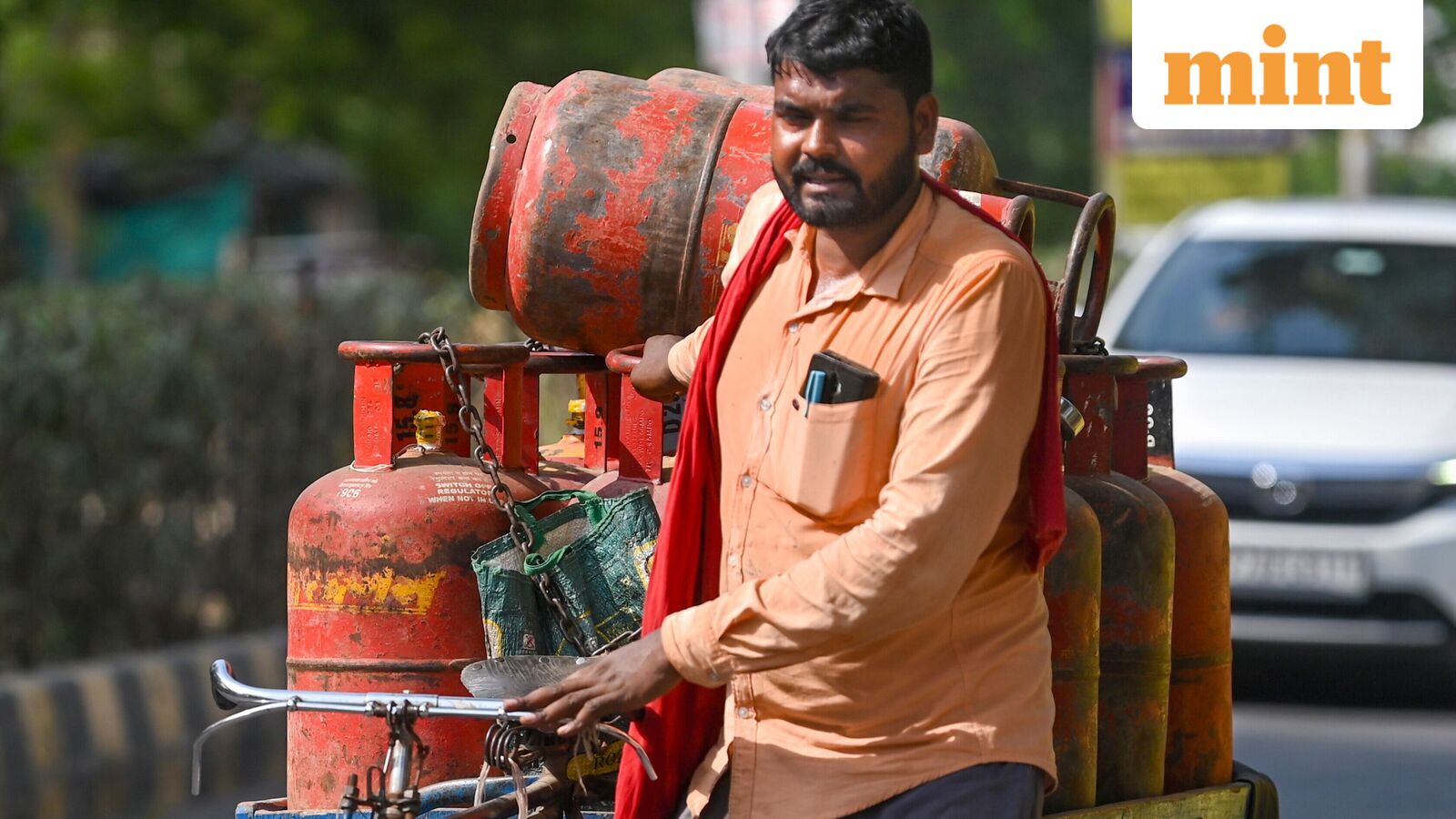
Domestic LPG cylinder rates in India held flat on May 29, with a 14.2-kg cylinder at ₹913 in Delhi, ₹912.50 in Mumbai, ₹939 in Kolkata, and ₹928.50 in Chennai. The price stability masks a growing strain on state-run oil marketing companies (OMCs) – Indian Oil (IOC), Bharat Petroleum (BPCL), and Hindustan Petroleum (HPCL) – which are absorbing roughly ₹550 crore per day in losses to keep household cooking gas affordable while global LPG benchmarks swing on West Asia tensions.
The risk event is not a price hike that has already happened. It is the accumulating subsidy burden and the political ceiling that make a sudden adjustment increasingly likely if crude oil or freight costs do not ease. Commercial 19-kg cylinders already jumped over ₹900 last month, offering a real-world test of how quickly rates can reset when the pass-through is allowed.
LPG Price Freeze Masks ₹550 Crore Daily Subsidy Burden
The ₹550 crore per day figure, cited by the defence ministry in a statement from Defence Minister Rajnath Singh, represents the gap between international parity pricing and the retail rate paid by households. The ministry specifically said that OMCs have "refrained from passing the full international price into retail" and that this cushion is intended for retail consumption alone. Industrial and commercial diesel pricing, by contrast, tracks international benchmarks as a standing policy.
Three factors determine the actual subsidy draw: the level of crude oil prices, the rupee-dollar exchange rate, and freight costs through the Strait of Hormuz. The US-Iran conflict has injected volatility into all three, particularly threatening the Strait of Hormuz – a chokepoint for roughly one-fifth of global LPG shipments. OMCs are effectively running a negative margin on domestic LPG sales, funded by upstream profits and government subsidy allocation.
Who Bears the Risk
The primary exposure sits with the three state-run OMCs – Indian Oil (IOC), Bharat Petroleum (BPCL), and Hindustan Petroleum (HPCL). A prolonged freeze on domestic rates erodes their refined-product margins at a time when crude procurement costs remain elevated. For consumers, the risk is delayed rather than avoided: if the subsidy burden becomes politically untenable or if the government caps the allocation, a step-change in retail prices becomes the default adjustment mechanism.
Political Sensitivity Caps the Pass-Through
Domestic cooking gas is a politically sensitive item in India, with direct impact on household budgets across income levels. The government has previously used subsidies and direct benefit transfers to smooth price increases, the current freeze is broader – it is a deliberate suppression of the retail price rather than a targeted subsidy payment. This approach avoids immediate voter backlash while building latent pricing pressure that grows with each week of unchanged rates.
Commercial Cylinder Already Showed a ₹900+ Jump – A Warning Signal
The 19-kg commercial LPG cylinder did not benefit from the same price cap. Its cost rose by over ₹900 in the preceding month before stabilising, reflecting the normal pass-through of international benchmarks. This divergence between domestic and commercial pricing creates a dispersion risk: businesses and small enterprises face higher fuel costs, which can feed into broader inflation for food preparation, hospitality, and manufacturing.
The commercial segment’s price action serves as a lead indicator for what domestic rates would look like without the absorption. If the gap between landed cost and retail price exceeds the government’s willingness to subsidise, the domestic freeze could break in a direction similar to the commercial trajectory.
Monthly Revision Cycle as the Next Trigger
LPG prices in India are revised at the start of every month based on changes in global crude, currency, and freight costs. The next revision is due June 1 (or the nearest working day). If crude benchmarks have not declined meaningfully by then, the pressure on OMCs to maintain the freeze will intensify.
- June 1 revision date: the first visible test of whether the freeze holds.
- Crude oil price direction: a sustained rally above $80 per barrel for Brent would widen the subsidy gap.
- Rupee depreciation: a weaker INR makes imported LPG more expensive in local currency terms, increasing the daily absorption.
- Strait of Hormuz disruption: any physical interruption to tanker traffic would spike freight and insurance costs, potentially forcing a mid-month adjustment.
Strait of Hormuz Risk and Global LPG Benchmarks
The Strait of Hormuz is the world’s most critical energy chokepoint. About 21% of global LPG transits the strait, most of it from Qatar and Saudi Arabia to Asian buyers including India, Japan, and South Korea. The current US-Iran tensions raise the probability of shipping disruptions, either through direct military confrontation or through increased insurance premiums and longer routing.
What This Means for Indian LPG Costs
India imports roughly 60% of its LPG requirements, primarily from the Middle East. A Hormuz-related disruption would immediately lift freight rates and cargo insurance costs, even if crude itself does not spike. Since OMCs are already absorbing a large subsidy on domestic sales, an additional cost layer would either accelerate the daily loss rate or force an earlier revision.
The practical market read: investors and traders watching Indian energy stocks should monitor the Brent crude spread to Saudi Aramco CP LPG as a real-time proxy for subsidy pressure. OMC margins on the retail side compress when this spread widens without a corresponding retail price adjustment.
What Could Break the Price Cap – Three Scenarios
The freeze is not indefinite. Three scenarios could force a change in domestic LPG pricing:
-
Geopolitical de-escalation: If US-Iran tensions ease and Hormuz shipping normalises, global LPG benchmarks fall. The subsidy burden shrinks and the freeze can persist longer, possibly until the next budget allocation. This is the risk-reducing scenario.
-
Sustained crude rally: A Brent rally above $85 per barrel for more than two weeks would push the daily absorption past ₹600 crore. At that level, the finance ministry may impose a ceiling, effectively forcing a pass-through of part of the increase to households.
-
Currency depreciation: A sharp rupee move past 84 per dollar would lift landed costs even if crude stays flat. This scenario is less visible while equally damaging to the freeze – OMCs would need to raise rates to avoid negative margins on a larger volume of imports.
What Would Confirm or Weaken the Thesis
| Indicator | Confirms subsidy strain | Weakens subsidy strain |
|---|
| Brent crude | Above $83/bbl sustained | Below $75/bbl for 2 weeks |
| INR/USD | Weaker than 84 | Stronger than 82 |
| LPG freight rate (Middle East-India) | Above $50/tonne | Below $30/tonne |
| Monthly revision outcome | Domestic price increase | No change or cut |
Watchlist: Next Monthly Revision Date and Crude Path
For traders focused on Indian OMC equities – IOC, BPCL, HPCL – the next clear catalyst is the June 1 LPG price revision. A continuation of the freeze means the market has already priced in the subsidy narrative; any increase would reset earnings expectations for the refining and marketing segment.
For commodity traders, the LPG-crude spread is the active trade. The current freeze means Indian LPG demand remains artificially strong at retail, which supports global propane prices relative to crude. If the freeze breaks, Indian demand could soften temporarily, compressing the propane discount to Brent.
The key risk to watch is not an immediate crisis. It is the accumulation of subsidy pressure in a system that has already absorbed one month of elevated costs. Commercial rates have already shown how fast the catch-up can come – domestic rates are simply the next domino if the policy guardrails slip.
For a broader look at how energy supply risks affect broader commodity markets, see the AlphaScala commodities analysis section. The crude oil profile also tracks the upstream drivers that feed into LPG pricing.