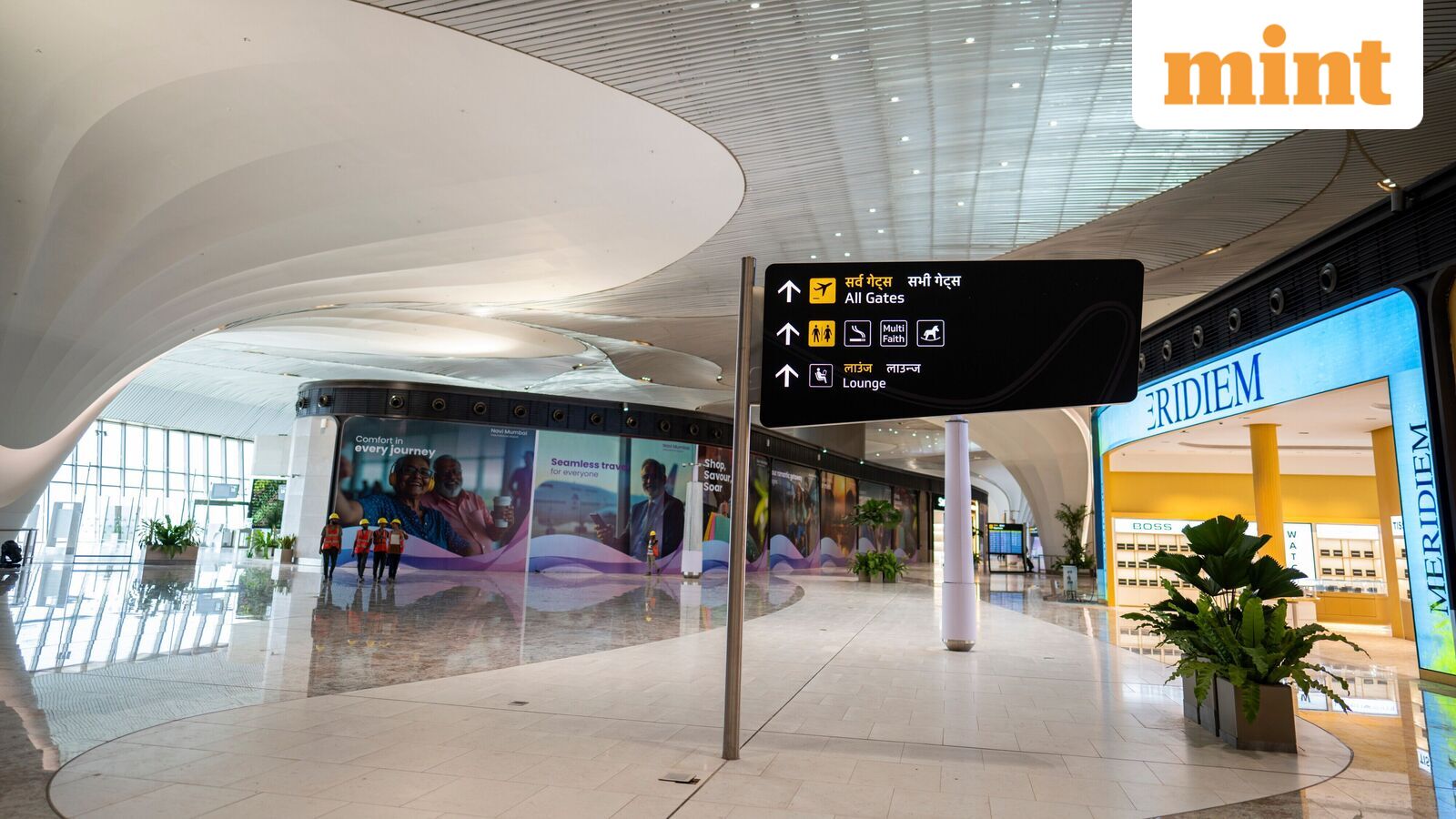
India's biggest private airport operators are pushing back against a regulatory proposal that would delay when they can charge passengers for new terminals and runways, warning the change could squeeze cash flows and complicate financing for billions of rupees in planned expansion.
GMR Airports, Adani Airport Holdings and Fairfax-backed Bangalore International Airport are among the operators objecting to the Airports Economic Regulatory Authority of India's plan to link passenger fee increases to the actual completion of infrastructure projects, according to minutes of a 6 July stakeholder meeting reviewed by Mint.
The dispute, which first emerged during Bengaluru airport's tariff review, has escalated as Hyderabad airport undergoes its own tariff determination for the five years through FY31. Hyderabad and Bengaluru alone plan more than ₹32,000 crore of combined capital spending.
Airport executives argue the incremental Aggregate Revenue Requirement framework, while well-intentioned, could trigger sharp fee increases later in the tariff cycle, weaken investor confidence, and complicate debt financing. Those concerns were echoed by lenders including ICICI Bank, even as passenger advocacy groups back the regulator's user-pay principle.
Narayana Rao Kada, group deputy managing director at GMR, said during the consultation meeting that the company respects the underlying rationale of the proposed user-pay principle but its implementation presents practical challenges. The issue is particularly significant for GMR-run Hyderabad International Airport, which has proposed a ₹13,548-crore expansion programme. Nearly 80% of the investment is scheduled for the latter half of the five-year tariff cycle, between FY27 and FY31.
Hyderabad's finance chief, Anand Kumar P., urged Aera to retain the existing tariff philosophy or introduce the framework only partially. The proposal could lead to "tariff shock in the latter years" with significantly higher user development fees, he said. A higher financing burden and "reduced tariff predictability" could affect internal accruals, Kumar warned. Any significant departure from established regulatory principles may also have implications for investor confidence and long-term financing arrangements, he said.
Delhi International Airport chief executive Pradip Panicker said the proposal could become difficult to administer because airports commission projects throughout the five-year control period, potentially resulting in numerous tariff revisions. Delhi airport is also run by GMR.
Adani Airport, which manages eight airports in the country, based its reasoning on implementation. Ashu Madan, head of regulatory affairs at Adani Airport, noted that airline tickets are booked several months in advance and frequent or sudden revisions in user development fees create reconciliation and implementation issues. He suggested a six-month implementation window.
Fairfax-run Bengaluru International Airport, which is undergoing its own tariff determination exercise involving around ₹18,700 crore of planned investments, proposed introducing the framework only partially by applying the user-pay principle to only 50% of the relevant capital expenditure or excluding projects capitalised during the first half of the control period.
The Association of Private Airport Operators, representing around 14 privately operated airports, urged Aera to ensure no adverse impact on cash flows. Secretary general Satyan Nayar said detailed consultation with members is underway and responses will be submitted to Aera.
ICICI Bank, which participated in the meeting, said airport projects are largely financed through long-term debt and depend on predictable future cash flows. Its representative, Manmohan Dwarkani, zonal head for corporate banking, cautioned that any material change in tariff methodology could affect debt servicing, credit metrics and financing costs. "Tariff uncertainty is often highlighted by rating agencies as a risk factor," Dwarkani said. The bank has an Alpha Score of 57, rated Moderate.
Passenger groups support Aera's proposal. G.S. Bawa, secretary general of the Air Travellers Association, said passengers should not be required to pre-pay for large future infrastructure through front-loaded charges. If projects are delayed, passengers who have already paid higher charges cannot realistically be identified and refunded, he argued.
Regulator Aera defended the proposal, saying it addresses a long-standing mismatch in airport regulation. Chairman S.K.G. Rahate said the authority's objective is to ensure the new approach does not cause any undue difficulty to airport operators. Aera argues the current system allows airports to recover the cost of projects years before passengers can actually use them. The proposed framework seeks to align tariff recovery with asset commissioning so that users pay only when infrastructure is available.
Amit Mittal, aviation expert and director at Aerointellect Aviation, said the challenge is to strike the right balance between airport financing and passenger interests. The implementation of user development fees at airports has an important aspect of sorting out intertwined aspects, such as capital expenditure incurred by airports and when the actual benefits are available for use to passengers, he said.