Commodities● Neutral
Impact JV Partner Kuniko Sets July Start for Six-Hole Gold-Silver Drill Campaign
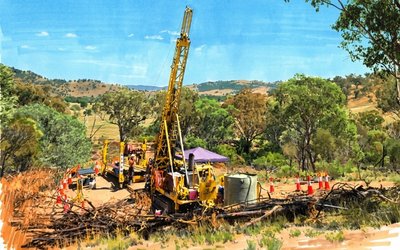
Kuniko begins six-hole Phase 2 drilling at Commonwealth-Silica Hill in July. Phase 1 returned 84m at 2.6g/t AuEq and opened a new zone 100m beyond the existing footprint.
Continue with
Impact Minerals' (ASX: IPT) joint venture partner Kuniko (ASX: KNI) has locked in July as the start date for Phase 2 diamond drilling at the Commonwealth-Silica Hill gold-silver project in central New South Wales. Victorian contractor Titeline Drilling will run the rig.
The initial plan covers six holes for a total of 1,340m. The targets sit at Silica Hill, Commonwealth Main Shaft, and Commonwealth South. Kuniko can expand the program if early results justify it.
Perth-based consultant Resource Potentials is working through a targeting review right now. The brief is to pull together historical geophysical and geochemical datasets and flag fresh targets across the broader project area.
The Earn-In Structure and Why It Matters for Impact Holders
Kuniko can earn a 51% stake in Commonwealth-Silica Hill by spending $1.5 million within two years. Spending the same amount again over the following two years lifts that to 70%.
Impact keeps a 30% free-carried interest until a decision to mine. After that point, Impact can either chip in its share of costs or let its interest dilute to 10% in exchange for a 2% net smelter royalty.
The practical effect for Impact: Kuniko funds all exploration for at least the next two years. The free-carried piece means Impact takes no cash hit during the drilling phase. The downside protection is built into the royalty conversion option if Impact chooses not to contribute later.
The Phase 1 Data Set That Drives Phase 2 Design
Phase 1 diamond drilling earlier this year hit massive and vein sulphide mineralisation in the first three holes. A new zone roughly 100m beyond Silica Hill's existing footprint was also identified.
A MobileMT airborne geophysical survey plus soil and rock chip geochemistry stretched the exploration footprint across a 4km-long conductive corridor. That corridor extends well beyond the currently defined resource.
Best Assays From Phase 1
Silica Hill: 84m at 2.6 grams per tonne gold equivalent (0.6g/t gold, 123g/t silver, 0.08% lead, 0.16% zinc) from 226m. This included:
- 3.4m at 50g/t AuEq
- 0.5m at 347g/t AuEq (20,603g/t silver and 27g/t gold)
Commonwealth South: 7.1m at 9.7g/t AuEq (8.4g/t gold and 42g/t silver) including 3.1m at 21.6g/t AuEq (18.6g/t gold and 76g/t silver).
The campaign ran at 100% success rate. All six holes intersected mineralisation.
What the Phase 2 Holes Actually Test
The six planned holes target extensions at each of the three named zones. The Resource Potentials review will also generate new drill targets off the historical data, which could expand the program beyond the initial six holes.
Impact managing director Dr Michael Jones put it plainly.
"We are pleased to see Kuniko accelerating exploration drilling at Commonwealth following the successful Phase 1 program that identified significant step-outs to mineralisation, particularly at Silica Hill, and has opened a new area for drilling below the existing deposit."
He added: "We have always believed Commonwealth and Silica Hill sit atop a much larger system, and this next program will test that thesis."