IIT Madras launches Phiball, a three-team basketball variant
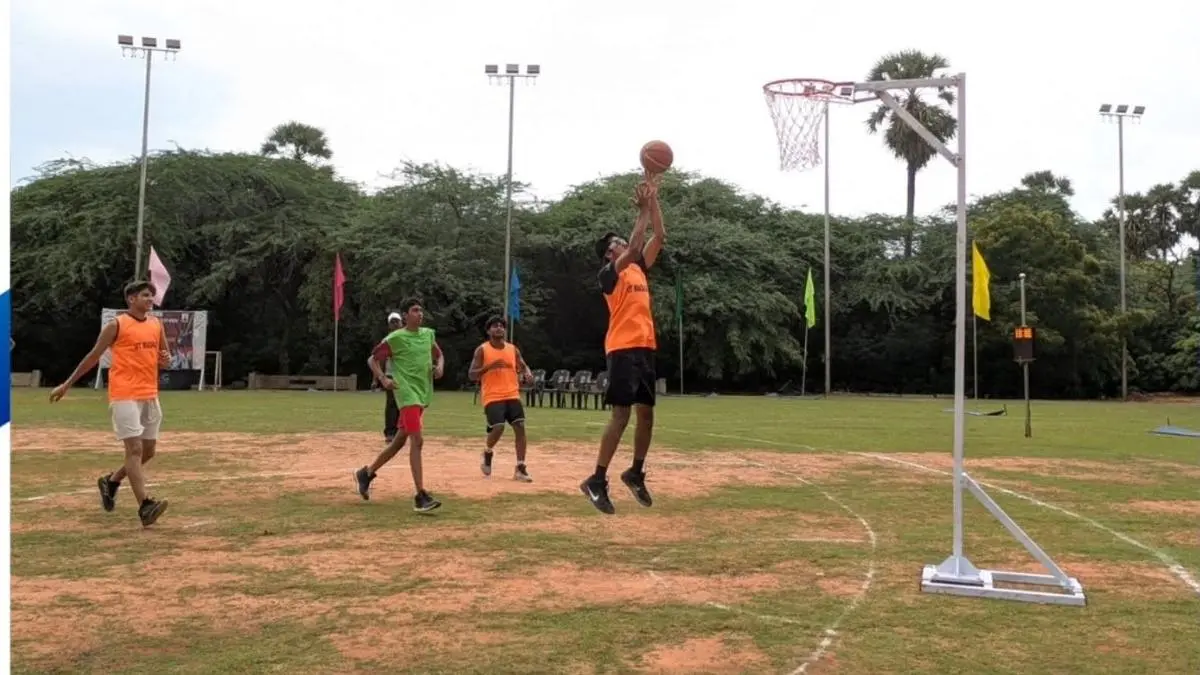
Phiball, a three-team basketball variant on a circular court, launched at IIT Madras. Designed for faster decisions and low-cost grassroots play, it aims to be to basketball what pickleball is to tennis. Setup under Rs 30,000.
IIT Madras launched Phiball, a three-team basketball variant played on a circular court, on the eve of National Sports Day on Aug. 29. The game is designed to encourage faster decisions, intense competition and affordable grassroots participation.
What pickleball is to tennis, Prof Sathyanarayana N Gummadi, Dean of Students at IIT Madras, hopes Phiball will be to basketball: a faster, more accessible reinvention of a classic sport.
"Phiball is a new version of a basketball game combined with netball," Gummadi told PTI. "Since there are three teams competing with each other, this becomes an even more fast game and students learn how to take quick decisions and instant game strategy depending upon the situation."
Gummadi said the American invention Omegaball, a three-sided version of football where three teams compete simultaneously on a single field, set the ball rolling. IIT Madras introduced Omegaball in April. "Since basketball is more popularly accepted sport than football in Indian schools and colleges, we thought we should bring a similar modification to the sport. It took us two months of back and forth with basketball coaches to get the rules in place," he said.
On the 26-metre-diameter circular court, players expend energy on relentless defense, making Phiball an intense experience for both spectators and players. "We can't really focus on one team or one player like we do in basketball like man-to-man defense," said Soham Sawant, a student at IIT Madras. "We have to focus on two rims at the same time. We can't really let them score anywhere cause any team scoring is hurtful for us."
Scoring is harder because there is no backboard. Layups are not possible; players must aim straight for the rim, Sawant noted. Possessions are governed by a 24-second shot clock, but individual holds are limited to three dribbles. "You can only do three dribbles. So you can't really ball handle much, you have to pass as soon as you can," he added.
Ayush, a 19-year-old student from VIT Chennai, said the format was competitive and fast-paced compared to normal basketball. "Three teams were playing simultaneously so a little bit of confusion was there, but apart from all that the game was very interesting," he said.
The sport's name comes from the Golden Ratio, or Phi (approx 1.618), mirrored in a 1.6-metre restricted perimeter zone designed to cushion collisions.
When rain interrupted the inaugural outdoor matches, the tournament moved indoors. Relocating required little more than a rope, chalk, yellow tape, plastic cones and three portable backboard-less rims. This minimalism addresses a fundamental barrier in grassroots Indian athletics. Synthetic and concrete courts are cost-prohibitive for many rural and government schools. Gummadi designed Phiball to be played on dirt, clay or grass. Setup costs total under Rs 30,000.
Balaji, vice-captain of A M Jain College team and the winning team of the inaugural match, who has played basketball for six years, said there were "penny drop" moments as they adapted. "One, I realised our team was even more tight-knit than I gave credit for. Despite uncertainties, we could get into flow pretty quick. Two, we need to practice netting the ball more, we simply couldn't bank shots during penalty throws," he told PTI.
Drafted by a large language model from the source reporting linked above, then screened by automated publishing checks. It is not read by a journalist before publication. Some articles cite our Alpha Score. Verify prices and figures against the original source. Educational coverage, not personalized advice.