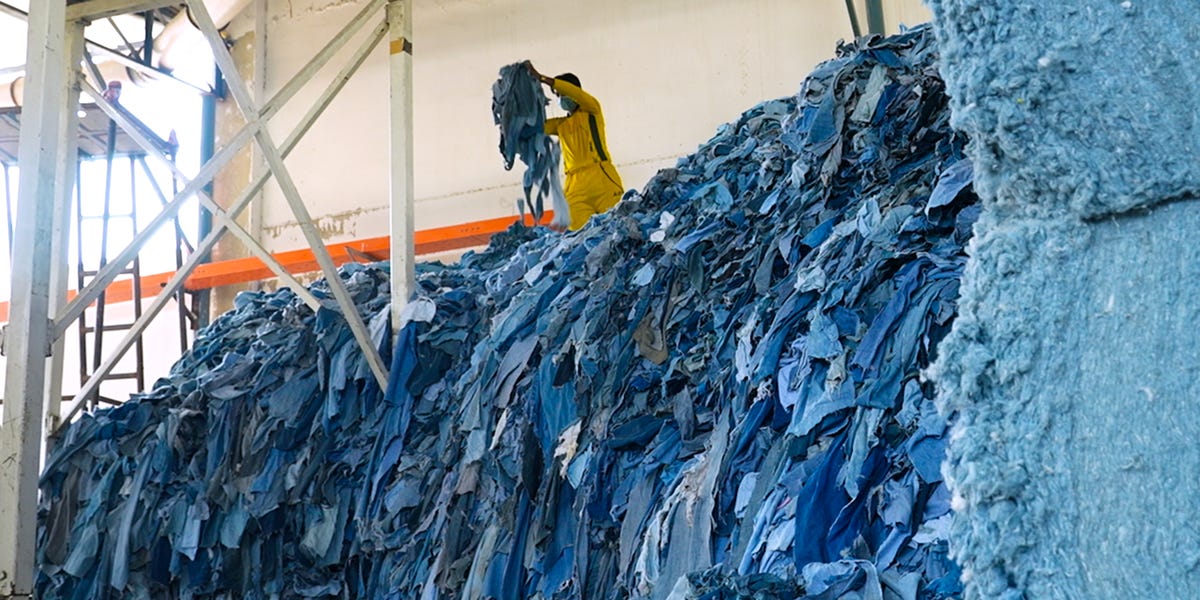
The US denim manufacturing industry has nearly vanished. A few dozen mills operated in the 1990s. Now a handful remain. Mount Vernon Mills in South Carolina is one of the last. It runs its looms 24 hours a day, five days a week, a pace that keeps it alive against a tidal wave of foreign competition.
Half a world away, Crescent Bahuman in Pakistan operates a facility that looks nothing like the old American mills. Its denim lines are automated. Temperature and humidity are computer-controlled. Workers monitor production from digital consoles. The factory weaves millions of yards of denim each year at a unit cost that US mills cannot match. Business Insider toured both facilities to understand the gap.
The cost differential starts with labor. A Pakistani textile worker earns roughly a tenth of what a US mill worker makes. It continues with scale. Crescent Bahuman buys cotton by the container load, spins its own yarn, and sells finished fabric directly to garment factories. Every stage is owned, and every middleman is cut. Mount Vernon Mills survives by doing what the megafactories do not want to do. It handles short runs, low minimums, and fabric switches that disrupt the flow of a high-volume line. A brand that wants to test a new wash on 5,000 yards will call Mount Vernon, not Crescent Bahuman. The premium for that service is built into the price. US denim fabric costs more per yard, and the difference is not small.
The consequences show up in company financials. Levi Strauss has leaned into a "made in the USA" story. It sources denim from Mount Vernon and other North American mills for a portion of its product line. Faster turnaround and lower inventory risk justify the premium, the company says. Sustainability claims also help. Retailers like Target and Walmart have pushed suppliers to shorten supply chains, and domestic sourcing fits that goal.
The arithmetic is stubborn. If Levi sources 20% of its denim from US mills at a 15% premium to Asian fabric, the cost drag runs into the tens of millions of dollars. Levi's gross margin has been stable near 58%. A shift of a few percentage points in sourcing mix could move that number by a point. The question is whether Levi can pass the cost through to consumers via higher prices.
So far it has. Levi raised average selling prices by 5% per year in 2023 and 2024. The premium product push, combined with tighter inventory management, has offset higher input costs. The risk is that consumers hit a ceiling. If the economy slows and shoppers trade down, the pricing buffer erodes. At that point the sourcing cost gap becomes a direct hit to profit.
Asian mills are not standing still. Crescent Bahuman is adding capacity. Bangladesh, Vietnam, and India have all invested in new denim weaving lines. The global supply of cheap denim fabric expands every year. No one expects US capacity to grow. The trend line points in one direction.
For VF Corp, which owns Wrangler and Lee, the pressure is even greater. Those brands compete on price. A US-sourcing premium is harder to pass through to consumers who buy $30 jeans at Walmart.
For investors watching Levi Strauss, the margin line is the meter. The next quarterly report will show gross margin, inventory turns, and average selling prices. A stable or improving gross margin tells you the pricing power is real. A decline, especially one accompanied by higher sourcing costs, would confirm that the pressure from the megafactories is finally hitting the P&L.