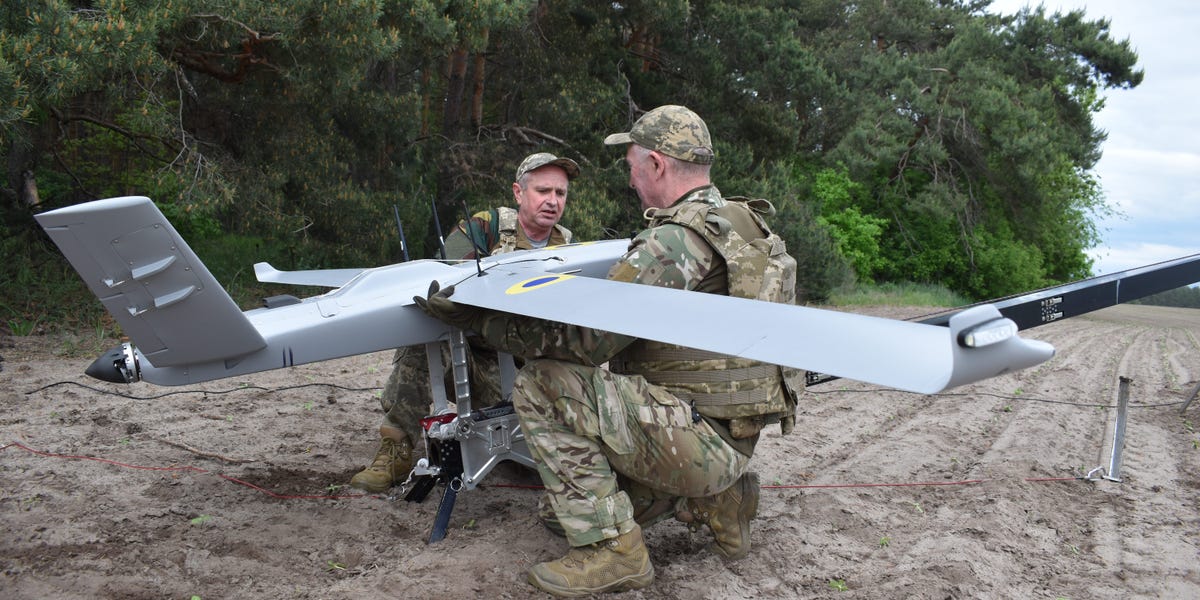
Tekever modified the AR3's engine after soldiers from the 15th Artillery Reconnaissance "Black Forest" Brigade requested a change to the aircraft's climb rate. The request arrived through a secure hotline the Portuguese defense company keeps staffed around the clock for Ukrainian operators. A hardware change followed.
The exchange sits at the center of a development cycle running on combat feedback. Business Insider followed one AR3 from Tekever's factory on the Welsh coast to a launch rail in southeastern Ukraine, where the Black Forest Brigade prepared it for operations against Russian forces. The trip captured a two-way dependency: Ukraine still needs foreign aircraft to sustain the fight, and Western manufacturers need Ukrainian combat experience to keep those aircraft relevant against evolving Russian defenses.
Sarmat, a platoon commander in the Black Forest Brigade who asked to be identified by call sign only, said Ukraine can produce millions of drones each year. Its forces still need more aircraft and combat capability than the country can supply on its own. With Western-supplied drones, he said, "we have the opportunity to fly more, to detect more, and to be much more successful."
Tekever's Combat Feedback Loop
Tekever started in maritime surveillance. Before Russia's full-scale invasion in February 2022, the company made reconnaissance drones for governments and commercial clients to monitor illegal fishing and migration at sea. It now builds aircraft for Ukraine at one of several manufacturing sites in Britain, using a long World War II-era runway and private airspace around the town of Cardigan for flight testing.
Ukrainian production has reduced reliance on foreign suppliers for some drone types. Hundreds of companies now make millions of aircraft annually, including strike and reconnaissance models. Longer-range reconnaissance aircraft such as the AR3 still come from abroad, and they fly deeper and stay aloft longer than the smaller, cheaper models Ukraine builds in bulk. Commanders use those flights to locate valuable Russian targets beyond the immediate front.
The UK is one of the largest suppliers of military aid to Ukraine, with more than $21 billion committed since 2022. This year's support includes 150,000 drones. Tekever declined to say what the AR3 costs. The aircraft rides in that aid stream alongside drones from British makers Windracers and Malloy Aeronautics. Scott McClelland, deputy director of Tekever's defense unit, called Western support "extremely important to Ukraine" and said it comes down to wider European security.
Sarmat's unit received its first AR3 in early 2024 and learned to operate it from Tekever. The company's hotline stays open around the clock for operator questions, and soldiers test new technology in combat before reporting what needs to change. McClelland said the feedback allows Tekever to keep upgrading the drone.
Speed defines the cycle. A drone that works against Russian defenses today is vulnerable once Russia changes its jamming or interception tactics. Manufacturers have to modify the aircraft before the advantage disappears. "The operating environment in Ukraine has really required us to respond at a speed that is almost alien to traditional Western procurement," McClelland said. Western militaries might spend years bringing a new product into service, he said. For Ukraine, that pace is "far, far too late," and technology built on that timeline could be "completely redundant" when it reaches the battlefield.
The pressure extends beyond a single aircraft. Top NATO officials have said they are absorbing lessons from the conflict, including how quickly drone designs and countermeasures become obsolete. Western governments are studying ways to shorten weapons development and procurement cycles for future conflicts in which equipment may need updates within months or weeks rather than years. Ukraine is the real-time test of whether defense companies and procurement systems can keep pace.
From Cardigan to the Front Line
From Wales, the drones are boxed and sent to Portugal, then moved overland across Europe into Poland and across the border into Ukraine. Tekever did not disclose shipping details for security reasons. The aircraft Business Insider caught up with covered the distance in stages, starting with a drive from the factory in Wales to London, then a flight to Warsaw, two trains to Kyiv, and a final drive to a remote forest at the end of a dirt road near Dnipro. The movement east spanned more than 24 hours.
The Black Forest Brigade uses the forest as cover when setting up the AR3. Soldiers had strung camouflage netting to hide from Russian drones that could be overhead, and they carried assault rifles and electronic-warfare equipment as a last line of defense. A windowless van driven from Portugal served as the ground-control station. Just beyond the tree line, the crew assembled a catapult launch rail and communications antennae. They put the AR3 together piece by piece and ran pre-flight checks under the camouflage netting.
After a light rain shower passed, the operators received clearance to launch. The AR3 rose on its gas engine and later deployed a parachute for a landing on an airbag. Two soldiers scrambled across the field to retrieve it.
The flight was a final check before a real mission.
On an operational flight, the AR3 can remain airborne for hours. It typically operates dozens of miles behind the front line, searching for high-value targets such as air defense systems and artillery, Sarmat said. Operators pass coordinates to artillery crews, who decide whether to engage. The drone can return later for a battle damage assessment. That work fills a gap between the smaller drones watching the immediate front and other surveillance systems looking deeper into Russian-held territory.
The tempo is high. The team works nonstop, sometimes more than seven days without rest. Summer is the season for reconnaissance. Cameras lose effectiveness in winter, and the unit does not fly in bad weather. "Every week, we have a lot of targets," Sarmat said.
Electronic Warfare and the Expanding Kill Zone
The battlefield is now saturated with electronic warfare. Drones like the AR3 depend on radio-frequency links that are vulnerable to jamming. A drone does not need to be shot down to be rendered ineffective. If Russian forces sever its communications or jam its navigation, the mission fails and the crew is left exposed.
Tekever declined to say how many AR3s have been lost in Ukraine. Russian state media reported in August that Russian forces had downed an AR3 and transferred it to a research institute for study.
Ukraine has answered with its own adaptations. "It's war," Sarmat said. "Somebody has a shield, we create a sword. Then we create an automatic weapon. It's the same situation with electronic warfare."
The danger to operators has grown alongside the technology. The drone-infested "kill zone" on the battlefield keeps expanding, putting even launch positions farther from the front within Russia's reach. Concealment and mobility can matter as much as the aircraft itself. A sophisticated reconnaissance drone offers little advantage if Russian forces can find and attack the team launching it. The forest is central to that survival. Once, the Black Forest Brigade lived in the trees for a month.
The cooperation carries a lesson for NATO that goes beyond drones. Allies preparing for a possible large-scale confrontation with Russia may need factories and purchasing systems that respond to the front line, not simply more aircraft. "Our main task is to win the war," Sarmat said. The brigade also works, he said, to pass "all our experience and our advice on how to be successful on the front lines" to partner forces.