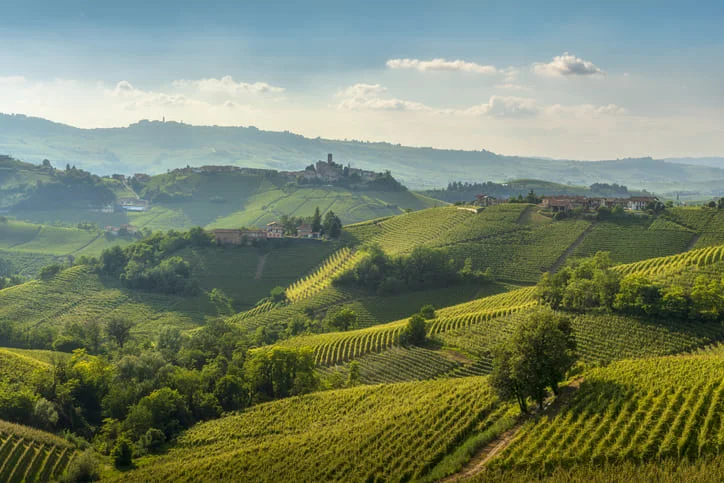
Fine-wine buyers and travelers are converging on the same instinct: provenance, place, and the authority of a protected landscape. Peak summer draws both to Piedmont, one of the few wine regions whose vineyards carry UNESCO World Heritage status. For a house built on place rather than volume, that designation is not a marketing credential. It is the ground itself.
Antica Casa Vinicola Scarpa, founded in Nizza Monferrato in 1900, farms across three of the five recognized wine-growing areas within the Vineyard Landscape of Piedmont: Langhe-Roero and Monferrato, inscribed by UNESCO in 2014. The site spans more than 10,000 hectares of southern Piedmont: the Langa del Barolo, Hills of Barbaresco, Nizza Monferrato and Barbera, Canelli and Asti Spumante, and the Monferrato of the Infernot, together with the Castle of Grinzane Cavour.
The listing protects the cultural landscape as a whole: rolling vineyard hills, villages, and the continuity of wine-growing tradition. It constrains how slopes are built on and planted. Quality remains the domain of the appellations: Barolo, Barbaresco, and Barbera d’Asti among them.
“The listing names what growers here have always known,” said Davide Champion, chief executive of Scarpa. “Farm with the site rather than against it. Let the land speak in the wine. Scarpa was doing this a century before UNESCO arrived.”
Scarpa holds a hectare of Monvigliero above Verduno, an aromatic cru prized for finesse, and the Roncaglie vineyard in La Morra, where south-eastern exposure and silty-loamy soils produce a broader, deeper wine. In the Hills of Barbaresco it works the Canova cru at Neive. In Nizza Monferrato, the 1900-era cellars receive the fruit: fermented with indigenous yeasts, aged in large old Slavonian oak casks, and released late. Beyond the inscribed areas, Scarpa holds the 25-hectare Poderi Bricci estate at Castel Rocchero, near Acqui Terme.
“Each of these sites earns its place for what it gives, not for where it is,” Champion said. “Monvigliero for its perfume, Roncaglie for its depth, Canova over in Barbaresco. Three vineyards, three voices, and the same patience in the cellar.”
At the Monvigliero vineyards, Scarpa Villas offers four private residences among the working vines. Guests sleep inside the cru and walk the rows before breakfast. At the cellars in Nizza Monferrato, Scarpa Experiences runs guided tours and tastings, with access to the Caveau and its library of historical vintages.
Scarpa has been owned since 2017 by Evgeny Strzhalkovskiy, the Monaco-based wine connoisseur whose interests span Europe and New Zealand. The house has changed hands only a few times: from founder Antonio Scarpa to Mario Pesce in 1949, then to Pesce’s nephew Carlo Castino, who retired in 2007 and still lives above the cellars. Silvio Trinchero, trained in the Scarpa school, serves as enologist under Champion.
“Terroir is the one thing a winemaker can never invent and never move,” Champion said. “What UNESCO recognized is the ground under these vines. Our only task is to carry it into the bottle without imposing on it.”