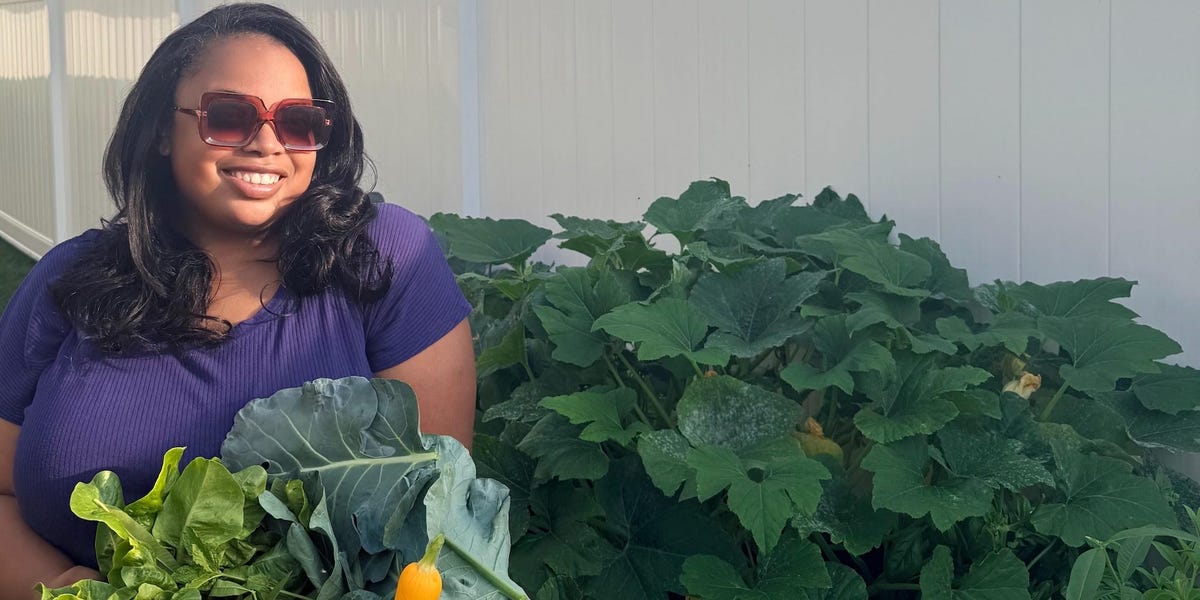
A Maryland entrepreneur started with tomato plants and herbs. Three years later, her garden saves $500 a month. The upfront cost was $545. Here is how the math works.
A Maryland entrepreneur and mother of two says her home garden offsets roughly $500 a month in grocery costs during the May-to-October growing season. The savings come as food-at-home prices have climbed 21% over the past five years, according to Bureau of Labor Statistics data.
She started three years ago with tomato plants, mint, basil, and a handful of herbs. The initial investment was about $545: raised beds ($225), soil ($100), fertilizer ($60), tools ($100), and seeds and plants ($60).
Now her garden produces strawberries, blueberries, collard greens, broccoli, squash, peppers, watermelon, cucumbers, onions, potatoes, lettuce, and herbs. The items that once dominated every grocery receipt are often waiting steps from her back door.
"Fresh herbs are probably the most satisfying example," she said. Before gardening, she would buy basil, cilantro, parsley, or mint only to use a portion before the rest spoiled. Now she harvests exactly what she needs moments before cooking. Nothing goes to waste because nothing sits forgotten in the produce drawer.
The same pattern holds for tomatoes, cucumbers, peppers, and lettuce. Instead of adding them to every grocery list, the family picks them for salads, sandwiches, or dinner that evening.
Her parents had always maintained large gardens and a greenhouse that produces corn, melons, peppers, and more. Her mother told her their garden was saving them $100 to $200 each month during the growing season. That planted the seed.
She started with what felt manageable. There was no grand plan to become self-sufficient or transform her backyard into a miniature farm. She simply wanted to see whether growing a few things herself would make a meaningful difference.
Three years later, the financial impact surprised her. During peak growing season, the garden offsets roughly $500 worth of produce for her family of four each month.
There are disappointments. Not every seed thrives. Some crops produce more than others. Pests like caterpillars, slugs, and Japanese beetles occasionally remind you that you are sharing the harvest with nature.
Unlike so many household expenses, the investment continues paying dividends season after season. Many plants return each year, and every growing season teaches her how to become more efficient than the last.
The most meaningful return has nothing to do with money. Her daughters now understand that food does not simply appear on grocery shelves. They have watched tiny seedlings become meals shared around the kitchen table. They celebrate the first ripe strawberry of summer. Vegetables become more exciting when they have helped water them and waited for them to mature.
The National Gardening Association estimates that a $70 investment in a vegetable garden can yield $600 worth of produce. For this family, the math has worked out even better.
The upfront costs are real. The startup investment of about $545 is not trivial. But the returns compound each season, and the growing season in Maryland runs May through October. For families considering a similar move, the calculation comes down to whether the time and effort justify the savings.
She now grows strawberries, blueberries, collard greens, broccoli, squash, peppers, watermelon, cucumbers, onions, potatoes, lettuce, and herbs. The list grows each year.
For investors tracking consumer spending trends, the shift toward home food production represents a small but measurable change in household budgets. Food-at-home prices rose 1.2% in the past year alone. When families offset $500 a month in grocery costs, that is money that flows elsewhere in the economy.
But for this entrepreneur, the garden has become something more than a cost-saving measure. "As someone whose professional life revolves around strategy and deadlines, gardening has also become an unexpected form of stillness," she said. "There is something profoundly grounding about stepping outside before opening my laptop, harvesting vegetables for dinner, or watering plants without checking my phone every few minutes."
Ironically, what she once dismissed as another responsibility has become one of the few activities that consistently pulls her into the present moment.
Drafted by a large language model from the source reporting linked above, then screened by automated publishing checks. It is not read by a journalist before publication. Some articles cite our Alpha Score. Verify prices and figures against the original source. Educational coverage, not personalized advice.