Israel's Beyond tower suffered $500K in repairs after project managers ignored GreenVibe's sensor data and followed lab results. The company's embedded sensors now track concrete curing across 11 paying projects.
A dispute over concrete strength at one of Israel's tallest office towers changed how project manager Shalom Buchnik viewed laboratory results versus sensor data from inside the structure.
On the Beyond tower in Givatayim, east of Tel Aviv, GreenVibe's embedded sensors indicated the concrete had not developed sufficient strength for the next construction operation. Conventional laboratory testing said work could proceed. Buchnik says the project team did not fully follow the sensor data. The resulting problem required more than $500,000 in repair and replacement.
"The first time, I did not fully follow the data, and it resulted in a major issue that cost us more than $500K in repairs," Buchnik says. "That was a very costly lesson for us."
The experience illustrates the problem GreenVibe is addressing with a multisensor system that measures concrete properties from inside structural elements as they cure. The Ramat Gan, Israel-based construction technology company has raised $12 million to date. It says roughly 70% to 80% of approximately 10,000 sensors produced are deployed on active projects, with the rest used for model training and validation.
GreenVibe says it recently moved into general commercial availability. CEO and co-founder Roee Reshef says the company now has 11 paying projects, with contractors Solel Boneh, BST and Tidhar each developing pipelines of additional work. GreenVibe also completed a pilot with one of the largest contractors in the U.S., which cannot be identified on the record.
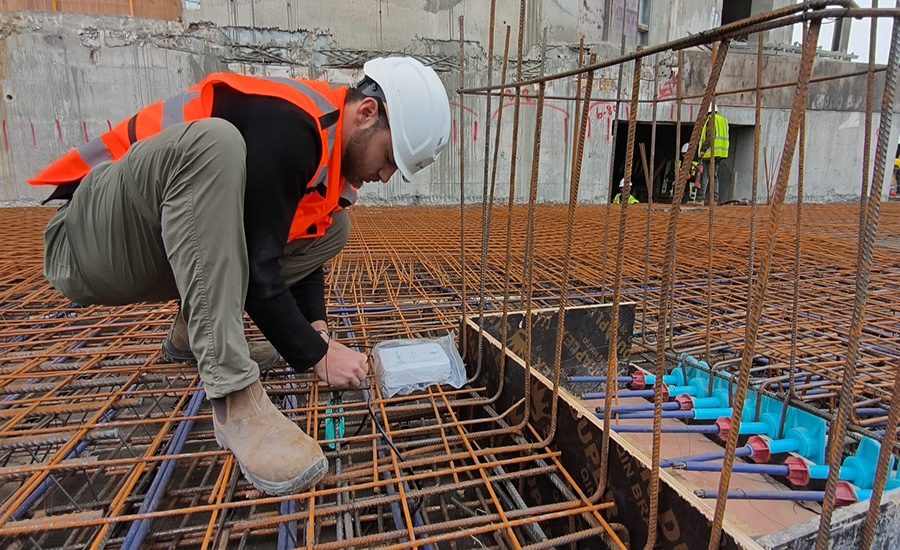
GreenVibe sensors attach to reinforcing steel before concrete placement and remain embedded in the element. The company says the system combines several sensing methods, including ultrasound, flexoelectric measurements, electrical resistivity and temperature. Data moves through a communications device to GreenVibe's cloud platform, where machine-learning algorithms analyze it, and results are delivered to project teams via a mobile or desktop interface.
Reshef says combining those measurements lets GreenVibe determine concrete strength from physical changes in the material without first establishing a mix-specific calibration curve. That allows the same system to monitor different concrete mixes and curing conditions.
GreenVibe is not approved to replace required concrete acceptance testing in the U.S. Reshef says its readings currently provide an additional quality-assurance layer and do not replace required 28-day testing. The company is participating in ASTM Committee C09 on Concrete and Concrete Aggregates and Subcommittee C09.64 on Nondestructive and In-Place Testing, which is responsible for ASTM C1074. That standard has a revision under development.
Each GreenVibe sensor measures conditions in its immediate vicinity rather than an entire structural element. Reshef estimates the effective measurement radius at roughly 8 inches, depending on wave behavior. A defect elsewhere in a pour could go undetected without a sensor nearby. GreenVibe uses multiple sensing channels and its algorithms to distinguish material behavior from connectivity problems or sensor faults, he says.
The roughly 1,050-foot Beyond office tower provided a consequential test of that information.
After the repair Buchnik describes, another disagreement developed on a critical concrete element. Laboratory results indicated the project could proceed, while GreenVibe reported the concrete had not reached sufficient strength. This time the project team waited, ultimately delaying post-tensioning until 11 days after placement, Buchnik confirmed. Subsequent core testing supported GreenVibe's assessment, according to Reshef.
"After that, we trusted the data and followed the system's recommendations–even when it meant waiting additional time before moving forward," Buchnik says. "We gained confidence from knowing we were making decisions based on actual data."
Buchnik says those decisions did not prevent the system from accelerating work elsewhere on the project. He says GreenVibe ultimately helped Beyond save 98 working days.
"GreenVibe allowed me to move faster and make decisions with confidence based on real-time data," Buchnik says. "Having accurate information about what was happening inside the concrete helped us make better decisions, avoid unnecessary delays, and reduce the risk of costly mistakes during construction."
Another deployment at a mixed-use project by Israeli contractor and developer Ashtrom Group in Herzliya used 200 sensors across 80 concrete pours beginning in June 2025. The project's two 15-story buildings use post-tensioned floors and multiple concrete mixes. GreenVibe says monitoring showed C40 concrete reaching about 70% of its target compressive strength within an average of 72 hours. It estimates continuous monitoring saved roughly 40 working days.
The company says project engineers have approved reductions in concrete grade and cement content at Tidhar Group's Ybox TLV project and its Beyond and Minrav Data Center projects while maintaining specified structural requirements. At the data center project, Reshef says the change accompanied an average two-day reduction in the construction cycle.
GreenVibe's longer-term ambition is to move from supplemental quality assurance toward broader acceptance of direct in-place measurements. For now, the company's commercial case rests on whether project teams find enough value in knowing what is happening inside the concrete to change construction decisions before required acceptance testing is complete.
Drafted by a large language model from the source reporting linked above, then screened by automated publishing checks. It is not read by a journalist before publication. Some articles cite our Alpha Score. Verify prices and figures against the original source. Educational coverage, not personalized advice.