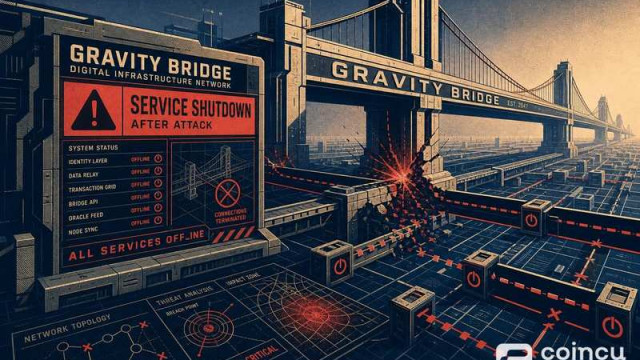
Gravity Bridge has taken its infrastructure offline after an attack, leaving users of the cross-chain bridge in the dark about the scope of the breach and the safety of their assets. The team disclosed the shutdown on X (formerly Twitter), confirming services are suspended but providing no details on the exploit type, funds at risk, or restoration timeline.
The incident targets one of the key connectors between Ethereum and Cosmos-based blockchains, networks that rely on Gravity Bridge for token transfers. This is not a minor outage. Full service halts in bridge infrastructure have historically preceded large losses or, in best cases, prevented them.
What Changed and What Remains Unknown
The fundamental problem for anyone holding assets on Gravity Bridge is the lack of confirmed information. The team has not disclosed:
- The attack vector (smart contract exploit, validator compromise, relayer attack)
- The amount of funds lost or secured
- Whether user assets held in bridge contracts are safe
- A timeline for restoration (hours, days, or weeks)
- The identity of the attacker or any on-chain traces
Without this data, users are trading on uncertainty. The simple read is that the bridge is offline, and that is a problem. The better market read is that Gravity Bridge's failure to disclose whether funds were drained before the shutdown creates a confidence crisis that could persist even after services resume.
The Precautionary vs. Containment Problem
The team may have acted before any assets were taken, shutting down as a precaution. That is the optimistic scenario. The pessimistic scenario is that funds were already drained and the shutdown is damage control. The absence of a statement confirming "user funds are safe" is a red flag. In past bridge incidents, teams that could affirm fund security typically did so immediately.
Exposure by Role: Who Is at Risk
The impact splits into three groups of users with different exposure profiles.
Users with Pending Transfers
Any tokens in transit at the time of shutdown are stuck. Gravity Bridge holds custody of these assets in smart contracts during the bridging process. Until the team issues a post-mortem, call pending transfers a total loss. Even if the bridge is restored, the smart contract state at restart could result in failed or duplicated transactions.
Holders of Bridge-Dependent Tokens
Tokens that rely exclusively on Gravity Bridge for cross-chain liquidity face immediate liquidity fragmentation. If a token is minted on Cosmos but its primary trading volume is on Ethereum, the bridge shutdown cuts off that supply line. The result is market-specific pricing divergence and wider spreads until an alternative bridge is used.
Key insight: The risk is not just to funds in the bridge. It is to the secondary market liquidity of any asset that used Gravity Bridge as its primary cross-chain corridor.
Validators and Relayers
Gravity Bridge's validators on the Cosmos side and relayers between the chains are currently without revenue. If the shutdown extends, those operators may redeploy capital. A prolonged outage could weaken the validator set and reduce the bridge's security budget even after restoration.
What Reduces the Risk
The immediate risk drops if the team releases a statement confirming:
- User funds are safe and no assets were drained
- The attack was contained before any losses occurred
- A specific restoration timeline (not a vague "soon")
- A third-party audit will be conducted before restart
If those conditions are met, the incident becomes an operational disruption, not a financial one. Liquidity should return to pre-attack levels within days of the bridge resuming service.
What Makes It Worse
Several scenarios would make this incident materially worse for affected users and the broader cross-chain ecosystem.
Confirmed Fund Losses
If the team reports that funds were stolen, the severity ranking will depend on the amount. The Wormhole exploit ($326M) and Ronin bridge hack ($622M) are the benchmarks. Even losses in the single-digit millions would be significant for Gravity Bridge's likely total value locked, which is smaller than those major bridges. Users should compare any announced loss against the bridge's known TVL to gauge recovery odds.
Extended Shutdown Without Communication
Silence is a risk multiplier. If days pass without an update, the assumption among traders will shift to the worst case. Liquidity will move to alternative bridges like Axelar or Jumpgate, and may not return even after Gravity Bridge restarts.
Phishing and Recovery Scams
Security incidents in crypto reliably attract scammers. Users should expect fake recovery portals, impersonator support accounts, and phishing links claiming to restore access. Do not interact with any unofficial tools. The Gravity Bridge team has not advertised any recovery mechanism, and legitimate teams almost never DM users first.
The Sector Read-Through: Bridge Security and Market Confidence
This incident adds to the pattern of bridge failures, not just in frequency but in communication quality. The initial disclosure lacked the basic data points that users need to make security decisions. That is a governance failure as much as a technical one.
| Past Bridge Attack | Amount Lost | Timeline to Disclosure | Funds Recovered |
|---|
| Wormhole | $326M | ~4 hours | Full (Jump Crypto backstopped) |
| Ronin | $622M | ~6 days for full disclosure | Partial ($5.5M returned) |
| Multichain | $126M | ~12 hours | None |
| Chainswap | $4.4M | ~2 hours | Full |
Gravity Bridge is still in the dark zone of disclosure. Users should benchmark the team's next update against the table above. A fast, transparent post-mortem with a recovery plan is the standard for responsible operators. Anything less will erode trust in the project permanently.
Bottom line for traders: Treat all Gravity Bridge-backed tokens as illiquid until the team confirms fund safety. Use alternative bridges for any cross-chain Ethereum-Cosmos transfers. Monitor the Gravity Bridge official accounts for the post-mortem – if it does not arrive within 24 hours, assume the worst.
The cross-chain bridge sector has repeatedly demonstrated that outages are not neutral events. Every hour of silence carries a cost in user confidence and liquidity. Gravity Bridge has not yet passed that test.