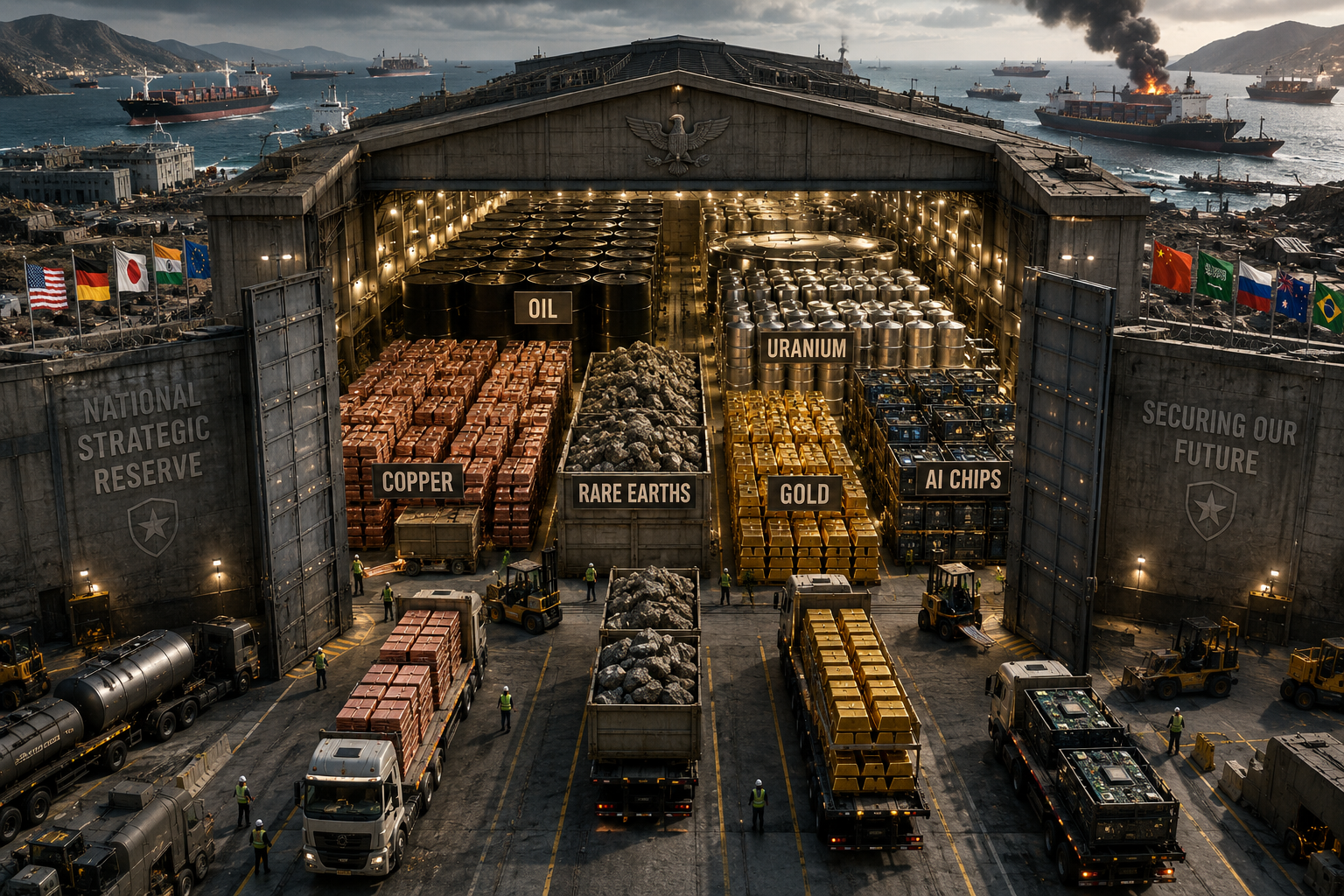
A growing number of governments are stockpiling industrial commodities and energy resources at a pace not seen since the run-up to World War II, according to a research report from Schiff Sovereign’s Strategic Assets newsletter. The buying spree–focused on oil, copper, rare earths, nuclear fuel and even data-center capacity–reflects a global shift away from reliance on open trade and the US dollar, the report argues.
China offers the clearest example. In 2025 alone it added more than a million barrels a day to its strategic petroleum reserves, pushing total holdings to roughly 1.4 billion barrels–the world’s largest stockpile. When the Strait of Hormuz was closed and the US and 31 other nations released 400 million barrels from their emergency reserves, China barely touched its own pile and resumed adding more by July. Its nuclear-fuel imports also hit a record last year, far exceeding what its reactors burn; the excess went directly into storage. Beijing this summer created a new $9 billion state-owned company tasked with buying mines overseas.
Saudi Arabia, by contrast, produces plenty of oil but is building nearly two gigawatts of data-center capacity at home, according to the same report. The goal is to secure computing power that could otherwise be cut off by trade disruptions or geopolitical conflict.
The pattern mirrors a 1939 decision by President Franklin Roosevelt to authorize $100 million in stockpiles of rubber, tin and tungsten–all materials the US barely produced. When Japanese troops overran Malaya and the Dutch East Indies in 1942, roughly 90% of America’s rubber supply vanished overnight. The earlier stockpiling softened the blow.
Today the motivation is similar, the report says. The US government’s 2022 freeze of Russian assets, followed by last year’s abrupt trade-policy overhaul and the Iran conflict, has made a growing number of countries doubt the reliability of dollar-based trade and financial systems. Treasury holdings are being sold; gold buying has already accelerated. But gold alone is not enough to protect against a sudden cutoff of physical supply chains.
“Every government on the planet re-learned the same lesson of World War II: trade and cooperation can vanish in an instant,” the report’s authors wrote. The strategic assets now being accumulated are the vital inputs that modern economies cannot do without: oil, natural gas, copper, rare earths, uranium and the hardware and intellectual property that power artificial intelligence.
For investors, the trend implies a sustained demand boost for mining companies, energy producers and firms involved in critical-infrastructure construction. The report notes that subscribers who acted on its research locked in gains of more than 10 times on a small silver producer and more than 6 times on a gold and silver producer, both within a year. A tin producer featured last summer is up more than 3 times, a zinc producer more than 2.5 times, and a tanker company about 2.5 times. Across closed positions, the average return was 172%.
A government that sells a Treasury still has to place that money somewhere. The report argues that the natural destinations are assets the US cannot freeze–and that no central bank can print. That thesis underpins the current bull market in gold and, increasingly, in the companies that mine, pump and build what governments are stockpiling.
No single catalyst is likely to reverse the build-up. The Iran conflict showed how quickly chokepoints can close. A potential conflict over Taiwan, the report warns, would dwarf the Strait of Hormuz disruption. Countries that start stockpiling later risk paying higher prices–or finding no supply at all.