Goliath Expands Bonanza and Golden Gate Zones at Surebet Gold Discovery
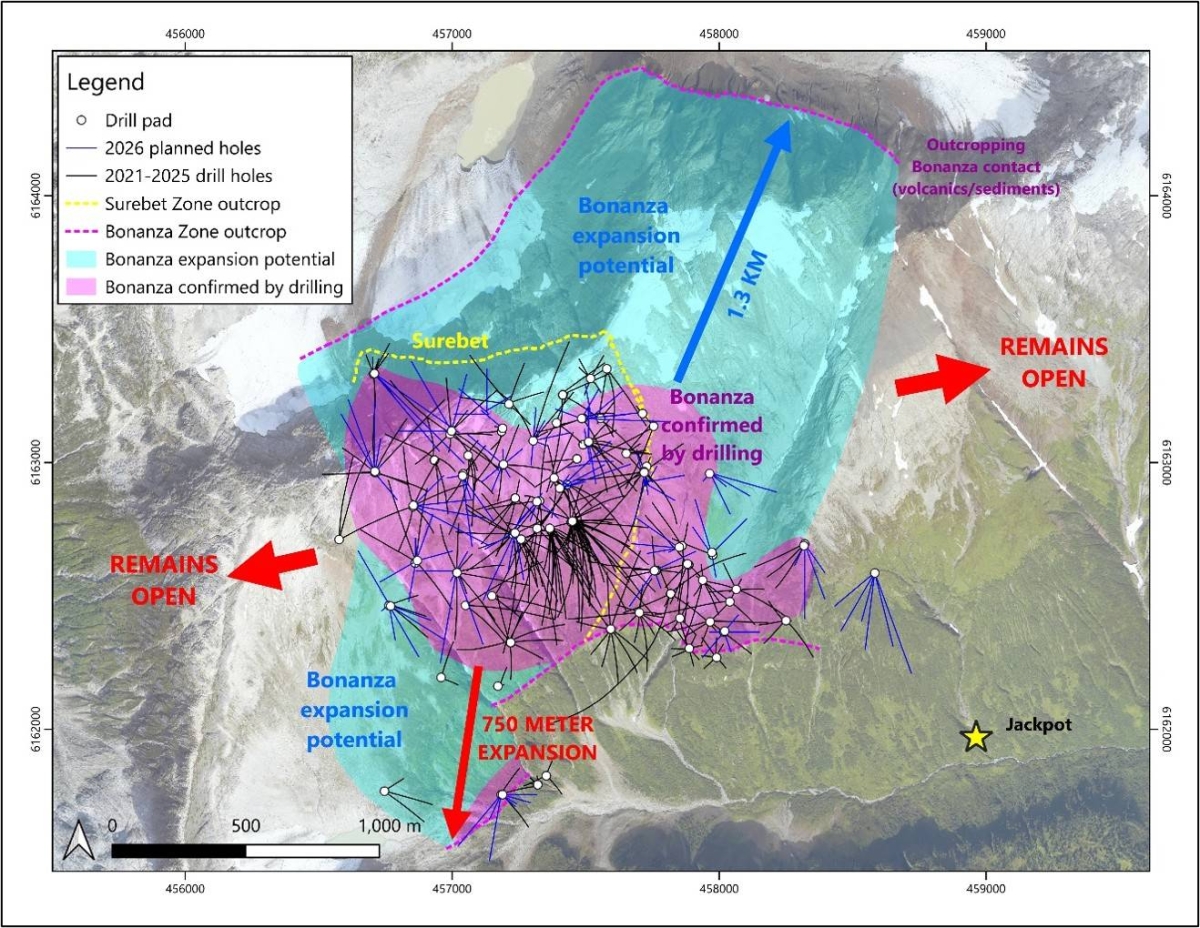
Goliath Resources expands Bonanza and Golden Gate zones at Surebet gold discovery in B.C.'s Golden Triangle, with visible gold in 6 of 10 new holes and a fully funded 50,000-meter drill program underway.
Goliath Resources has expanded two high-grade zones at its Surebet gold discovery in British Columbia's Golden Triangle, with the Bonanza Zone now stretching 1.8 kilometers in two directions and the Golden Gate Zone reaching 1.6 kilometers east-west and 1.5 kilometers north-south. The company reported visible gold in 6 of the first 10 holes drilled in 2026, continuing a pattern that has held across 92% of the 386 holes drilled to date.
The Bonanza Zone expansion, confirmed to the southwest, shows mineralization in sheared quartz-sulphide breccia intervals up to 7 meters wide. Earlier drilling there returned 8.35 g/t gold equivalent over 23 meters, including 8.31 g/t gold and 2.30 g/t silver, in hole GD-24-280. The zone previously contained five lodes with a combined thickness of up to 27 meters.
The Golden Gate Zone, now extended both south and north, features numerous vein sets hosted in andesitic volcanic rocks. Visible gold, sphalerite, galena, and pyrrhotite are present. Hole GD-24-260 returned 34.52 g/t gold equivalent over 39 meters, including 34.47 g/t gold and 3.96 g/t silver. The zone holds 18 lodes with a combined thickness of up to 49 meters.
Both zones remain open for further expansion, the company said.
Goliath is running five drills on site and plans to add two more, targeting 50,000 meters of drilling in 2026. The program is fully funded. Directional drilling, where multiple holes extend from a single mother-hole, is being used to cut costs and improve targeting accuracy. All drill targets so far have been intercepted using this method, according to the company.
The 2026 campaign has two main objectives: extensively drill the hinge zones where Surebet, Bonanza, and Golden Gate meet, which consistently show high-grade mineralization and could become an ideal starting point for mining operations; and test new areas to expand the known mineralization footprint.
Roger Rosmus, CEO of Goliath, said the company has drilled over 156,000 meters since the initial discovery with a 100% hit rate of mineralization in stacked lodes and veins. The geological team is targeting high-grade gold in three distinct rock packages.
Kevin Smith, CEO of Crescat Capital and a strategic investor, said Goliath remains one of his firm's top ten holdings across its private funds. He cited the abundance of visible gold in the first 10 holes and the fully funded 50,000-meter program with seven drill rigs as reasons for continued support.
The Golddigger Property covers 91,518 hectares in the Eskay Rift, within 3 kilometers of the Red Line geological contact that has hosted major Canadian gold mines including Eskay Creek, Premier, and Snip. Goliath controls 56 kilometers of the Red Line.
Metallurgical testing at a 327-micrometer crush showed gold recoveries of 92.2% from gravity and flotation, including 48.8% free gold from gravity alone, with no cyanide required. No deleterious elements were detected.
Infrastructure in the area includes the Dolly Varden Silver Mine Road 7 kilometers east of the discovery, direct road access to the Alice Arm barge landing 18 kilometers south, and high-tension power 25 kilometers east. The town of Kitsault, accessible by road from Terrace and Prince Rupert, has a barge landing, dock, and housing for at least 300 people with high-tension power.
Goliath's key strategic shareholders include Crescat Capital, a Global Commodity Group based in Singapore, McEwen Mining, Waratah Capital Advisors, Rob McEwen, Eric Sprott, and Larry Childress.
Drafted by a large language model from the source reporting linked above, then screened by automated publishing checks. It is not read by a journalist before publication. Some articles cite our Alpha Score. Verify prices and figures against the original source. Educational coverage, not personalized advice.