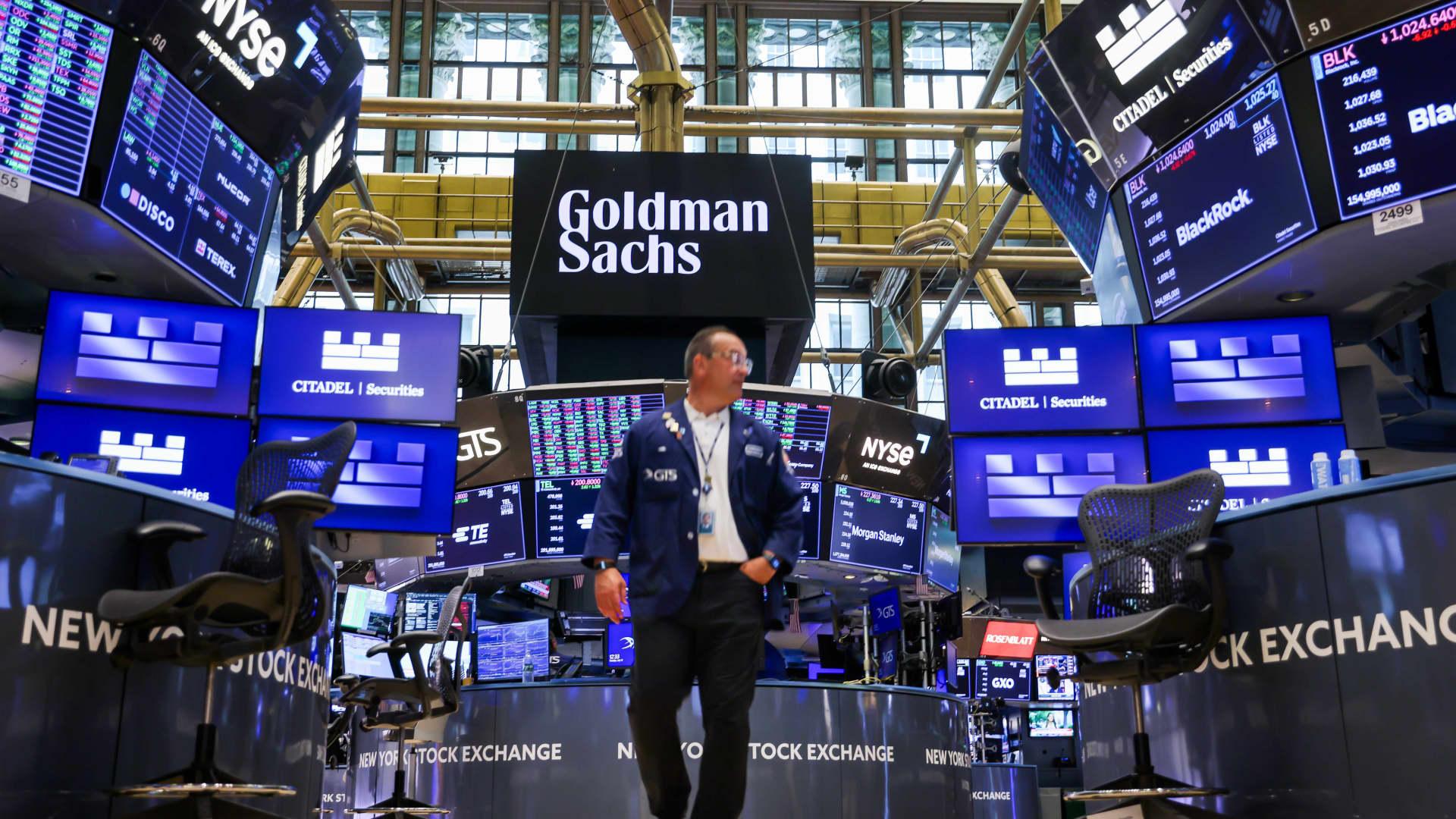
Goldman Sachs traders are on pace for their best year ever.
The investment bank's equities business generated $7.42 billion in revenue last quarter, up 72% from a year earlier and blowing past analyst estimates. The surge powered a broader quarter in which Global Banking & Markets, the firm's largest division, brought in $15.5 billion – more than three-quarters of Goldman's total revenue.
Kevin Kelly, global co-head of client coverage for Global Banking & Markets and global co-head of equities, sat for an interview on July 22. He described a business that has shifted its strategy in the last eight years – since CEO David Solomon and President John Waldron took over – to put the client at the center of every interaction, rather than letting products operate in silos.
"Everyone knew each other, but I don't think we worked as cohesively to really enhance our client relationships," Kelly said.
The equities division covers three core activities. First, cash sales and trading – buying and selling stocks for institutional and wealth clients. Second, derivatives – options, puts, calls and other structures that let clients hedge or speculate. Third, equity financing, which includes prime brokerage for hedge funds, futures trading for asset managers, and custody services for registered investment advisors.
Kelly said the current market environment has been unusually favorable for all three.
Single-name stock volatility is at all-time highs, even as index-level volatility stays low. That spread is wider now than it was during the period after Trump's "Liberation Day" tariff announcement in April 2024, Kelly said. Clients are hedging more because individual stocks are moving faster and less predictably.
"I think AI creates this pace of change in evolution, where people are moving around portfolios quickly," he said.
What changed in the last six to eight weeks, Kelly said, is dispersion. Earlier this year, the market treated software stocks as a monolith: anything not directly tied to AI infrastructure got sold, regardless of fundamentals. That correlation has broken down.
"There could be a winner and there could be a loser," he said. "It's not like a correlation of one in software."
Clients have used the good returns this year to take some risk off the table, Kelly said. At the start of 2026, semiconductor and semi-cap equipment stocks made up about 10% of Goldman clients' net portfolios – long exposure minus short. That share rose to 24% at its peak. It has since eased to about 18%.
"The concern of the market is they believe in earnings power, they believe in the three- to five-year story, but the question is, 'is it just crowded right now?'" Kelly said.
The AI capital-expenditure cycle is the structural tailwind, he said. But the view goes beyond semiconductors. Kelly cited examples across Goldman's business lines: the capex cycle flows into derivatives, cash equities, and financing products. The firm's multi-year investment in its Asia franchise – hiring people, upgrading technology, building out execution and financing – has also paid off, as Korea, Taiwan and Japan are home to much of the AI hardware supply chain.
Asked what could slow the momentum, Kelly pointed to the unusual nature of the current environment. Volatility and client activity are both elevated, which is rare. Most clients target a specific volatility level in their portfolios. When vol picks up, activity usually drops. That hasn't happened this time.
Kelly said Goldman's defense is diversification – across client types (hedge funds, systemic funds, multi-managers like Citadel and Millennium), across products (cash, derivatives, financing, custody), and across regions.
"I wish I could predict the market. We can't," he said. "But I think what we can do is build a ballast of businesses with diversified clients and diversified products to meet their needs."
As for Goldman's edge over Morgan Stanley and JPMorgan, Kelly described it as a cultural and structural shift known internally as "One GS" – the effort to get clients who come through the door for investment banking or wealth management to use the equities desk, and vice versa.
"We spend a lot of time with our clients to understand what problems they're facing as a business," he said. "We view it as if we can be solution providers to our clients, which will lead us to continue to gain more share."
Goldman's investment banking revenue rose 55% to $3.4 billion last quarter, beating expectations. That included fees from SpaceX's IPO and a $25 billion bond sale, as well as money earned from co-leading Alphabet's $85 billion equity raise announced in June. FICC revenue rose 32% to $4.6 billion.
Kelly has been at Goldman for 26 years. He joined as an analyst and rose through the ranks to managing director, partner, and now global co-head. The rewiring he described – putting the client at the center – took years, he said.
"We've always been great at risk intermediation. We've always been really good financing partners. We've always been a really good derivatives house," he said. "Putting those product specialties, expertise, and excellence together, all focused on client outcomes, has really been the accelerant."