Stocks● Neutral
Global Housing Affordability: Where $1 Buys the Most Home
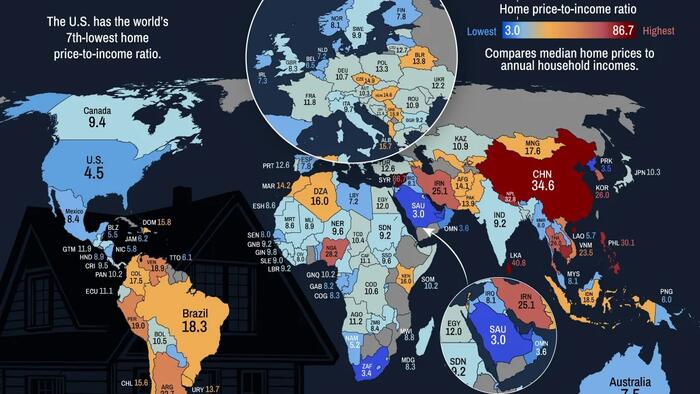
UN Habitat data shows home price-to-income ratios in 180+ countries. Saudi Arabia and UAE rank lowest at 3.0, Syria highest at 86.7. The U.S. sits at 4.5, below Canada and the U.K. The gap affects global housing demand.
Continue with
Housing affordability is a global issue, but the gap between home prices and incomes varies widely. A new dataset from the UN Habitat World Cities Report 2026, compiled by Visual Capitalist's Dorothy Neufeld, shows the median home price-to-income ratio across more than 180 countries. The measure tells how many years of median household income it would take to buy a median-priced home.
Saudi Arabia and the UAE rank lowest at 3.0, meaning a home costs about three years of income. The U.S. is seventh-lowest at 4.5, well below the U.K. at 8.3, Australia at 7.5, and Canada at 9.4. The Gulf countries benefit from high incomes and government housing programs. In the U.S., rising mortgage rates and constrained supply have eroded affordability, but on a global scale the ratio remains relatively low.
At the other end, Syria posts the highest ratio at 86.7, followed by Sri Lanka at 40.8 and China at 34.6. South Korea, Thailand, Vietnam, and the Philippines also rank among the least affordable. China's housing market has cooled, but prices remain high after decades of urbanization-driven appreciation, the data show.