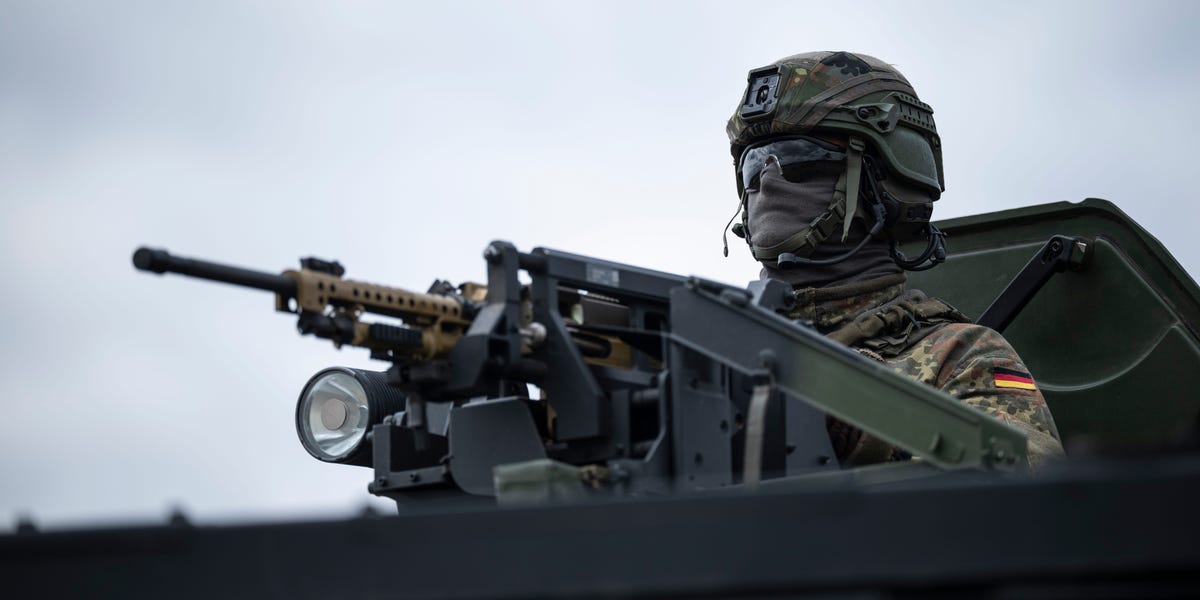
Germany plans to spend nearly €12 billion on a four-part missile arsenal to deter Russia, with low-cost cruise missiles arriving by 2027 and hypersonic weapons by the mid-2030s.
BERLIN – The German government expects to spend almost €12 billion, roughly $14 billion, on a new arsenal of long-range weapons to deter Russia, according to defense ministry documents obtained by POLITICO. The weapons would let German forces strike command centers, airfields, missile launchers, and supply hubs hundreds or even thousands of kilometers behind the front line.
Internal ministry documents call the effort a top priority for both Germany and NATO. The goal is to allow German forces to hit targets "far into the rear area of an adversary" and maintain conventional strike capability "below the nuclear threshold," the documents said.
Chancellor Friedrich Merz told the Bundestag in early July that Germany had reached an agreement with the U.S. government to acquire American Tomahawk cruise missiles and station them in Germany. "We are closing an important strategic gap in our defense," Merz said.
The plan has four parts, with the first weapons due as early as next year. The fastest component is a low-cost cruise missile that Germany wants to start fielding in 2027. POLITICO reported in June that the defense ministry was looking at missiles from U.S.-Israeli startup Covenant Industries and Ukrainian-linked companies. New documents show that effort has moved further. Germany is in contract talks with two suppliers, aiming to receive missiles for qualification by the end of this year. The candidates are Covenant's Anthem missile, the BARS missile from an unnamed Ukrainian company, and Flamingo from Ukrainian company Fire Point.
The documents describe the low-cost missile as a "cost-efficient and, above all, mass-producible" weapon that can overwhelm enemy air defenses through mass attacks. The Ukrainian war has taught Berlin that cheap, abundant missiles are essential for credible deterrence.
The second part is the Tomahawk purchase, which gives Berlin a proven long-range weapon while European alternatives are developed. Germany's internal target is an initial Typhon and Tomahawk capability by the end of the decade.
The final two parts are being developed with Britain. Germany and the UK are working on a new high-end cruise missile and a hypersonic glide weapon, part of last year's Trinity House Agreement. The documents show a targeted initial capability by the middle of the next decade. The two governments have said publicly that their new long-range weapons should be able to reach targets more than 2,000 kilometers away.
The hypersonic project accounts for most of the money. One internal document puts nearly €9 billion toward development and procurement of the hypersonic weapon, plus €182 million for in-service support. It lists another €1.8 billion for cruise missile development and procurement and €97 million for maintenance. Those figures add up to roughly €11 billion. Separate ministry talking points put the overall expected funding at "almost €12 billion."
The money has not yet been approved. Another ministry document says the costs have been estimated and submitted as part of the government's budget planning process. Germany's defense ministry declined to comment on the figure or individual programs. "The measures you refer to are generally subject to the approval of the German Bundestag," a ministry spokesperson told POLITICO. The ministry could only comment after parliament had considered them, the spokesperson added.
For Germany, the missile plan marks a major change. Instead of waiting for one new European missile, Berlin wants several types of weapons: cheaper missiles that can be produced in large numbers, American Tomahawks available sooner, and more advanced European weapons later. The buildup is taking place as German military leaders warn that Russia could be able to attack NATO territory by the end of the decade. Berlin wants to make sure that if deterrence fails, Russian forces would not be safe simply because they are far behind the front.
The spending plan is a significant shift for a country that has long been cautious about military investment. The €12 billion figure is separate from the €100 billion special defense fund announced in 2022. German defense stocks, including Rheinmetall and Hensoldt, have rallied on the prospect of sustained procurement. The missile plan adds a new layer of demand for precision-guided munitions and hypersonic technology.
NATO allies are watching closely. The U.S. has already stationed Typhon missile systems in Germany on a temporary basis. The German purchase would make the capability permanent. The Trinity House Agreement with Britain also signals a deeper European defense industrial integration.
The next concrete step is the Bundestag budget approval, expected in the fall. If approved, contract awards for the low-cost cruise missile could come as early as the first quarter of 2026.
Prepared with AlphaScala editorial tooling from the source reporting linked above. Indexable analysis may include a cited Alpha Score value. Publishing checks screen each story before release. Educational coverage, not personalized advice.